
Steady gas heat built for southwest Kansas winters.
Dependable, instant heat for Elkhart, Rolla, Richfield, and the ranches spread across Morton County's open plains near the Cimarron National Grassland. Find the right gas fireplace or insert and connect with a trusted local dealer.
Every Project Starts From One of These Five Situations
Reliable warmth without hauling wood across the shortgrass prairie.
Morton County sits in the far southwest corner of Kansas, where the shortgrass prairie runs flat to the horizon and the Cimarron National Grassland—one of the largest blocks of public grassland in the country—covers a good share of the county. With just over 2,200 residents spread across Elkhart, Rolla, Richfield, and the surrounding ranches, this is sparse, wide-open country where winters bring average lows around 21°F and roughly 4,658 heating degree days a year. That's a real heating season, though nowhere near the brutal totals a place like Bismarck, ND racks up—enough cold to matter, not enough to demand a wood-burning arsenal.
Trees are scarce here outside the osage orange hedgerows planted generations ago as windbreaks and the scattered oak and hickory in river bottoms—which is why wood stoves never caught on the way they did farther east, and pellet fuel has never built a local supply chain either. Gas fills that gap. Elkhart has natural gas service through a regional utility, while homes and ranches out on the grassland typically run on propane delivered and stored in tanks. Either way, a gas fireplace or insert gives Morton County households the kind of instant, thermostat-controlled zone heat that makes sense in a county this spread out—no wood to split, haul, or stack, and no dependence on a firewood supply that simply doesn't exist locally.
Three steps. No salesperson until you're ready.
Tell us about your project
Your zip code, your situation, and the fuel you're leaning toward—or let the answers point you to one.
See what's actually available
The brands dealers within 100 miles genuinely carry—real options, never a catalog mirage.
Get your dealer & Project Guide
A trusted local dealer, plus the free Project Guide & Parts List that names every component of the job.
Frequently Asked Questions
How much does a gas fireplace installation cost in Morton County?
Costs vary with the unit, the venting path, and whether you're on natural gas in Elkhart or propane out on the ranch. A direct-vent gas insert into an existing fireplace typically lands in the $3,500–$7,000 range; a new built-in gas fireplace with fresh venting and gas line work runs higher, often $6,000–$10,000, especially if a propane tank installation is part of the job. Because Morton County is thinly populated, most hearth dealers are based out of Liberal or Garden City, and a trip charge for the drive out to Rolla or Richfield is common—factor that into any quote.
Can I convert an old wood fireplace to gas?
Yes, and it's a common request in older Morton County homes built before propane delivery was reliable out on the grassland. A gas insert drops into the existing masonry firebox and vents through a stainless liner run up your existing chimney, so you keep the look of the original fireplace while gaining real, controllable heat. Since wood was never abundant here—most local homes with a wood-burning fireplace built it more for looks than for heavy use—converting to gas is usually a straightforward upgrade rather than a replacement of a heavily-used heat source.
Do I need natural gas, or does propane work for a gas fireplace?
Both work. Elkhart has natural gas service through a regional utility, so homes in town can usually tie a new fireplace into existing gas lines. Outside Elkhart—in Rolla, Richfield, and the ranches scattered across the county—propane is the standard fuel, stored in an above-ground or buried tank and delivered by regional suppliers. Nearly every gas fireplace model on the market can be configured for either fuel; your installer sets the orifice and regulator to match whichever supply you have.
Will my gas fireplace work during a power outage?
Most modern gas fireplaces are built to run without utility power. Units with IPI (intermittent pilot ignition) carry a battery backup—usually AA batteries in the unit—that kicks in the moment power drops, so the fireplace lights and runs on demand just like normal. Valor's gas fireplaces skip batteries altogether: the pilot's thermocouple generates the small amount of electricity the valve needs, so the fireplace works even if the batteries were never replaced. That distinction matters on the open plains around Morton County, where a downed line or an ice storm can mean an outage that stretches well past the time it takes a crew to drive out from Liberal or Garden City.
What's the difference between a gas fireplace, gas insert, and gas stove?
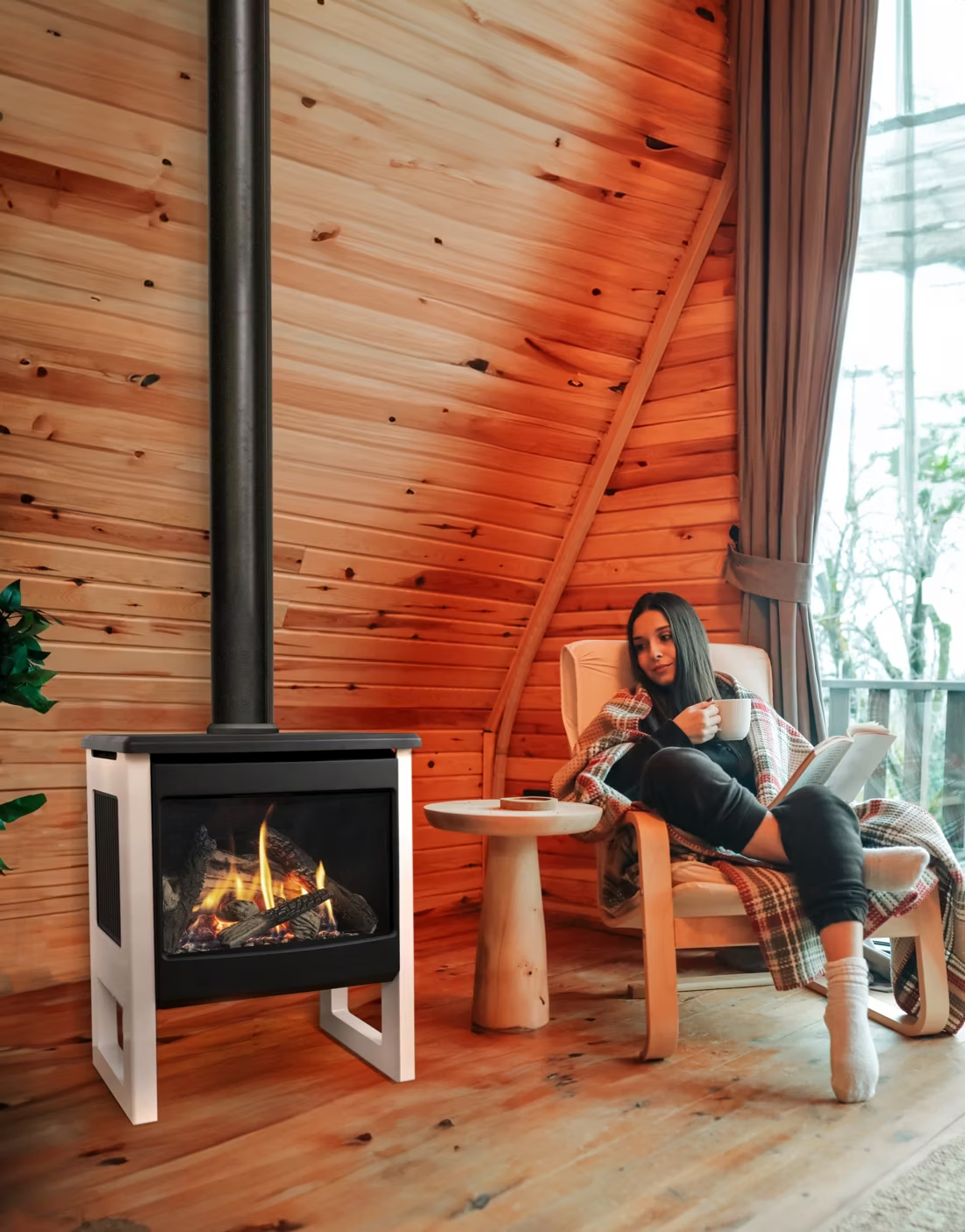
A gas fireplace is a fully built-in unit framed into a wall—the right choice for new construction or a remodel. A gas insert slides into an existing masonry firebox and vents up the chimney you already have, turning an old fireplace into an efficient, sealed heat source. A gas stove is a freestanding unit that sits on the floor on its own hearth pad, similar in footprint to a wood stove but running on gas. Most Morton County homeowners upgrading an older fireplace go with an insert; new builds or rooms without an existing chimney usually call for a built-in fireplace or a freestanding stove.
Do I need a permit to install a gas fireplace in Morton County?
Yes—a building permit and a gas line permit are required for new gas fireplace installations, whether you're inside Elkhart city limits or out in the unincorporated county. The gas line connection has to be done by a licensed gas-fitter, which is one of the main reasons to go with a certified hearth dealer rather than a general handyman: they coordinate the gas work, venting, and inspection as one job instead of leaving you to chase down separate trades in a county with very few of them.
What's the difference between vented and vent-free gas fireplaces?
Vented gas fireplaces—direct-vent or B-vent—pull combustion air from outside and exhaust the byproducts back outside through a sealed vent. Vent-free units burn gas directly into the room without external venting, which makes them simpler to install but means some water vapor and trace combustion byproducts stay indoors, so they're restricted to specific room sizes with an oxygen depletion sensor required. Vent-free models are legal in Kansas, but for a Morton County home—especially one running on propane, where fuel-flow consistency matters—a direct-vent unit is the more commonly recommended option and delivers real heat without any indoor air quality tradeoffs.
How often should my gas fireplace be serviced?
Plan on an annual inspection for any gas fireplace or insert—a technician checks the burner, pilot assembly, gas connections, and venting, and cleans the glass and interior. It's a lighter job than sweeping a wood chimney but just as important for safety, particularly on propane systems where a technician will also check tank connections and regulator pressure. Because Morton County has so few full-time hearth technicians, most homeowners schedule this with a company out of Liberal or Garden City that services southwest Kansas on a rotating basis—worth booking a few weeks ahead of the season.
Gas vs. wood—which is right for my home?
Wood heat is uncommon in Morton County simply because there isn't much wood to burn—the shortgrass prairie here supports scattered osage orange hedgerows and a handful of hardwoods like oak and hickory in the draws and river bottoms, but nothing close to the forested supply that makes wood heat practical elsewhere in Kansas. A few older homes still keep a wood-burning fireplace for ambiance or as an emergency backup using hauled-in firewood, but for day-to-day heat, gas—whether natural gas in Elkhart or propane out on the ranch—is by far the more practical and dominant choice countywide.
Why is a fireplace insert so efficient?
An insert does two things: it seals the chimney completely, so you stop losing air you already paid to heat, and it radiates warmth into the room through the firebox and glass. Most add a heat-exchange fan that pulls cool room air underneath, wraps it around the hot firebox, and pushes it back out warm. Your home is more efficient before you've even lit the first fire.
What's the difference between an insert and a zero-clearance fireplace?
An insert is a fireplace that slides into a pre-existing wood-burning fireplace—if you don't have one, there's nothing to insert it into. A zero-clearance fireplace is built into a framed wall, which makes it the answer for remodels and new construction. Simple test: existing masonry fireplace means insert; blank or framed wall means zero-clearance.
How much should I budget for a fireplace?
For an average home—covering the fireplace, the vent pipe, and basic installation—a budget between $3,900 and $5,500 gives you a lot of options across wood, gas, and pellet. By the time you add finish work, gas line, and electrical, the average complete installation lands between $5,000 and $12,000 all-in. In a remodel or new build, a good rule is to put about 2.5% of the total project cost toward the fireplace.
What is an in-home preview and do I need one?
It's a visit where a hearth professional measures your space, confirms the model you picked actually works in your home, and walks the specs—framing, gas line, venting, finish work—before anything is ordered. Some details you just can't know until you see the house. Never make a down payment without one; it's the single most-skipped step that burns buyers.
Find your gas fireplace in Morton County.
Tell us a bit about your home in Elkhart, Rolla, Richfield, or out on the ranch, and we'll match you with a trusted local dealer and send over a free Project Guide & Parts List—the exact parts, including the vent kit, for your gas fireplace or insert project.
Find Your Fireplace →