
Electric heat for a high-plains town with no woodlot to fall back on.
At 3,334 feet on the Stanton County plains, Johnson City sees winter lows averaging 16°F and a long, cold winter season. With Pioneer Electric Cooperative billing residential power at roughly $0.1119 per kWh, a well-chosen electric fireplace runs cheap. We'll help you find a trusted local dealer and a free plan for your home.
Every Project Starts From One of These Five Situations
The shortgrass plains never gave this county much wood to burn.
Johnson City is the Stanton County seat, sitting out on open shortgrass prairie near the Colorado line with no real forest cover nearby. The oak, hickory, and osage orange you'll spot locally are mostly old shelterbelt plantings and farmstead hedgerows, not woodland—never enough standing timber to support cutting permits or a cordwood supply chain, which is exactly why wood stoves never took hold here. Pellet fuel has the same problem: brands like Lignetics and Indeck Energy Services supply the region, but without local demand or easy delivery routes, pellet stoves stay rare. Electric sidesteps all of that—no fuel to source, haul, or stack through a plains winter wind.
Pioneer Electric Cooperative serves Stanton County at a residential rate around $0.1119 per kWh, a notably affordable number that keeps an electric fireplace cheap to run even across a heating season that stretches well past five months. Most Johnson City homes still lean on propane or a gas furnace as primary heat, since the town and surrounding farms sit well off any natural gas main—but an electric fireplace layered in as zone heat for a living room or bedroom adds instant warmth and ambiance without a flue, a gas line, or combustion byproducts to vent. For a town this size, that simplicity matters: there's no need to coordinate a chimney sweep or a propane delivery schedule around it.
Three steps. No salesperson until you're ready.
Tell us about your project
Your zip code, your situation, and the fuel you're leaning toward—or let the answers point you to one.
See what's actually available
The brands dealers within 100 miles genuinely carry—real options, never a catalog mirage.
Get your dealer & Project Guide
A trusted local dealer, plus the free Project Guide & Parts List that names every component of the job.
Frequently Asked Questions
How much does it cost to install an electric fireplace in Johnson City?
A plug-in insert or mantel package that runs off a standard 120-volt outlet is the cheapest route, often landing under $1,000 installed, including a basic surround. A built-in wall unit or a larger linear model that needs a dedicated 240-volt circuit run by an electrician typically pushes the total to $1,200-$2,500, depending on how far the new circuit has to travel from your panel. Given how spread out properties are around Stanton County, that wire run can be the biggest cost swing—a unit going into an interior wall near the breaker box is cheaper than one on an exterior wall of an older farmhouse.
Do I need a permit to install an electric fireplace in Johnson City?
A plug-in unit on an existing outlet doesn't need a permit. A hardwired built-in or any install requiring a new dedicated circuit does need an electrical permit, which for an address inside city limits goes through the Johnson City clerk's office, and for addresses out in unincorporated Stanton County routes through the county courthouse. Either way, the licensed electrician doing the circuit work typically pulls the permit as part of the job, so you're not chasing down paperwork yourself.
What size electric fireplace do I need for a Johnson City home?
Electric units are rated by room coverage rather than whole-house BTU output, since most are built as supplemental zone heat rather than a furnace replacement. For a single living room or bedroom in an older Stanton County farmhouse with less insulation, a 1,500-watt unit rated for 400-1,000 square feet is usually enough to take the edge off on a 16°F morning while your furnace carries the rest of the load. Don't expect a plug-in electric unit to heat an open, uninsulated farmhouse floor plan on its own—it's built to warm the room you're sitting in, not the whole structure.
What does an electric fireplace actually cost to run here?
At Pioneer Electric Cooperative's residential rate of about $0.1119 per kWh, a typical 1,500-watt unit running on medium heat for 8 hours a day costs roughly $1.34 a day, or around $40 a month if you're running it daily through the coldest stretch of a long, cold winter season. That's one of the more affordable per-kWh rates in the region, which is part of why electric zone heat pencils out well here compared to areas served by investor-owned utilities charging 20-30% more.
What's the difference between an electric insert, a wall-mount, and a built-in unit?
An electric insert drops into an existing fireplace opening or a zero-clearance mantel surround and is the easiest retrofit for a Johnson City home with an old, unused wood-burning firebox that was never practical to actually fire up. A wall-mount unit hangs flush on a wall like a flat-screen TV, popular for newer construction or a remodel. A built-in linear unit gets framed into a wall during construction or a larger renovation and generally needs that dedicated 240-volt circuit. All three run on the same basic principle—resistance heat and an LED flame effect—so the choice mostly comes down to the room and whether you're retrofitting or building new.
Can an electric fireplace be my main heat source in Johnson City?
Not on its own. With winter lows averaging 16°F and a long, cold winter season each year, a 1,500-watt electric unit doesn't have the output to carry a whole house through a Stanton County winter—it's built as supplemental zone heat. Most local homes run propane or a gas furnace as the primary system and add an electric fireplace in the room where people spend the most time, which lets you turn the thermostat down a degree or two elsewhere and heat only the occupied space.
What happens to my electric fireplace during a power outage?
It stops working, same as any other electric appliance on the grid. Pioneer Electric Cooperative's rural lines across Stanton County can go down during plains ice storms or high-wind events, and when that happens an electric fireplace offers no backup heat the way a propane furnace or a wood stove would. If outage resilience matters more to you than low running cost, that's a real tradeoff worth discussing with your dealer—some households keep a propane heater as a backup specifically for that scenario.
Where do I actually buy an electric fireplace near Johnson City?
Johnson City itself is small enough that there's no dedicated hearth showroom in town—most residents end up driving to a dealer in Garden City or Liberal for a look at units in person, or working with an installer who travels out to rural Stanton County addresses. That's exactly the gap we help close: we'll help you find a trusted dealer who actually services your zip and send a free Project Guide & Parts List so you know what you're ordering and what the electrician needs to run, before you make the drive.
Why don't more people around Johnson City use wood heat instead of electric?
There's simply not enough standing timber on the shortgrass plains around Stanton County to support it—the oak, hickory, and osage orange you see are shelterbelt trees and hedgerows planted for windbreak, not a cuttable wood supply, and there's no nearby national forest issuing permits the way there is in more wooded parts of Kansas. Without a fuel source nearby, wood stoves and pellet stoves never became practical here, which is part of why propane heat and electric zone heaters are the two options most homeowners actually weigh.
Do electric fireplaces actually produce heat?
Yes—most put out around 4,800–5,000 BTUs from a standard outlet, which comfortably warms a bedroom, office, or den as a comfort-zone heater. What they won't do is carry a whole house the way wood, gas, or pellet can. Think of electric as ambiance-first with honest supplemental heat: flames on with no heat in July, flames plus warmth in January.
Can I put a TV above my fireplace?
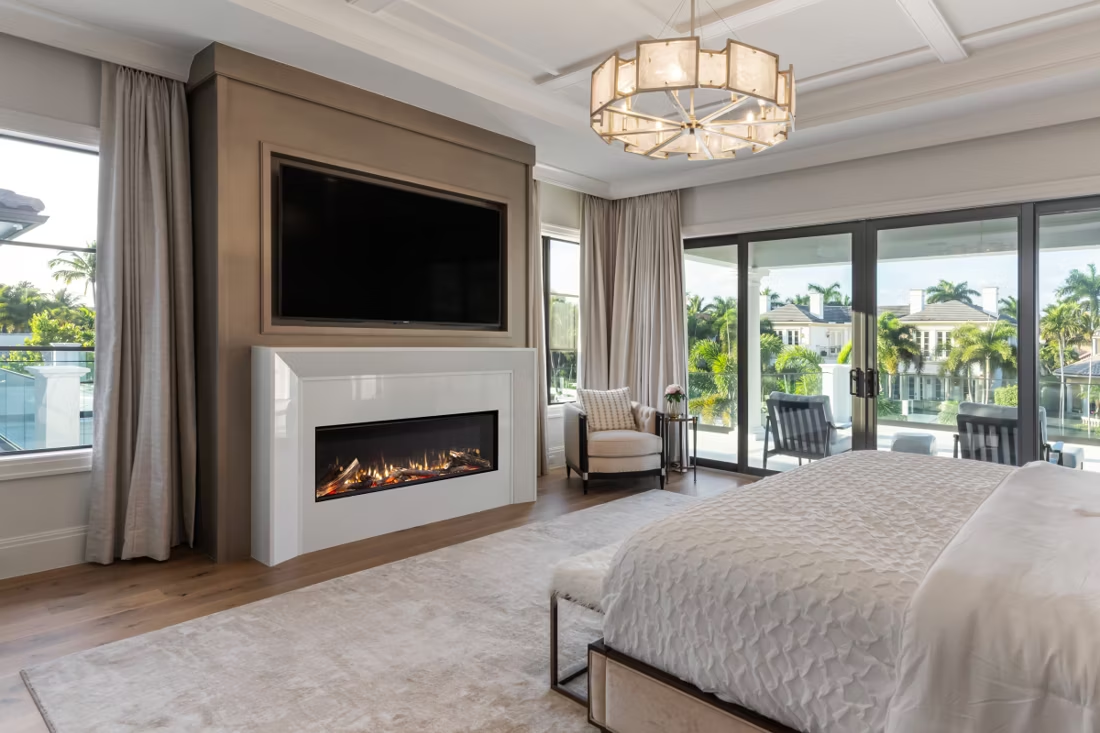
Yes—with an asterisk. Fireplaces are hot and TVs don't like heat. Either put a mantel between them to deflect rising warmth, or choose a fireplace with heat-management technology that creates a cool zone on the wall above—the wall stays around 125 degrees, barely warm, while the room still gets full heat. If you like clean lines and don't want a mantel, heat management is the answer.
How much should I budget for a fireplace?
For an average home—covering the fireplace, the vent pipe, and basic installation—a budget between $3,900 and $5,500 gives you a lot of options across wood, gas, and pellet. By the time you add finish work, gas line, and electrical, the average complete installation lands between $5,000 and $12,000 all-in. In a remodel or new build, a good rule is to put about 2.5% of the total project cost toward the fireplace.
Should the dealer who sells my fireplace also install it?
Ideally, yes. A fireplace project involves vent pipe, gas line, electrical, and often tile or stone. Hire three or four separate trades and you own the liability and the game of telephone between them. One company selling and installing means one accountable party, start to finish—ask about factory training, on-time completion records, and what happens if an inspection fails.
Nearby Dealers
Hearth shops serving Johnson City and the surrounding area. Every listing shows whether it is a WhyFire partner, a dealer we have verified as authorized for the brands we recommend, or a local business carrying hearth products. No manufacturer pays for placement. How we verify dealers →
We’ve paused dealer listings for this connection today. Enter your zip or postal code above to find dealers near you, or come back tomorrow.
Popular Electric Brands
Where each brand came from, what's inside it today, and every current model. No brand pays to be here. Not every dealer carries every brand, so enter your zip code to see what's sold near Johnson City.
Fireplace Xtrordinair
Fireplace Xtrordinair, now often called FireplaceX, is the fireplace brand of Travis Industries, Inc., of Mukilteo, Washington.
5 electric models →DaVinci
DaVinci Custom Fireplaces is a brand of Travis Industries, Inc., of Mukilteo, Washington, the company behind Lopi and Fireplace Xtrordinair.
5 electric models →Kozy Heat
Kozy Heat was founded in 1976 by Dudley Hussong in Lakefield, Minnesota, and incorporated as Hussong Manufacturing Co., Inc. in 1978.
3 electric models →Forge & Flame
Forge & Flame is the stove brand Hearth & Home Technologies introduced in August 2023 to bring Vermont Castings, Harman, and Quadra-Fire under one name.
1 electric model →Electric Service in Johnson City
An electric fireplace's heater draws about 1,500 watts—pennies per hour at local rates.
Pioneer Electric Coop, Inc - (Ks)
Get your free Project Guide & Parts List for a Johnson City electric fireplace.
Tell us about your home and your Pioneer Electric Cooperative service, and we'll help you find a trusted local dealer and send a free Project Guide & Parts List with the exact unit, circuit requirements, and parts your project needs.e
Find Your Fireplace →