
Reliable heat for a town with winters as long and cold as Madison, Wisconsin or Fargo, North Dakota.
Calmar sits in the driftless hills of Winneshiek County at 1,248 feet, where winter lows average 10°F and stay there for months. We'll help you find a trusted local dealer who knows the propane realities, the venting, and what's actually installable on a farmhouse or a Main Street storefront here.
Every Project Starts From One of These Five Situations
A fuel that doesn't depend on a woodpile or a forecast.
Calmar's heating season runs closer to Madison, Wisconsin or Fargo, North Dakota than most people picture for northeast Iowa. Climate zone 6A and a 10°F average winter low mean the furnace and any supplemental heat source both work hard from November into March. Oak, hickory, maple, and walnut are all common in the woodlots and fencerows around Winneshiek County, and plenty of farmhouses keep a stack on hand for backup, but splitting and stacking wood isn't the daily habit it once was for most households here—a unit that fires at the flip of a switch fits how people actually live now.
Calmar is a town of just over 1,000 people, and piped natural gas infrastructure doesn't reach every block the way it does in Decorah or larger towns up the road—many homes and farms in this part of Winneshiek County run on propane delivered by local suppliers rather than a municipal gas main. Either fuel path supports a direct-vent fireplace or insert, and that distinction matters most when you're budgeting for a tank set versus a simple gas line tap. Interstate Power and Light Co. and MiEnergy Cooperative handle electric service in the area at $0.179 and $0.1656 per kWh respectively—rates worth knowing if you're weighing a gas unit's battery-backed ignition against an electric fireplace as an alternative.
Three steps. No salesperson until you're ready.
Tell us about your project
Your zip code, your situation, and the fuel you're leaning toward—or let the answers point you to one.
See what's actually available
The brands dealers within 100 miles genuinely carry—real options, never a catalog mirage.
Get your dealer & Project Guide
A trusted local dealer, plus the free Project Guide & Parts List that names every component of the job.
Frequently Asked Questions
How much does a gas fireplace installation cost in Calmar?
Most installs in and around Calmar run roughly $3,500 to $9,500. A direct-vent insert going into an existing masonry firebox—common in the older farmhouses and Main Street buildings around town—lands toward the lower end, especially if a gas line or propane tank is already nearby. A new built-in unit for a remodel, or any install that requires a fresh propane tank set and line run out to a detached structure, pushes toward the top of that range. Get quotes from an installer who's worked rural Winneshiek County before, since tank placement and line distance vary a lot from farm to farm.
Is my home on natural gas or propane, and does it matter for a fireplace?
In Calmar, it depends on your address. Piped natural gas service doesn't blanket the whole town or the surrounding township the way it does in larger communities, so a meaningful share of homes and farms run on propane with an above-ground or buried tank. Both fuels run the same basic direct-vent fireplace hardware—the difference is in the regulator and orifice sizing, which your installer sets for whichever fuel you're on. If you don't already have a propane account, budget for a tank set or lease as part of the project rather than assuming a simple gas-line tie-in.
Do I need a permit to install a gas fireplace in Calmar?
Yes. Building permits for a town this size typically route through the Winneshiek County Zoning & Building Department, and any new gas or propane line work needs to be done by a licensed gas fitter as a separate piece of the job. Most hearth dealers who cover this part of the county are used to pulling both the building permit and coordinating the gas-fitter sign-off, so ask upfront whether that's included in your quote rather than something you'd need to chase down yourself.
Will a gas fireplace still work if the power goes out?
Most will, and that matters here—rural Winneshiek County can see extended outages after a heavy winter storm, well before a line crew reaches a farm outside town. Units with intermittent pilot ignition (IPI) run on AA battery backup that kicks in automatically. Millivolt or Valor-style systems skip the battery altogether, since the pilot's own thermocouple generates enough current to open the gas valve. If you're on a rural electric line through MiEnergy Cooperative or Interstate Power and Light, ask your dealer specifically about ignition type—it's the difference between a fireplace that keeps the living room warm during an outage and one that's just as dark as the rest of the house.
What's the difference between a gas fireplace, insert, and stove for a Calmar house?
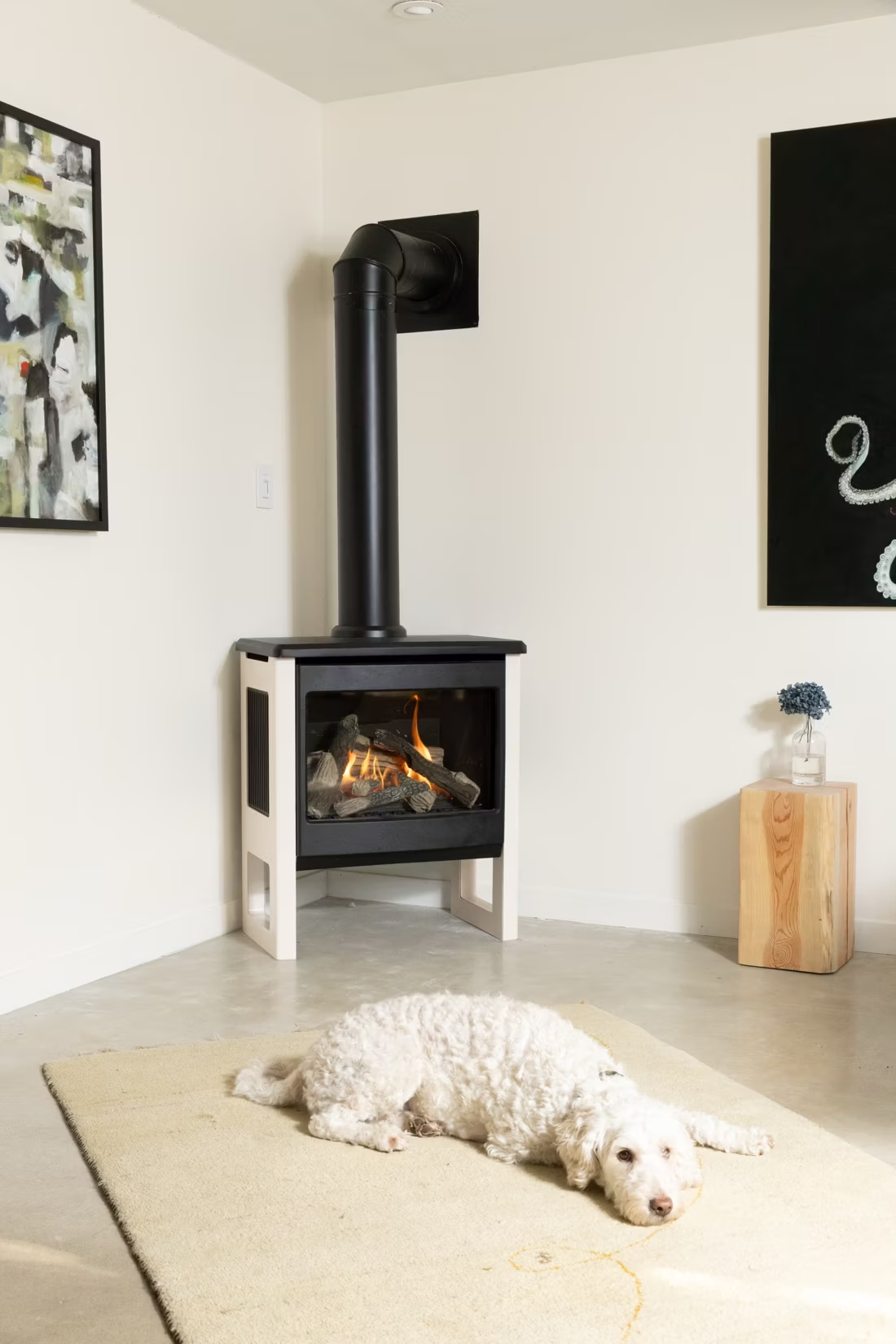
A gas fireplace is a built-in unit framed into a wall, typical for new construction or a full remodel. A gas insert fits into an existing masonry firebox—common in the older limestone-and-brick farmhouses scattered through the driftless hills around Calmar, where the chimney chase is already there and just needs a liner and the insert itself. A gas stove is freestanding on its own hearth pad, a good option for a detached garage, shop, or a farmhouse room that never had a fireplace to begin with. For most existing homes in town, an insert into the current chimney is the least disruptive and generally the cheaper route.
What size gas fireplace do I need for a Calmar winter?
With winters as cold as Fargo or Duluth and lows that routinely sit at 10°F or colder, a gas fireplace here is doing real supplemental heating, not just ambiance—similar sizing logic to what you'd use in those places. For a typical living room or farmhouse great room, a unit in the 25,000 to 35,000 BTU range usually covers the space without overheating it, but older farmhouses with less insulation or higher ceilings often do better sized toward the top of that range. A local dealer should size against your actual square footage and insulation rather than a rule of thumb, especially in a home built before modern wall insulation was standard.
How often does a gas fireplace need to be serviced?
Plan on an annual check, ideally in late summer or early fall before the first hard freeze rather than waiting until the middle of a Winneshiek County winter when technicians are booked solid. A service visit covers the burner, pilot or ignition system, gas connections, and glass cleaning—straightforward work, but skipping it on a unit that's running daily through a six-month-plus heating season is how an ignition problem shows up on the coldest night in January. Expect roughly $150-$250 for a standard visit from installers serving this part of the county.
Why would I choose gas over wood when oak and hickory are so available around here?
Oak, hickory, maple, and walnut are genuinely plentiful in the woodlots and fencerows around Calmar, and plenty of longtime residents still burn wood as backup heat. But for a primary living-room fireplace, most homeowners here choose gas for the same reason they choose a furnace over a woodstove for the house at large: it fires on demand with no splitting, stacking, or chimney cleaning schedule to manage. Gas also sidesteps the moisture and insect concerns that come with storing a winter's worth of hardwood against a house. If you want wood's ambiance without wood's upkeep, a gas unit with a realistic log set is the common middle ground locally.
Are there any rebates or efficiency programs for a gas fireplace in Calmar?
There's no dedicated statewide rebate specifically for gas fireplaces in Iowa, so don't expect one to offset the install. Interstate Power and Light Co. (Alliant Energy) runs seasonal efficiency rebate programs for furnaces and other whole-home equipment, and it's worth a call to see whether a high-efficiency direct-vent model qualifies under any current program terms. Propane suppliers serving rural Winneshiek County sometimes offer early-fill or pre-buy discounts each fall, which won't lower your install cost but can meaningfully cut your fuel bill once the fireplace is running through the winter.
What's the difference between an insert and a zero-clearance fireplace?
An insert is a fireplace that slides into a pre-existing wood-burning fireplace—if you don't have one, there's nothing to insert it into. A zero-clearance fireplace is built into a framed wall, which makes it the answer for remodels and new construction. Simple test: existing masonry fireplace means insert; blank or framed wall means zero-clearance.
Can I put a TV above my fireplace?
Yes—with an asterisk. Fireplaces are hot and TVs don't like heat. Either put a mantel between them to deflect rising warmth, or choose a fireplace with heat-management technology that creates a cool zone on the wall above—the wall stays around 125 degrees, barely warm, while the room still gets full heat. If you like clean lines and don't want a mantel, heat management is the answer.
What is an in-home preview and do I need one?
It's a visit where a hearth professional measures your space, confirms the model you picked actually works in your home, and walks the specs—framing, gas line, venting, finish work—before anything is ordered. Some details you just can't know until you see the house. Never make a down payment without one; it's the single most-skipped step that burns buyers.
Can I install a fireplace myself?
If you're putting a fire in your house on purpose, it's best to work with an expert. Unless you're genuinely experienced in framing, gas line, vent pipe, and the national code on clearances to combustibles, have a professional do it—and ideally the same company that sells you the fireplace, so warranty, service, and liability all live under one roof.
Nearby Dealers
Hearth shops serving Calmar and the surrounding area. Every listing shows whether it is a WhyFire partner, a dealer we have verified as authorized for the brands we recommend, or a local business carrying hearth products. No manufacturer pays for placement. How we verify dealers →
We’ve paused dealer listings for this connection today. Enter your zip or postal code above to find dealers near you, or come back tomorrow.
Popular Gas Brands
Where each brand came from, what's inside it today, and every current model. No brand pays to be here. Not every dealer carries every brand, so enter your zip code to see what's sold near Calmar.
Kozy Heat
Kozy Heat was founded in 1976 by Dudley Hussong in Lakefield, Minnesota, and incorporated as Hussong Manufacturing Co., Inc. in 1978.
28 gas models →Fireplace Xtrordinair
Fireplace Xtrordinair, now often called FireplaceX, is the fireplace brand of Travis Industries, Inc., of Mukilteo, Washington.
25 gas models →Town & Country
Town & Country Fireplaces is the luxury gas fireplace brand of Pacific Energy Fireplace Products Ltd., of Duncan, British Columbia.
14 gas models →Lopi
Lopi is a wood, pellet, and gas stove brand founded by Kurt Rumens in Bellevue, Washington, in 1979.
7 gas models →Forge & Flame
Forge & Flame is the stove brand Hearth & Home Technologies introduced in August 2023 to bring Vermont Castings, Harman, and Quadra-Fire under one name.
6 gas models →Vermont Castings
Vermont Castings was founded in 1975 by Duncan Syme, the designer, and his brother-in-law Murray Howell, the business partner, in Randolph, Vermont.
6 gas models →Get your free Project Guide & Parts List for a Calmar gas fireplace.
Tell us about your home and whether you're set up for propane or already have a natural gas line, and we'll help you find a trusted local dealer and send a free Project Guide & Parts List with the exact vent kit and parts your project needs.
Find Your Fireplace →