
Real Heat, Zero Venting, Any Room in Sullivan.
No chimney, no gas line, no permit hassle—just plug in or wire up and get warmth in the room you actually use. Find the right unit for your Sullivan home and connect with a trusted local dealer.
Every Project Starts From One of These Five Situations
The easiest heat source to add to an existing room.
Sullivan sits in Indiana's Wabash Valley coal country, with a climate zone of 4A, a solid annual heating workload, and winter lows that average around 21°F. That's a real heating season—cold enough that a supplemental heat source in the living room or bedroom pulls its weight from November through March—but not the deep-freeze territory of the northern Great Lakes. That distinction matters for electric: in a town this size, with a mix of older farmhouses, manufactured homes, and newer builds along Section Street and out toward the county roads, electric fireplaces work well as everyday zone heat rather than just decoration.
Sullivan's electric service is split between Duke Energy Indiana in and around town and Western Indiana Energy REMC for many rural county addresses, with residential rates running roughly 12.75¢ per kWh on Duke and 14.39¢ per kWh on the REMC side. Because electric fireplaces need no chimney, no gas line, and in most cases no building permit, they're often the fastest and least invasive way to add heat to a converted garage, a finished basement, a rental unit, or a room a wood stove or gas line just can't reach.
Three steps. No salesperson until you're ready.
Tell us about your project
Your zip code, your situation, and the fuel you're leaning toward—or let the answers point you to one.
See what's actually available
The brands dealers within 100 miles genuinely carry—real options, never a catalog mirage.
Get your dealer & Project Guide
A trusted local dealer, plus the free Project Guide & Parts List that names every component of the job.
Frequently Asked Questions
How much does it cost to install an electric fireplace in Sullivan?
Most electric fireplace projects in Sullivan fall into one of two categories. A plug-in insert or freestanding stove that uses a standard 120-volt outlet typically runs $200 to $1,500 for the unit itself, with no electrician needed if an outlet already exists nearby. A built-in wall unit or a larger insert that requires a dedicated 20-amp circuit usually adds $300 to $800 in electrician time, since Sullivan homes—especially older farmhouses near downtown—often need a new circuit run rather than tying into existing wiring. Framing a mantel surround or recessing a unit into a wall adds carpentry cost on top of that. A local dealer can tell you within minutes whether your home's existing panel and wiring can support the unit you want.
Do I need a permit to install an electric fireplace in Sullivan?
In most cases, no—a plug-in electric fireplace that doesn't involve new wiring is treated like any other appliance and doesn't require a permit. If your project involves adding a new dedicated circuit, running wire through a wall, or any structural framing for a built-in unit, check with Sullivan County's building department before work starts, since that crosses into licensed electrical and building work. Most local installers and electricians who handle these projects regularly know exactly what triggers a permit in the county and will flag it upfront rather than leave you to guess.
What's the difference between an electric insert, a wall-mount unit, and an electric log set?
An electric insert is built to slide into an existing fireplace opening—a common choice for Sullivan homes with an old, rarely-used masonry or zero-clearance wood fireplace that the owner wants to retire without tearing anything out. A wall-mount or built-in unit is designed to be recessed into or mounted flush against a wall, often with a custom surround, and works well in a room with no existing fireplace at all. An electric log set is the simplest option—a set of glowing logs that drops into an existing firebox for ambiance with minimal heat output. For most Sullivan homeowners retrofitting an old fireplace, an insert is the straightforward upgrade; for new construction or a room being finished from scratch, a wall-mount unit gives more design flexibility.
How much does it cost to run an electric fireplace in Sullivan?
Most electric fireplaces draw around 1,500 watts on their highest heat setting, or 1.5 kWh per hour. On Duke Energy Indiana's residential rate of about 12.75¢ per kWh, that works out to roughly 19 cents an hour of heat. On Western Indiana Energy REMC's rate of about 14.39¢ per kWh, it's closer to 22 cents an hour. Running the flame effect alone, without the heater engaged, draws only a few watts and costs pennies a day—which is why a lot of owners run electric fireplaces for ambiance most of the year and only switch on the heat during the coldest stretches of a Sullivan winter.
Will my electric fireplace still work if the power goes out?
No—electric fireplaces require power to run, including the flame effect, so they go dark along with everything else during an outage. That's worth planning around in Sullivan County, where ice storms and downed lines during winter can knock out power in rural areas served by Western Indiana Energy REMC for hours or longer. If backup heat during outages matters to your household, a lot of local homeowners pair an electric fireplace for everyday convenience with a wood stove or fireplace insert—oak and hickory are the dominant local firewood species—as the fallback that doesn't need the grid.
What size electric fireplace do I need for my room?
Electric fireplace heaters are generally rated for 400 to 1,000 square feet, which covers most single rooms in Sullivan homes without much guesswork. The bigger sizing question is usually width and mounting style: a 30 to 40-inch unit suits a standard living room wall, while a 50-inch-plus unit is better suited to an open-concept space or a room with a wide fireplace opening to fill. Ceiling height, how much natural light the room gets, and whether the unit will run as background heat or just ambiance all factor in too—a local dealer will walk through this with you rather than sell off a size chart alone.
What are the best electric fireplace brands to look at?
Dimplex, Napoleon, and Touchstone are three of the most widely available and well-reviewed electric fireplace brands, covering everything from budget inserts to realistic flame-effect wall units. Dimplex is particularly known for its flame technology and wide range of insert sizes to fit older fireplace openings, which comes up often in Sullivan's stock of older homes. Napoleon and Touchstone both offer strong mid-range built-in options for new construction or remodels. A local dealer can show you the difference in flame realism and heater performance in person, which matters more with electric units than the spec sheet alone suggests.
Electric vs. wood vs. pellet—which makes sense for my Sullivan home?
Wood is the traditional choice in Sullivan County, where oak, hickory, maple, and beech are all common locally cut species, and a wood stove or insert keeps working during a power outage—a real consideration given the rural REMC territory around town. Pellet stoves, using brands like Lignetics or Somerset Pellet Fuel, burn cleaner and are easier to load than cordwood but still need electricity to run the auger and blower. Electric fireplaces need no fuel storage, no venting, and no chimney maintenance at all, but they provide zone heat rather than whole-home heat and go dark in an outage. Many Sullivan households end up using electric for everyday ambiance and convenience in the main living space, with wood or pellet as the serious cold-weather backup elsewhere in the house.
Does it matter whether I'm on Duke Energy Indiana or Western Indiana Energy REMC?
It affects your ongoing running cost more than your installation. Duke Energy Indiana, which serves in-town Sullivan addresses, currently runs about 12.75¢ per kWh, while Western Indiana Energy REMC, which serves much of the surrounding rural county, runs closer to 14.39¢ per kWh. Over a heating season of regular use, that difference adds up to real dollars, though it won't change which unit or size fireplace makes sense for your room. Either utility can support a standard electric fireplace circuit without issue—check your panel capacity with an electrician if you're adding a hardwired unit rather than a plug-in model.
Can I put a TV above my fireplace?
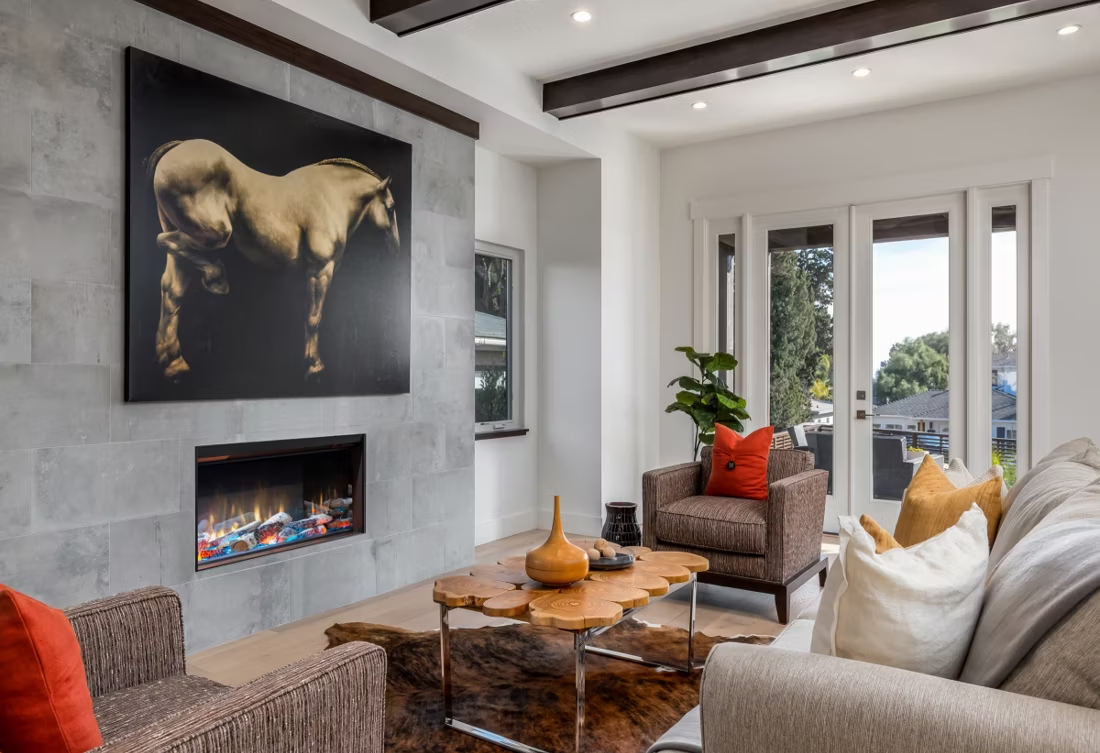
Yes—with an asterisk. Fireplaces are hot and TVs don't like heat. Either put a mantel between them to deflect rising warmth, or choose a fireplace with heat-management technology that creates a cool zone on the wall above—the wall stays around 125 degrees, barely warm, while the room still gets full heat. If you like clean lines and don't want a mantel, heat management is the answer.
Does an electric fireplace need a vent or chimney?
No—that's its superpower. An electric fireplace needs a wall and an outlet, period. No vent pipe, no gas line, no clearances to design around, which is why it works in bedrooms, offices, apartments, and walls where venting a gas or wood unit would be impractical or impossible. Installation is typically the simplest and least expensive of any fireplace type.
What is an in-home preview and do I need one?
It's a visit where a hearth professional measures your space, confirms the model you picked actually works in your home, and walks the specs—framing, gas line, venting, finish work—before anything is ordered. Some details you just can't know until you see the house. Never make a down payment without one; it's the single most-skipped step that burns buyers.
Does a fireplace add value to my home?
On average, a fireplace adds back to the home about the same amount you spent installing it. Add the monthly savings from heating the rooms you actually use instead of the whole house—often hundreds of dollars a year—and the value case is strong before you even count what a fire does for how your family uses the room.
Nearby Dealers
Hearth shops serving Sullivan and the surrounding area. Every listing shows whether it is a WhyFire partner, a dealer we have verified as authorized for the brands we recommend, or a local business carrying hearth products. No manufacturer pays for placement. How we verify dealers →
We’ve paused dealer listings for this connection today. Enter your zip or postal code above to find dealers near you, or come back tomorrow.
Popular Electric Brands
Where each brand came from, what's inside it today, and every current model. No brand pays to be here. Not every dealer carries every brand, so enter your zip code to see what's sold near Sullivan.
Fireplace Xtrordinair
Fireplace Xtrordinair, now often called FireplaceX, is the fireplace brand of Travis Industries, Inc., of Mukilteo, Washington.
5 electric models →DaVinci
DaVinci Custom Fireplaces is a brand of Travis Industries, Inc., of Mukilteo, Washington, the company behind Lopi and Fireplace Xtrordinair.
5 electric models →Kozy Heat
Kozy Heat was founded in 1976 by Dudley Hussong in Lakefield, Minnesota, and incorporated as Hussong Manufacturing Co., Inc. in 1978.
3 electric models →Forge & Flame
Forge & Flame is the stove brand Hearth & Home Technologies introduced in August 2023 to bring Vermont Castings, Harman, and Quadra-Fire under one name.
1 electric model →Electric Service in Sullivan
An electric fireplace's heater draws about 1,500 watts—pennies per hour at local rates.
Duke Energy Indiana, LLC
Western Indiana Energy Remc
Find your electric fireplace in Sullivan.
Tell us a bit about your home and we'll put together a free Project Guide & Parts List for your Sullivan electric fireplace project, plus help finding a trusted local dealer who can install it right.
Find Your Fireplace →