
Warmth on Demand for Smithville-Sanders Homes.
Zone heat and real flame ambiance for Monroe County homes—no chimney, gas line, or venting required. Find the right unit and connect with a trusted local dealer.
Every Project Starts From One of These Five Situations
Electric heat fits the realities of rural Monroe County.
Smithville-Sanders sits in unincorporated Monroe County just southeast of Bloomington, at roughly 714 feet elevation in climate zone 4A. Winters here bring a solid five-month heating season with lows near 22°F—noticeably colder than the Deep South but a long way from the extremes of a place like Duluth, Minnesota. Much of the local housing stock is manufactured homes, ranch houses, and newer subdivision construction built without a masonry chimney, which is part of why wood-burning fireplaces are rare in this specific area even though the surrounding woods are full of oak, hickory, maple, and beech.
That combination—no existing chimney, and homes that don't always support a new gas line or propane tank—is exactly where electric fireplaces do their best work. A plug-in or hardwired electric unit needs no venting, no flue, and no fuel storage; it just needs an outlet or a licensed electrician for a dedicated circuit. Duke Energy Indiana serves the area at a residential rate of about $0.1275 per kWh, which keeps the cost of running one as supplemental zone heat modest. For a bonus room, converted garage, or finished basement in Smithville-Sanders, that's often the simplest, lowest-cost way to add real warmth and the look of a fire.
Three steps. No salesperson until you're ready.
Tell us about your project
Your zip code, your situation, and the fuel you're leaning toward—or let the answers point you to one.
See what's actually available
The brands dealers within 100 miles genuinely carry—real options, never a catalog mirage.
Get your dealer & Project Guide
A trusted local dealer, plus the free Project Guide & Parts List that names every component of the job.
Frequently Asked Questions
How much does an electric fireplace installation cost in Smithville-Sanders?
Electric fireplace installations in Smithville-Sanders range widely depending on unit type. A basic plug-in electric fireplace insert or freestanding cabinet unit runs $150 to $1,000 with no professional installation required beyond setting it in place. Wall-mounted or built-in electric fireplaces that need a dedicated 20-amp circuit run $1,500 to $3,500 once you include a licensed electrician's time for wiring and any trim carpentry. Converting an old masonry firebox to an electric insert typically falls between $1,200 and $2,800. Because Smithville-Sanders sits in unincorporated Monroe County, any work involving new circuits should be permitted and inspected through the Monroe County Building Department rather than a city office.
What's the difference between a plug-in electric fireplace and a built-in unit?
Most electric fireplaces sold today are either plug-in units, which draw standard 120-volt/15-amp household current and can be moved from room to room, or built-in units, which are often heavy draws on a 120-volt line that an electrician will recommend putting on a dedicated 20-amp circuit. For a mobile home, ranch house, or older farmhouse typical of this part of Monroe County, a plug-in unit is usually the simplest option since it requires no rewiring. If you're finishing a basement or converting a garage bay near Smithville-Sanders into living space, a built-in unit on its own circuit gives you more consistent heat output and avoids tripping a shared breaker.
Do I need a permit for an electric fireplace in Monroe County?
Plug-in electric fireplaces generally don't require any permit since they use an existing outlet. If you're installing a built-in or wall-mounted unit that needs new wiring or a dedicated circuit, that electrical work should be pulled through the Monroe County Building Department, since Smithville-Sanders itself is unincorporated and doesn't have its own building office. A licensed electrician will typically handle the permit and inspection as part of the job. Unlike wood or gas installations, there's no venting or chimney inspection involved—the permit, when one is needed, is strictly about the electrical circuit.
How much does it cost to run an electric fireplace with Duke Energy rates?
Duke Energy Indiana serves Smithville-Sanders at a residential rate of about $0.1275 per kWh. A typical 1,500-watt electric fireplace running on its highest heat setting costs roughly $0.19 an hour to operate—about $1.50 for an eight-hour evening of use. Most units let you run the flame effect alone, without the heater, for pennies an hour, which matters if you want ambiance without warming up a room in shoulder-season months. Compared to running a furnace to heat the whole house, an electric fireplace used for zone heating in one room can meaningfully lower a winter electric bill.
Can an electric fireplace actually heat a room in this climate?
Monroe County sees a solid five-month heating season each year, with winter lows dipping into the low 20s—colder than much of the Ohio Valley, though nowhere near the deep freeze of International Falls, Minnesota. Electric fireplaces are built as supplemental or zone heat, typically rated to warm 400 to 1,000 square feet, not to replace a furnace on a January night. In a well-insulated bonus room, converted garage, or finished basement in Smithville-Sanders, a 1,500-watt unit can genuinely take the chill off. For the main living areas of the house during a real cold snap, it's meant to work alongside your existing furnace or heat pump, not instead of it.
Why don't more homes here use wood or pellet stoves instead?
Wood and pellet stoves are uncommon around Smithville-Sanders, even though the surrounding Monroe County woods are full of oak, hickory, maple, and beech. Much of the housing stock here is manufactured homes, smaller ranch houses, and newer construction without an existing masonry chimney, which makes wood retrofits expensive relative to the payoff. Pellet stoves see the same pattern—regional brands like Lignetics and Somerset Pellet Fuel are sold in the wider Bloomington market, but installations in this specific area are rare. Electric fireplaces have become the practical default for homeowners here who want the look of a fire without chimney work, fuel storage, or ash cleanup.
What's the difference between an electric insert, a wall-mount, and a freestanding unit?
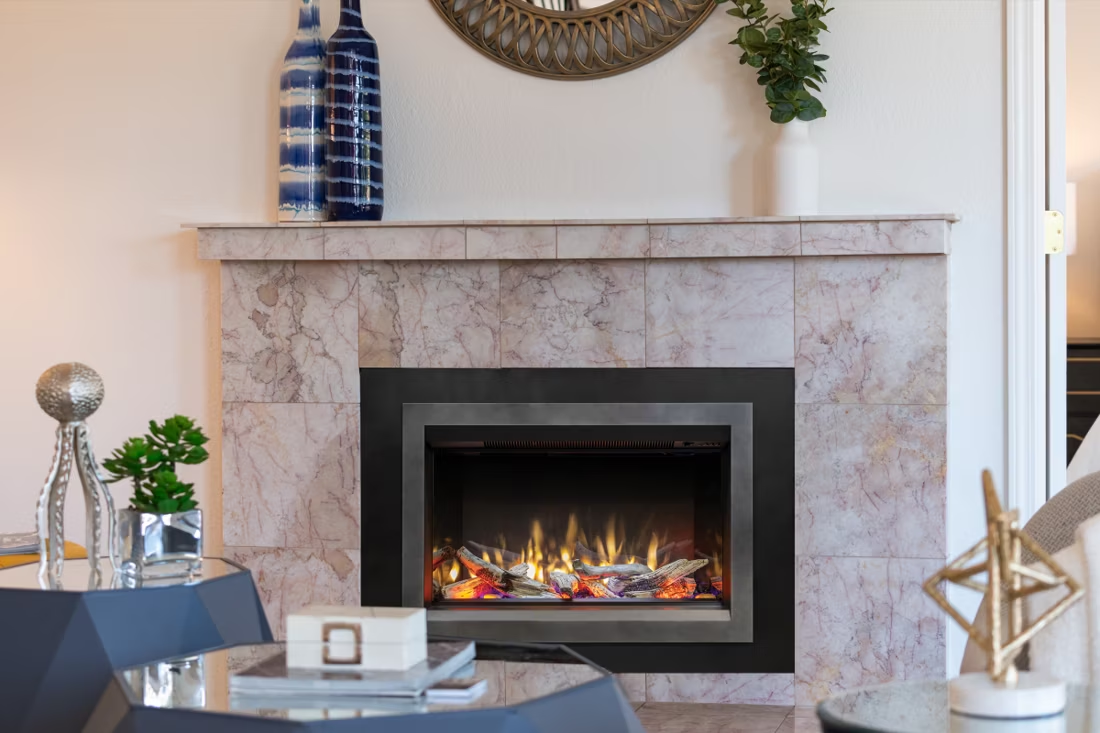
An electric insert is built to slide into an existing wood-burning firebox, giving an old fireplace a heat source and glowing flame effect without touching the chimney (the insert simply blocks the flue rather than using it). A freestanding electric fireplace is a self-contained cabinet, similar to furniture, that plugs in and sits against any wall. A wall-mounted electric fireplace hangs like a flat-screen TV and recesses a heater and LED flame display into a shallow frame. For a Smithville-Sanders home with an old, rarely-used masonry fireplace, an insert is often the easiest upgrade; for a newer home without one, a wall-mount or freestanding unit is more common.
How long does an electric fireplace installation take?
A plug-in or freestanding electric fireplace can be unboxed, placed, and running within an hour—there's no curing time, gas line pressure test, or venting to install. A built-in unit that requires a new dedicated circuit generally takes a licensed electrician half a day to a full day, plus any drywall patching or trim carpentry around the unit. Compare that to a gas fireplace conversion, which often takes two to three days once gas line work and venting are factored in—electric is by far the fastest path from decision to a working fireplace in Smithville-Sanders.
Electric vs. gas—which is right for my home?
Gas is a real option here too—propane is common in unincorporated parts of Monroe County that sit outside the natural gas mains extending from Bloomington. A propane fireplace puts out more heat per hour and, with a millivolt pilot system, can keep running during a power outage, which matters when winter ice storms take down lines in this area. Electric fireplaces need continuous power to run the heater and flame effect, so they go dark in an outage unless you have a generator or battery backup for the house. What electric wins on is upfront cost, installation simplicity, and running cost at Duke Energy Indiana's $0.1275/kWh rate for occasional supplemental use. For a primary heat source in a room you use daily through winter, propane often makes more sense; for occasional ambiance and light supplemental heat, electric is hard to beat on cost and ease.
Do electric fireplaces actually produce heat?
Yes—most put out around 4,800–5,000 BTUs from a standard outlet, which comfortably warms a bedroom, office, or den as a comfort-zone heater. What they won't do is carry a whole house the way wood, gas, or pellet can. Think of electric as ambiance-first with honest supplemental heat: flames on with no heat in July, flames plus warmth in January.
Does an electric fireplace need a vent or chimney?
No—that's its superpower. An electric fireplace needs a wall and an outlet, period. No vent pipe, no gas line, no clearances to design around, which is why it works in bedrooms, offices, apartments, and walls where venting a gas or wood unit would be impractical or impossible. Installation is typically the simplest and least expensive of any fireplace type.
How much should I budget for a fireplace?
For an average home—covering the fireplace, the vent pipe, and basic installation—a budget between $3,900 and $5,500 gives you a lot of options across wood, gas, and pellet. By the time you add finish work, gas line, and electrical, the average complete installation lands between $5,000 and $12,000 all-in. In a remodel or new build, a good rule is to put about 2.5% of the total project cost toward the fireplace.
Should the dealer who sells my fireplace also install it?
Ideally, yes. A fireplace project involves vent pipe, gas line, electrical, and often tile or stone. Hire three or four separate trades and you own the liability and the game of telephone between them. One company selling and installing means one accountable party, start to finish—ask about factory training, on-time completion records, and what happens if an inspection fails.
Nearby Dealers
Hearth shops serving Smithville-Sanders and the surrounding area. Every listing shows whether it is a WhyFire partner, a dealer we have verified as authorized for the brands we recommend, or a local business carrying hearth products. No manufacturer pays for placement. How we verify dealers →
RT's Fireplace Shop
Stoll Sales LLC
Lost River Fireplaces And More
Electric Service in Smithville-Sanders
An electric fireplace's heater draws about 1,500 watts—pennies per hour at local rates.
Duke Energy Indiana, LLC
Find your electric fireplace in Smithville-Sanders.
Tell us a bit about your home and we'll match you with the right electric fireplace or insert, plus a free Project Guide & Parts List—the exact parts for your project and our recommended local dealer in Monroe County.
Find Your Fireplace →