
Find the right gas fireplace for your Kankakee County home.
Instant, reliable heat for winters that run cold along the Illinois and Kankakee Rivers—from Kankakee and Bradley to Bourbonnais, Manteno, and the farm towns beyond. Find the right unit and connect with a trusted local dealer.
Every Project Starts From One of These Five Situations
Clean, dependable heat for Kankakee County's Illinois River Valley winters.
Kankakee County sits in northeastern Illinois where the Kankakee and Illinois Rivers meet flat farmland and river-bottom timber. Winters here average a low of 16°F with a heating season that stretches five or six months—colder than St. Louis, milder than Minneapolis or Buffalo, but still cold enough that a heating system needs to actually perform for five or six months a year. Between Kankakee, Bradley, Bourbonnais (home to Olivet Nazarene University), Manteno, and the smaller towns like Herscher and Momence, most of the county's growth over the past two decades has been in newer subdivisions and remodels—exactly the kind of housing stock where gas fireplaces have become the default choice.
Nicor Gas provides natural gas service through most of the county's incorporated areas, so a homeowner in Kankakee, Bradley, or Bourbonnais with an existing gas line for a furnace or water heater can usually add a fireplace without much extra plumbing. Outside the service footprint—on farmland and in unincorporated pockets of the county—propane fills the gap, delivered and tanked by regional suppliers. Either way, a gas fireplace gives you instant heat at the flip of a switch or remote, the option to keep running during a winter power outage with the right ignition system, and none of the ash, creosote, or wood-handling that comes with a solid-fuel appliance.
Three steps. No salesperson until you're ready.
Tell us about your project
Your zip code, your situation, and the fuel you're leaning toward—or let the answers point you to one.
See what's actually available
The brands dealers within 100 miles genuinely carry—real options, never a catalog mirage.
Get your dealer & Project Guide
A trusted local dealer, plus the free Project Guide & Parts List that names every component of the job.
Frequently Asked Questions
How much does a gas fireplace installation cost in Kankakee County?
Most gas fireplace installations in Kankakee County run somewhere between $3,500 and $9,000, with the low end covering a direct-vent insert dropped into an existing masonry fireplace that already has gas nearby, and the high end covering new construction or a remodel that requires framing, fresh venting, and a new gas line run. Homes already on Nicor Gas service with an existing appliance nearby (a furnace or water heater) tend to land toward the lower end because the gas line work is minimal. Rural properties running on propane sometimes see added cost if a new tank has to be set. A local dealer will give you a firm number after walking the space.
Can I convert my existing wood-burning fireplace to gas?
Yes, and it's a common project for older homes in Kankakee and Bourbonnais with original masonry fireplaces. A direct-vent gas insert slides into the existing firebox, and a stainless liner runs up the existing chimney to vent it—no new chase needed on the exterior of the house. The job typically runs $4,000 to $8,500 depending on the insert and whether new gas piping is required to reach the fireplace location. It's a straightforward way to keep the look of a wood fireplace while eliminating the ash, chimney maintenance, and the wood supply that homes in this area's oak, hickory, and walnut woodlots would otherwise require.
Do I need natural gas service, or can I run a fireplace on propane?
Either works, and the choice usually comes down to where you live. Nicor Gas serves Kankakee, Bradley, Bourbonnais, and most of the county's incorporated municipalities, so if your home already has a gas furnace or gas water heater, a fireplace add-on is usually a simple tie-in. Out in the unincorporated parts of the county—the farmland between Manteno, Herscher, and Momence, for instance—homes typically rely on a propane tank, either owned or leased from a regional supplier. Nearly every gas fireplace model on the market can be set up for either fuel; your installer just fits the correct orifice and regulator for whichever gas you're running.
Will my gas fireplace still work if the power goes out?
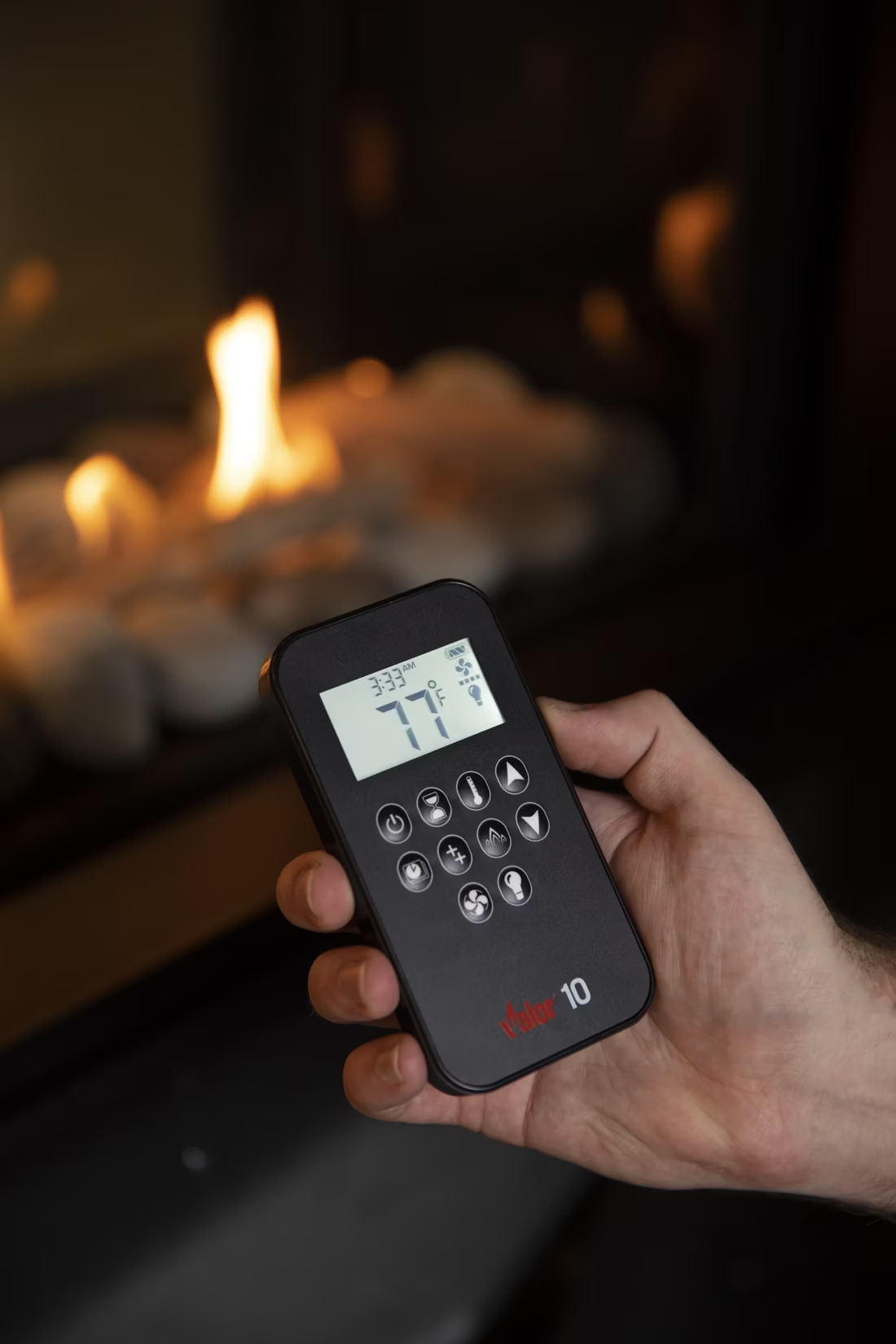
It depends on the ignition system, and it's worth asking about before you buy. Units with intermittent pilot ignition (IPI) run on a small battery backup inside the unit, so the fireplace lights on demand even with the power out—you just need to keep fresh batteries in it. Valor fireplaces take a different approach: the pilot's thermocouple generates its own electricity, so there's no battery to remember at all. For Kankakee County winters, where an ice storm or high-wind event can knock out power for a stretch, that distinction matters more than it sounds like it should. Ask your local dealer which ignition system is on any model you're considering.
What's the difference between a gas fireplace, a gas insert, and a gas stove?
A gas fireplace is a built-in unit framed into a wall—typical for new construction or a full remodel. A gas insert is built to slide into an existing masonry fireplace opening, sealing it up and using the existing chimney as a vent chase. A gas stove is a freestanding unit that sits on the floor on its own hearth pad, similar in footprint to a wood stove but running on gas. For most of the older housing stock in Kankakee and Bourbonnais with an existing fireplace, an insert is the natural fit. Newer homes in Manteno or Bradley without an existing firebox are usually better suited to a built-in fireplace or a freestanding stove.
Do I need a permit to install a gas fireplace in Kankakee County?
Yes. Inside city limits—Kankakee, Bradley, Bourbonnais, Manteno—permits are issued by that municipality's own building department, and a gas line permit is required in addition to the general building permit. In unincorporated parts of the county, the Kankakee County Building & Zoning Department handles it. The gas piping itself has to be run or inspected by a licensed gas-fitter, which is one of the practical reasons to go through a hearth dealer rather than a general handyman—they coordinate the gas hookup, the venting, and the inspection as one job instead of leaving you to manage separate trades.
Vented vs. vent-free gas fireplaces—what should I know?
Vented (direct-vent) gas fireplaces draw combustion air from outside and exhaust the byproducts back outside through a sealed pipe—they're the standard choice and the one most local dealers install by default. Vent-free units burn directly into the room without any outside venting; they're legal in Illinois but come with strict room-size minimums and oxygen-depletion sensors, and some states restrict them outright. For most Kankakee County homes, a direct-vent unit is the safer and more universally recommended option—it delivers real heat without any tradeoff on indoor air quality. Ask a local dealer to walk you through both if you're deciding between them.
How often does a gas fireplace need to be serviced?
Plan on an annual inspection, ideally before the start of the heating season each fall. A technician checks the burner, pilot assembly, gas connections, and venting, and cleans the glass and interior—a much smaller job than a chimney sweep, but just as important for safety and efficiency. Most gas service providers covering the Kankakee area charge somewhere in the $150 to $250 range for a standard annual visit. If your unit sat unused over a mild winter or you notice the flame pattern looking uneven, it's worth having it looked at sooner.
Why is gas so much more common than wood heat in Kankakee County?
Kankakee County has plenty of oak, hickory, walnut, and maple in its river-bottom woodlots, but wood-burning appliances are genuinely uncommon here—there's no non-attainment air quality issue driving people toward cleaner-burning appliances, no public cutting-permit infrastructure like you'd find near national forest land, and Nicor Gas service reaches most of the county's population centers. The result is that gas has become the practical default for both new construction and fireplace remodels, with propane covering the rural gaps. Wood stoves still show up occasionally on larger rural properties for backup heat during outages, but for the vast majority of Kankakee County homeowners, a gas fireplace or insert is simply the more available and lower-maintenance choice.
What's the difference between an insert and a zero-clearance fireplace?
An insert is a fireplace that slides into a pre-existing wood-burning fireplace—if you don't have one, there's nothing to insert it into. A zero-clearance fireplace is built into a framed wall, which makes it the answer for remodels and new construction. Simple test: existing masonry fireplace means insert; blank or framed wall means zero-clearance.
Can I put a TV above my fireplace?
Yes—with an asterisk. Fireplaces are hot and TVs don't like heat. Either put a mantel between them to deflect rising warmth, or choose a fireplace with heat-management technology that creates a cool zone on the wall above—the wall stays around 125 degrees, barely warm, while the room still gets full heat. If you like clean lines and don't want a mantel, heat management is the answer.
How much should I budget for a fireplace?
For an average home—covering the fireplace, the vent pipe, and basic installation—a budget between $3,900 and $5,500 gives you a lot of options across wood, gas, and pellet. By the time you add finish work, gas line, and electrical, the average complete installation lands between $5,000 and $12,000 all-in. In a remodel or new build, a good rule is to put about 2.5% of the total project cost toward the fireplace.
Can a fireplace actually lower my heating bill?
Yes—by creating a comfort zone. A furnace heats every square foot of the house just to warm the one room you're in; a gas fireplace on low burns roughly a sixth of the gas a typical furnace does. Set the furnace around 55–60 degrees as a baseline, then heat the rooms your family actually uses. Families who heat this way commonly save $20–$60 a month.
Find your gas fireplace in Kankakee County.
Tell us a bit about your home and we'll match you with the right gas fireplace, insert, or stove, plus a free Project Guide & Parts List with the exact vent kit and parts your installer will need—and a recommended local dealer to install it.
Find Your Fireplace →