
A Gas Flame for Wahiawa's Cool Plateau Evenings.
Wahiawa doesn't need heat the way the mainland does—but a real gas flame still has a place here. Find the right unit and connect with a trusted local dealer.
Every Project Starts From One of These Five Situations
Ambiance first, heat second—and that's fine.
Wahiawa sits at just under 1,000 feet on the Leilehua Plateau between the Waianae and Koolau ranges, which makes it noticeably breezier and a few degrees cooler on winter nights than coastal Honolulu—winter lows average around 61°F, and trade-wind evenings can dip into the mid-to-upper 50s. Even so, Wahiawa's overall need for winter heating is tiny, amounting to only about 12 on the same scale that measures how much a home needs. Compare that to a place like Duluth, Minnesota, which racks up over 9,000 on that same scale in a single winter, and it's clear that no home here is being heated by a fireplace out of necessity.
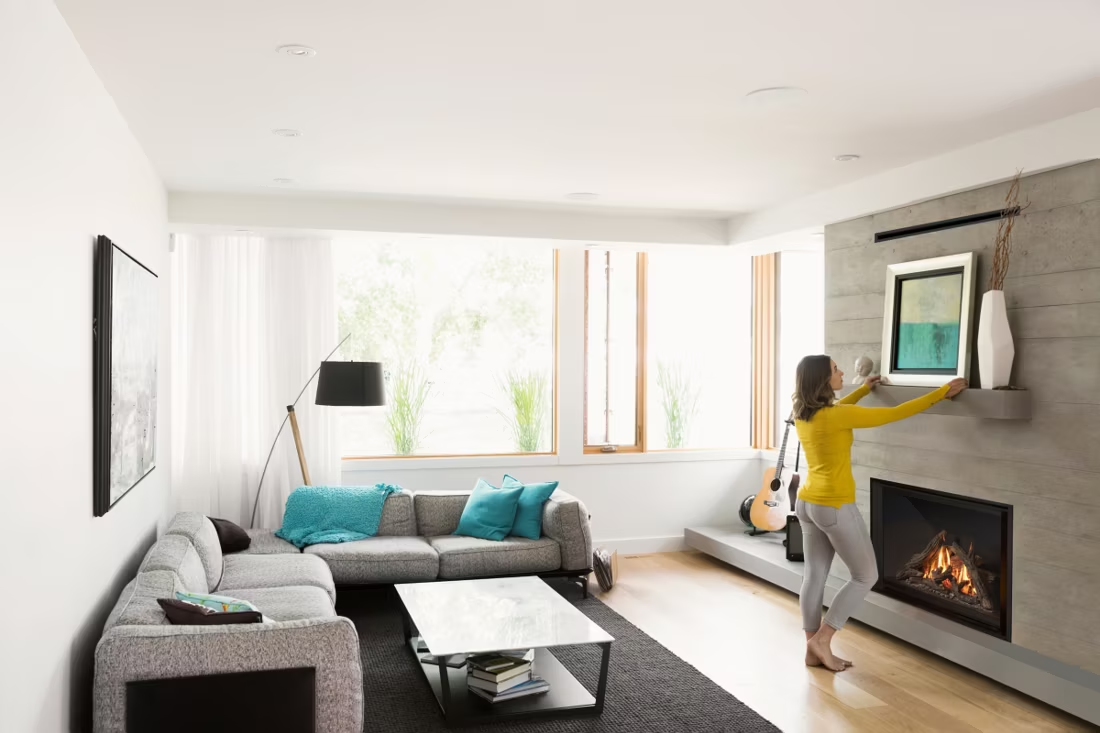
That's why gas fireplaces in Wahiawa are chosen almost entirely for ambiance—the look and sound of a real flame, a focal point in a living room or lanai, and resale appeal in newer central Oahu subdivisions. Piped utility gas from Hawaii Gas is largely limited to the urban Honolulu core, so most Wahiawa installations run on propane, delivered by tank or cylinder and installed by a licensed local technician. Because nearly all appliances, venting components, and fixtures have to be shipped in, installed costs in Wahiawa tend to run higher than mainland averages—typically $6,000 to $13,500 depending on the unit and whether new gas line or tank work is required.
Three steps. No salesperson until you're ready.
Tell us about your project
Your zip code, your situation, and the fuel you're leaning toward—or let the answers point you to one.
See what's actually available
The brands dealers within 100 miles genuinely carry—real options, never a catalog mirage.
Get your dealer & Project Guide
A trusted local dealer, plus the free Project Guide & Parts List that names every component of the job.
Frequently Asked Questions
How much does a gas fireplace installation cost in Wahiawa?
Most Wahiawa installations run $6,000 to $13,500. Since piped utility gas doesn't reach central Oahu, nearly every project involves setting up a propane tank or cylinder alongside the fireplace, which adds cost compared to homes already on a gas line. A direct-vent unit installed during new construction, with the tank and gas piping run at the same time as other trades, tends to land on the lower end. Retrofitting an older Wahiawa home—especially one with single-wall or concrete block construction and no existing chimney chase—pushes toward the higher end because new venting has to be framed in from scratch. A local dealer will give you a firm number after seeing your home.
Can I convert my existing wood fireplace to gas?
For most Wahiawa homes, this question doesn't really apply—traditional masonry, wood-burning fireplaces are rare here. Older plantation-era homes were built single-wall with no chimney, and newer construction skips wood fireplaces entirely given Oahu's climate. Instead of a conversion, most gas fireplace projects in Wahiawa are new installs: a sealed, direct-vent unit framed into a wall and vented straight through to the outside, which works well in homes that never had a chimney to begin with.
Do I need natural gas to install a gas fireplace, or can I use propane?
In Wahiawa, propane is the standard, not the exception. Hawaii Gas supplies piped utility gas mainly to the urban Honolulu and Waikiki corridor, and that network doesn't extend out to the central Oahu plateau. Local installers set homes up with either a leased or owned propane tank, sized to the fireplace's BTU output, and most fireplace models on the market can be configured for propane with the correct orifice and regulator. If you're building new or doing a larger remodel, ask your installer whether an underground or above-ground tank makes more sense for your lot.
Will my gas fireplace work during a power outage?
Most modern gas fireplaces with IPI (intermittent pilot ignition) include a battery backup that keeps the unit running when Hawaiian Electric's grid goes down—something worth planning for given how storms and high-wind events on Oahu can knock out power for hours at a time. Valor fireplaces take a different approach: their pilot's thermocouple generates its own electricity, so the fireplace works during an outage with no batteries at all. Either way, since Wahiawa fireplaces are chosen for ambiance rather than emergency heat, this matters less for survival and more for keeping the room usable and lit when the power's out.
What's the difference between a gas fireplace, gas insert, and gas stove?
A gas fireplace is a fully built-in unit framed into a wall—the most common choice in Wahiawa given how few homes have an existing masonry fireplace to retrofit. A gas insert is designed to slide into an existing wood-burning fireplace and use its chimney for venting, which is a less common project locally simply because that older housing stock is rare here. A gas stove is a freestanding cabinet-style unit that vents through a wall or roof—a popular option for covered lanais and indoor-outdoor living spaces that are typical of central Oahu homes. Most Wahiawa homeowners end up choosing between a built-in fireplace for the main living area and a freestanding stove for a lanai or bonus room.
Do I need a permit to install a gas fireplace in Wahiawa?
Yes. Wahiawa falls under the City & County of Honolulu Department of Planning and Permitting (DPP), which requires a building permit for the fireplace installation and a separate mechanical/gas permit for the propane line and tank placement, including required setback distances from the structure and property line. A licensed propane technician has to handle the tank and line work. Most local hearth dealers coordinate the DPP permitting as part of the install, so you're not left submitting paperwork yourself.
What's the difference between vented and vent-free gas fireplaces?
Vented (direct-vent) gas fireplaces draw combustion air from outside and exhaust it back outside through sealed venting—they're the safest option and the one most Wahiawa dealers recommend. Vent-free units burn fuel directly into the room, releasing water vapor and small amounts of combustion byproducts indoors. That's a bigger consideration in Wahiawa than it would be in a dry mainland climate: Oahu's year-round humidity means added indoor moisture from a vent-free unit can contribute to mold and mildew issues faster than in a drier climate. For that reason, direct-vent units are the more practical choice for most homes here.
How often should my gas fireplace be serviced?
Plan on an annual inspection, same as anywhere—a technician checks the burner, pilot assembly, venting, and gas connections. In Wahiawa specifically, ask about corrosion-resistant components; while the plateau location means less direct salt exposure than coastal Oahu towns, trade winds still carry enough moisture and salt air over central Oahu to accelerate wear on lower-quality metal parts over time. A local dealer familiar with island conditions can point you toward hardware built to hold up better in this climate.
Gas vs. electric—which is right for my home?
This is a real question in Wahiawa, since neither fuel is being chosen for actual heating need. Electric fireplaces are simpler to install—no propane tank, no gas line, often just a standard outlet—but Hawaiian Electric's residential rate runs about $0.43 per kWh, among the highest in the country, so running one for hours of ambiance adds up fast. Propane-fired gas fireplaces cost more upfront to install because of the tank and line work, but cost less per hour to operate and give you a real flame rather than an LED simulation. For homeowners who want the authentic look and sound of fire, gas is usually worth the higher install cost. For a simpler, lower-commitment project—especially in a rental or a room where venting isn't practical—electric is the easier path.
Is my gas fireplace wasting gas?
If it was installed more than 15 years ago, probably. Older gas fireplaces keep a standing pilot light burning all the time, and that little flame can cost a couple hundred dollars a year. Newer models use pilot-on-demand ignition—the pilot lights only when you use the fireplace and goes out when you turn it off.
What's the difference between an insert and a zero-clearance fireplace?
An insert is a fireplace that slides into a pre-existing wood-burning fireplace—if you don't have one, there's nothing to insert it into. A zero-clearance fireplace is built into a framed wall, which makes it the answer for remodels and new construction. Simple test: existing masonry fireplace means insert; blank or framed wall means zero-clearance.
Does a fireplace add value to my home?
On average, a fireplace adds back to the home about the same amount you spent installing it. Add the monthly savings from heating the rooms you actually use instead of the whole house—often hundreds of dollars a year—and the value case is strong before you even count what a fire does for how your family uses the room.
Can a fireplace actually lower my heating bill?
Yes—by creating a comfort zone. A furnace heats every square foot of the house just to warm the one room you're in; a gas fireplace on low burns roughly a sixth of the gas a typical furnace does. Set the furnace around 55–60 degrees as a baseline, then heat the rooms your family actually uses. Families who heat this way commonly save $20–$60 a month.
Nearby Dealers
Hearth shops serving Wahiawa and the surrounding area. Every listing shows whether it is a WhyFire partner, a dealer we have verified as authorized for the brands we recommend, or a local business carrying hearth products. No manufacturer pays for placement. How we verify dealers →
Island Pool And Supply
Find your gas fireplace in Wahiawa.
Tell us a bit about your home and we'll match you with a trusted local dealer and a free Project Guide & Parts List—the exact parts, including the vent kit, for your Wahiawa gas fireplace project.
Find Your Fireplace →