
Ambiance and Warmth for Mild Gulf Coast Winters.
With winter lows averaging 44°F on Santa Rosa Sound, Tiger Point homes don't need a furnace-grade fireplace—they need clean, instant ambiance with a heat boost on the rare cold snap. Find the right unit and connect with a trusted local dealer.
Every Project Starts From One of These Five Situations
Electric heat fits the Gulf Coast climate honestly.
Tiger Point sits at essentially sea level along Santa Rosa Sound in the Florida Panhandle, in climate zone 2A with a very light winter heating load—a fraction of what a place like Duluth, MN or Burlington, VT logs each winter. Winter lows here average in the mid-40s, and hard freezes are the exception, not the rule. That changes the calculus on fireplace choice: most Tiger Point homeowners aren't heating a house through a five-month winter, they're adding warmth and glow for the handful of genuinely chilly nights and the visual appeal of a fireplace the rest of the year.
That's exactly the niche electric fireplaces fill well. There's no chimney to maintain in a coastal, humid environment, no combustion byproducts to vent, and no masonry to worry about corroding in salt air. Electric units run on the standard household circuit through Florida Power & Light, at a residential rate of about 13.71 cents per kWh, and install in a fraction of the time and cost of a wood or gas system. The honest tradeoff: electric fireplaces need grid power to run, and Santa Rosa County sees its share of tropical storm outages—so if backup heat during an extended outage matters to you, it's worth discussing that with a local dealer alongside the ambiance case for electric.
Three steps. No salesperson until you're ready.
Tell us about your project
Your zip code, your situation, and the fuel you're leaning toward—or let the answers point you to one.
See what's actually available
The brands dealers within 100 miles genuinely carry—real options, never a catalog mirage.
Get your dealer & Project Guide
A trusted local dealer, plus the free Project Guide & Parts List that names every component of the job.
Frequently Asked Questions
How much does an electric fireplace installation cost in Tiger Point?
A plug-in electric insert or freestanding unit that uses an existing standard outlet typically runs $200 to $600 installed in Tiger Point, since there's no venting or gas line involved. A built-in linear wall unit—framed into a wall with a dedicated 20-amp circuit run by a licensed electrician—usually lands between $1,500 and $4,000 depending on unit size and whether new wall framing or trim work is needed. Because Tiger Point's mild winters mean most homeowners are prioritizing look over heat output, a lot of installs here skew toward the simpler, lower end of that range.
What will it actually cost to run an electric fireplace here?
Most electric fireplaces draw around 1,500 watts on the heat setting. At Florida Power & Light's residential rate of roughly 13.71 cents per kWh, running one for 4-5 hours on a cool evening costs about $1 a night, or roughly $25-$30 a month if you use it most evenings through Tiger Point's short cool season (typically December through February). Running it on ambiance-only/no-heat mode draws a fraction of that, since the flame effect itself uses very little power.
Will my electric fireplace still work during a hurricane power outage?
No—this is worth being upfront about. Electric fireplaces require grid power, so during a tropical storm or hurricane outage (which Santa Rosa County residents plan around every season), an electric unit won't provide heat or light unless you're running a generator that can carry the circuit. If backup heat during outages is a real priority for your household, a wood-burning option using local oak or pine, or a propane unit with battery-backed ignition, will serve you better as a storm-season backup. Many Tiger Point homes end up with electric for daily ambiance and a separate plan for outages.
Do I need a permit to install an electric fireplace in Tiger Point?
It depends on the installation type. A plug-in electric insert or freestanding unit that uses an existing wall outlet generally doesn't require a permit. A built-in unit that needs a new dedicated electrical circuit does require an electrical permit through the Santa Rosa County Building Department, since Tiger Point is unincorporated county territory. Licensed electricians who regularly do hearth work will typically pull this permit as part of the installation.
What should I look for in an electric fireplace given the humidity here?
Gulf Coast humidity and salt air are harder on electronics than most people expect, especially for units near windows, screened porches, or lanai spaces. Look for models with sealed circuit boards and corrosion-resistant hardware—brands like Dimplex, Napoleon, and Touchstone build units with this in mind. If you're installing near an exterior wall or a space that isn't fully climate-controlled, ask your local dealer specifically about moisture-resistant components; it's a common upgrade question in coastal Santa Rosa County installs.
Does it make sense to install wood or gas instead, given how mild winters are here?
Some Tiger Point homeowners do still choose wood, often for the look and the tradition of a real fire using local oak, pine, or mahogany rather than for serious heat output—with such a light winter heating load here, wood as a primary heat source isn't really necessary the way it would be in the upper Midwest. Gas is a middle option, offering instant flame with more heat than electric if you already have or want to add a propane tank. For most homes in this climate, though, electric hits the sweet spot: real flame appearance, zero maintenance, and heat output sized appropriately for a handful of genuinely cold nights rather than a full winter season.
What's the difference between an electric insert, wall-mount, and freestanding unit?
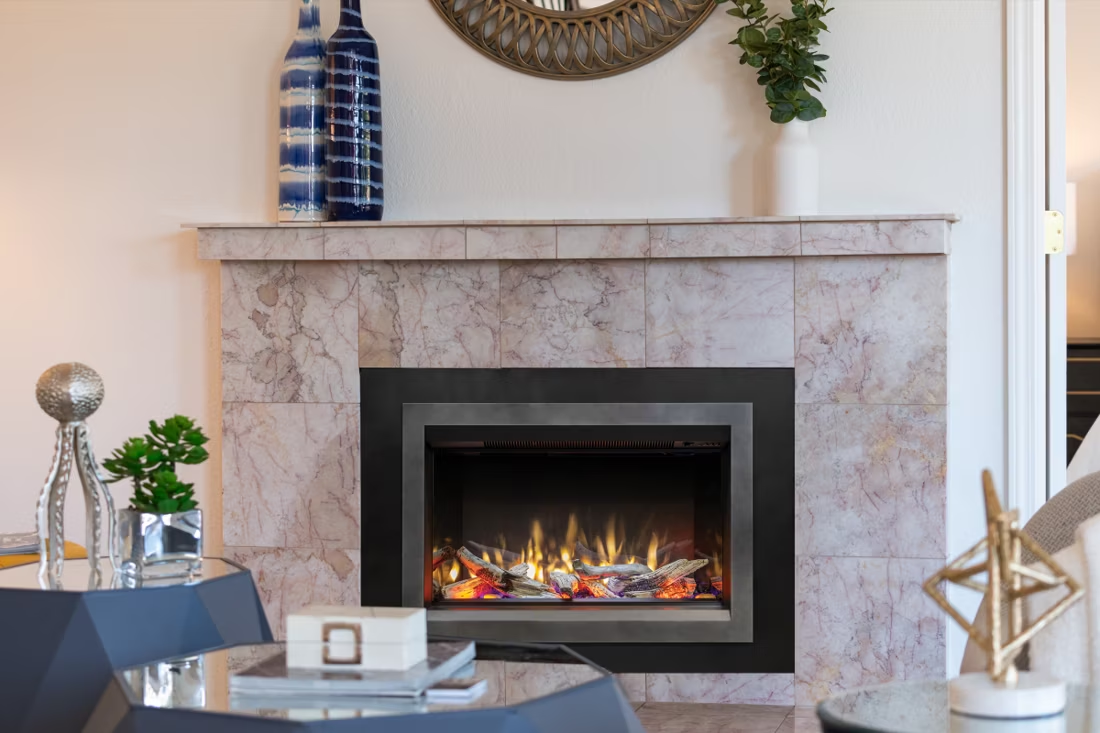
An electric insert fits into an existing fireplace opening—a common choice if your Tiger Point home already has a masonry or built-in wood fireplace you want to convert to no-maintenance electric. A wall-mount unit hangs flush on the wall like a piece of art, popular in newer construction and condos along the Sound where there's no existing fireplace box. A freestanding electric stove or console sits on the floor and can be relocated, which suits renters or homeowners who aren't ready to commit to built-in framing. All three plug into standard household power in most cases.
Will an electric fireplace actually heat my living room?
Most electric fireplaces are rated to supplement heat in a room of 400 to 1,000 square feet, which is plenty for a Tiger Point living room or den on a cold snap night when temperatures dip into the 30s. They're not designed to replace central HVAC for the whole house, and given the area's mild winter low average of 44°F, most homeowners here use the heat function occasionally rather than as a daily necessity—the flame and glow get far more regular use than the heater element.
Is an electric fireplace safe for a home this close to the water?
Yes, and in some ways it's a safer choice than the alternatives for a low-elevation property like Tiger Point, which sits near sea level along Santa Rosa Sound. There's no open flame, no combustion gases, and no chimney or venting penetrating the roof or wall—points of concern in flood-prone, storm-exposed coastal construction. The main precaution is making sure any built-in unit and its wiring are installed above expected flood lines and that outlets near windows or screened areas are rated for the humidity; a licensed local electrician familiar with coastal Santa Rosa County homes will know the right placement.
Do electric fireplaces actually produce heat?
Yes—most put out around 4,800–5,000 BTUs from a standard outlet, which comfortably warms a bedroom, office, or den as a comfort-zone heater. What they won't do is carry a whole house the way wood, gas, or pellet can. Think of electric as ambiance-first with honest supplemental heat: flames on with no heat in July, flames plus warmth in January.
Does an electric fireplace need a vent or chimney?
No—that's its superpower. An electric fireplace needs a wall and an outlet, period. No vent pipe, no gas line, no clearances to design around, which is why it works in bedrooms, offices, apartments, and walls where venting a gas or wood unit would be impractical or impossible. Installation is typically the simplest and least expensive of any fireplace type.
What is an in-home preview and do I need one?
It's a visit where a hearth professional measures your space, confirms the model you picked actually works in your home, and walks the specs—framing, gas line, venting, finish work—before anything is ordered. Some details you just can't know until you see the house. Never make a down payment without one; it's the single most-skipped step that burns buyers.
How much should I budget for a fireplace?
For an average home—covering the fireplace, the vent pipe, and basic installation—a budget between $3,900 and $5,500 gives you a lot of options across wood, gas, and pellet. By the time you add finish work, gas line, and electrical, the average complete installation lands between $5,000 and $12,000 all-in. In a remodel or new build, a good rule is to put about 2.5% of the total project cost toward the fireplace.
Nearby Dealers
Hearth shops serving Tiger Point and the surrounding area. Every listing shows whether it is a WhyFire partner, a dealer we have verified as authorized for the brands we recommend, or a local business carrying hearth products. No manufacturer pays for placement. How we verify dealers →
We’ve paused dealer listings for this connection today. Enter your zip or postal code above to find dealers near you, or come back tomorrow.
Popular Electric Brands
Where each brand came from, what's inside it today, and every current model. No brand pays to be here. Not every dealer carries every brand, so enter your zip code to see what's sold near Tiger Point.
Fireplace Xtrordinair
Fireplace Xtrordinair, now often called FireplaceX, is the fireplace brand of Travis Industries, Inc., of Mukilteo, Washington.
5 electric models →DaVinci
DaVinci Custom Fireplaces is a brand of Travis Industries, Inc., of Mukilteo, Washington, the company behind Lopi and Fireplace Xtrordinair.
5 electric models →Kozy Heat
Kozy Heat was founded in 1976 by Dudley Hussong in Lakefield, Minnesota, and incorporated as Hussong Manufacturing Co., Inc. in 1978.
3 electric models →Forge & Flame
Forge & Flame is the stove brand Hearth & Home Technologies introduced in August 2023 to bring Vermont Castings, Harman, and Quadra-Fire under one name.
1 electric model →Electric Service in Tiger Point
An electric fireplace's heater draws about 1,500 watts—pennies per hour at local rates.
Florida Power & Light Co
Find your electric fireplace in Tiger Point.
Tell us a bit about your home and we'll put together a free Project Guide & Parts List—the right electric fireplace or insert for your space, plus a trusted local dealer to install it.
Find Your Fireplace →