
Warm up Madison County without the wood, the vent, or the wait.
With winters this mild across Madison, Greenville, Lee, and the rest of Madison County, an electric fireplace delivers real ambiance and just-enough warmth—no chimney, no gas line, no wood to split. Find the right unit and connect with a trusted local dealer.
Every Project Starts From One of These Five Situations
Mild winters, real warmth when you actually want it.
Madison County sits in Florida's Big Bend, home to about 5,254 people spread across the city of Madison, Greenville, Lee, Pinetta, and Cherry Lake. In climate zone 2A, winters are short and mild—the average low sits around 40°F, and the county has one of the lightest winter heating loads of any county in the country. That's nothing like a Duluth, MN or Fargo, ND winter. Most homes here don't need a furnace running hard, let alone a wood stove keeping a fire through the night.
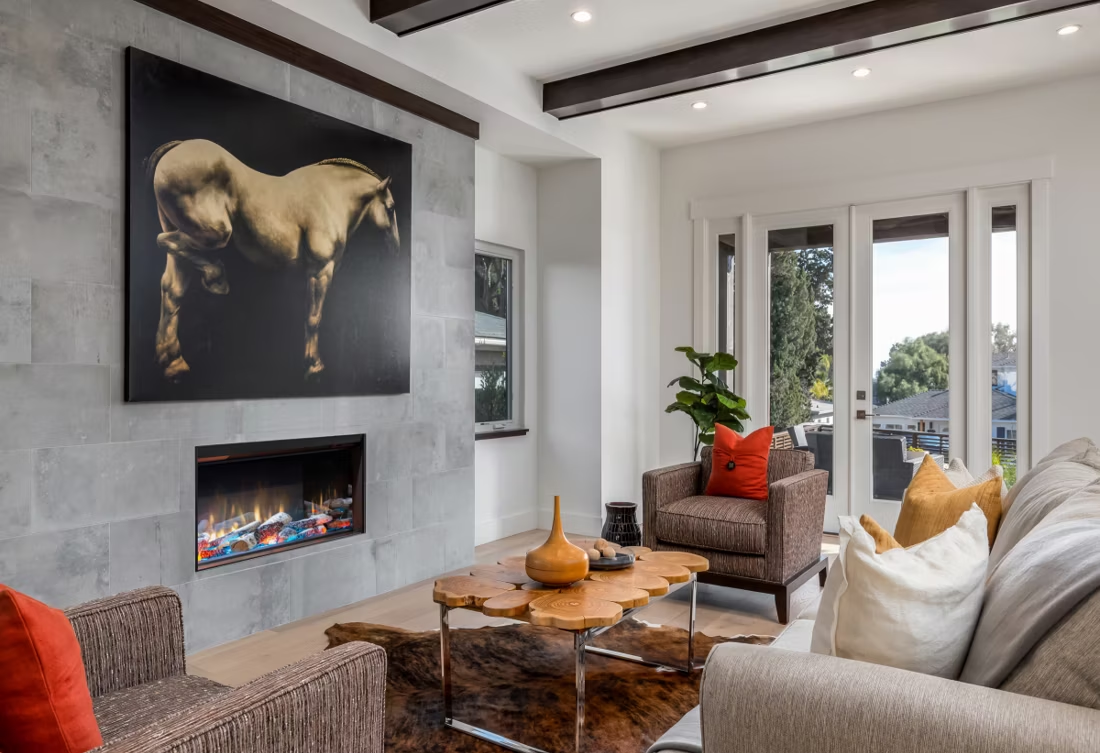
That's exactly why electric fireplaces fit so well in Madison County. There's no chimney to build, no gas line to run, and in most cases no combustion venting to plan around—which matters in a rural county where many homes are manufactured or modular construction. A plug-in or built-in electric unit can go into a bedroom, a den, or a mobile home living room and still deliver the flicker-and-glow of a real fire plus a modest heat boost on the occasional 30s-degree night. Wood heat still has its place here too—oak, mahogany, and pine are all burned locally—but for homeowners who want the look without the upkeep, electric is often the simplest answer.
Three steps. No salesperson until you're ready.
Tell us about your project
Your zip code, your situation, and the fuel you're leaning toward—or let the answers point you to one.
See what's actually available
The brands dealers within 100 miles genuinely carry—real options, never a catalog mirage.
Get your dealer & Project Guide
A trusted local dealer, plus the free Project Guide & Parts List that names every component of the job.
Frequently Asked Questions
How much does an electric fireplace cost to install in Madison County?
Costs vary a lot by unit type. A freestanding plug-in electric fireplace or stove runs $150 to $700 for the unit itself and typically needs nothing more than an outlet—no installer required. A wall-mounted or recessed electric insert set into an existing opening or built cabinetry usually runs $800 to $2,500 installed, including any minor electrical work. Larger built-in linear units with custom framing, a dedicated circuit, and finish carpentry can run $3,000 to $5,000 or more. Because Madison County has a mix of site-built and manufactured homes, your installer will factor in whether the wall can support the unit and whether the home's electrical panel has room for a dedicated circuit.
Do I need a permit to install an electric fireplace in Madison County?
In most cases, no. A plug-in freestanding electric fireplace that simply plugs into an existing outlet doesn't trigger a permit anywhere in Madison County. If you're installing a built-in unit that requires a new dedicated 120V or 240V circuit, an electrical permit is typically required through the Madison County Building Department, and the work should be done by a licensed electrician. Since electric units produce no combustion byproducts, there's no venting inspection or chimney code to satisfy—which is part of why they're a fast option for homeowners here.
Will an electric fireplace actually heat my home in Madison County's climate?
It depends on what you're asking it to do. With Madison County having one of the lightest winter heating loads in the country and winter lows typically staying near 40°F, most homes don't need a fireplace to carry the heating load—a standard 1,500-watt electric fireplace producing roughly 5,000 BTU is plenty to take the chill off a room during a cold front or an early morning in Greenville or Pinetta. For homes with wood stoves for ambiance but no real heating need, an electric unit is often a more practical everyday choice. If you want serious backup heat for the rare deep freeze, talk to a local dealer about a higher-output insert.
Electric vs. wood—which makes more sense in Madison County?
Wood still has a following here—oak, mahogany, and pine are all common and readily available locally, and a wood stove or fireplace provides real backup heat if the power goes out, which matters during hurricane season in the Big Bend. But given how mild Madison County winters actually are, most households don't need wood as a primary heat source. Electric fireplaces are a lower-maintenance option for day-to-day ambiance—no ash, no chimney sweeps, no permit hassle for a plug-in unit—while wood remains the better choice for anyone who wants a genuine off-grid heat source for storm season.
Where can an electric fireplace be installed in a manufactured or mobile home?
Electric fireplaces are one of the few fireplace options that work well in manufactured and mobile homes, which make up a meaningful share of housing stock across rural Madison County communities like Pinetta and Cherry Lake. Because there's no chimney, no floor-penetrating vent, and no combustion air requirement, a wall-mounted or recessed unit can typically go into a living room or bedroom wall with only minor framing modifications, as long as the wall isn't load-bearing on a structural member. A local dealer can confirm what's feasible for your specific home's construction before you buy.
What does an electric fireplace cost to run on my local utility rates?
Most of Madison County is served by Duke Energy Florida, though the city of Madison operates its own municipal electric utility within city limits. A typical electric fireplace draws about 1,500 watts on the heat setting, which costs a few cents to a bit over $0.15 per hour of heated use depending on your rate and whether you're inside city limits or on the Duke Energy side of the county. Since most Madison County homeowners are only running the heater function occasionally—on cool mornings or during a cold front—the ambiance-only flame setting draws minimal power and can run for pennies a day.
What's the best type of electric fireplace for Florida's humid climate?
Because climate zone 2A means hot, humid summers and mild winters, moisture resistance matters more here than raw heat output. Look for units with sealed electronics and LED-based flame effects rather than older water-vapor or mist-based models, which can struggle with humidity over time. A recessed wall insert or built-in linear unit tends to hold up well in Madison County's climate since it's protected within the wall cavity rather than exposed as a standalone appliance. Ask your local dealer which models they've seen perform best in North Florida's humidity.
Will my electric fireplace work during a power outage?
No—electric fireplaces require power to run, which is worth planning around in a county that sees tropical storm and hurricane activity that can knock out power for days at a time. If your electric fireplace is purely for ambiance, that's not a major issue, but if you're counting on it for backup heat during a rare cold snap combined with an outage, you'll want a different fuel source as a backup. Some Madison County homeowners keep a small wood stove or a propane heater on hand specifically for storm-season outages, using the electric unit for everyday convenience the rest of the year.
Electric vs. pellet stove—which fits Madison County better?
Pellet stoves, using bagged fuel from brands like Lignetics, Hamer Pellet Fuel, or Greenway Renewable Energy, put out real heat and can serve as a genuine backup heat source, but they need electricity to run the auger and blower—so they don't help during a power outage either, and they require venting through an exterior wall or roof. Electric fireplaces skip the venting requirement entirely and the pellet bags, but they can't compete with a pellet stove's heat output if you actually need to warm a large room. Given Madison County's mild winters, most homeowners lean electric for convenience and ambiance, with pellet stoves better suited to anyone heating a larger, older, less-insulated farmhouse.
Do electric fireplaces actually produce heat?
Yes—most put out around 4,800–5,000 BTUs from a standard outlet, which comfortably warms a bedroom, office, or den as a comfort-zone heater. What they won't do is carry a whole house the way wood, gas, or pellet can. Think of electric as ambiance-first with honest supplemental heat: flames on with no heat in July, flames plus warmth in January.
Can I put a TV above my fireplace?
Yes—with an asterisk. Fireplaces are hot and TVs don't like heat. Either put a mantel between them to deflect rising warmth, or choose a fireplace with heat-management technology that creates a cool zone on the wall above—the wall stays around 125 degrees, barely warm, while the room still gets full heat. If you like clean lines and don't want a mantel, heat management is the answer.
Can I install a fireplace myself?
If you're putting a fire in your house on purpose, it's best to work with an expert. Unless you're genuinely experienced in framing, gas line, vent pipe, and the national code on clearances to combustibles, have a professional do it—and ideally the same company that sells you the fireplace, so warranty, service, and liability all live under one roof.
Can a fireplace actually lower my heating bill?
Yes—by creating a comfort zone. A furnace heats every square foot of the house just to warm the one room you're in; a gas fireplace on low burns roughly a sixth of the gas a typical furnace does. Set the furnace around 55–60 degrees as a baseline, then heat the rooms your family actually uses. Families who heat this way commonly save $20–$60 a month.
Find your electric fireplace in Madison County.
Tell us a bit about your home and we'll put together a free Project Guide & Parts List—the right electric fireplace or insert for your space, plus a trusted local Madison County dealer to install it.
Find Your Fireplace →