
A Gas Fireplace That Works Even When the Power Doesn't.
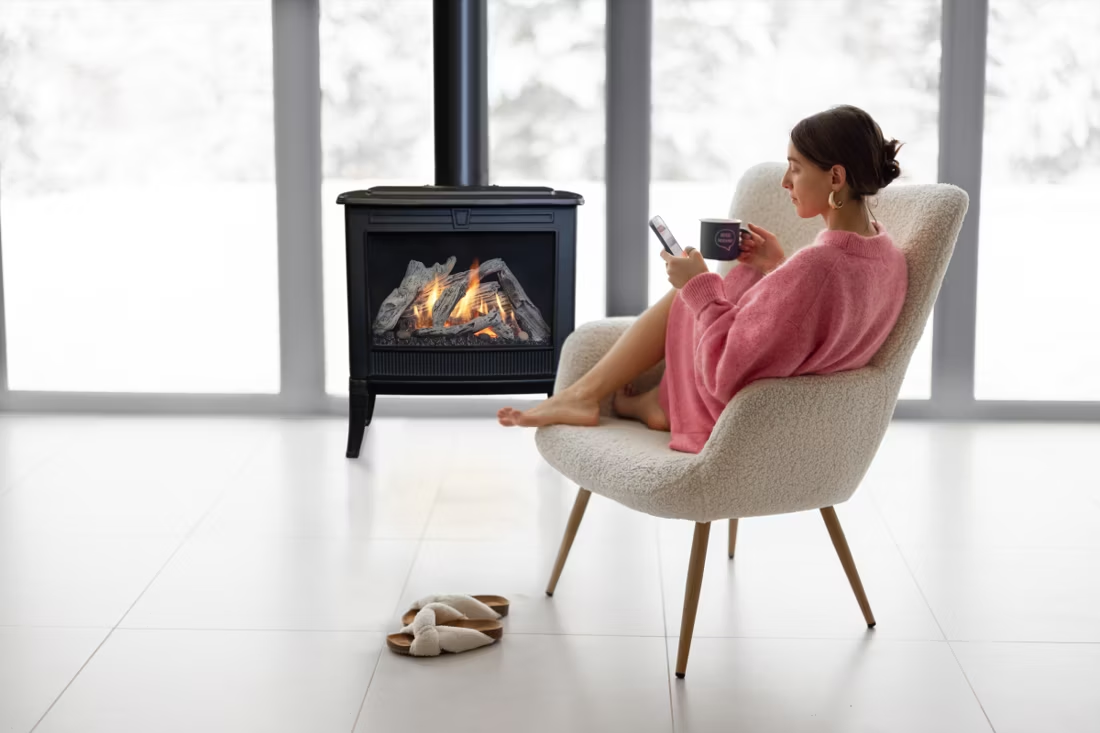
Edgewater doesn't need a furnace, but a gas fireplace still earns its place—for cool fronts off the Indian River, and for the nights after a storm knocks the grid out. We'll match you with a trusted local dealer who knows the difference.
Every Project Starts From One of These Five Situations
Built for ambiance first, backup power second.
Edgewater sits at 8 feet of elevation on Florida's Volusia County coast, in climate zone 2A, where winter lows average 52°F and the city has only a light winter heating need—a fraction of what a place like Bismarck, ND or Fargo, ND sees in a single January. Nobody here is heating a house on wood or pellets, and neither of those fuels shows up as a realistic option for local homes. Gas is different: it's a legitimate, standard choice, but the reason to install one in Edgewater has less to do with staying warm and more to do with ambiance, resale value, and having a real flame available when it matters.
There's no natural gas utility serving Edgewater directly, so most gas fireplace installations here run on propane—a tank set outside the home, feeding a direct-vent unit indoors. That distinction matters when you're budgeting, since propane setups involve either a tank lease or purchase in addition to the appliance itself. It also matters for hurricane season: a propane fireplace with battery-backup or self-powering ignition keeps working when Florida Power & Light or Duke Energy Florida service goes down after a named storm, which happens with some regularity along this stretch of coast.
Three steps. No salesperson until you're ready.
Tell us about your project
Your zip code, your situation, and the fuel you're leaning toward—or let the answers point you to one.
See what's actually available
The brands dealers within 100 miles genuinely carry—real options, never a catalog mirage.
Get your dealer & Project Guide
A trusted local dealer, plus the free Project Guide & Parts List that names every component of the job.
Frequently Asked Questions
How much does a gas fireplace installation cost in Edgewater?
Most propane-fueled gas fireplace or insert installations in Edgewater run somewhere between $3,800 and $9,500, with the spread driven mainly by whether you're feeding an existing masonry fireplace or building venting from scratch, plus whether you need a new propane tank set and line run. Converting an existing wood-burning fireplace to a direct-vent gas insert tends to land on the lower end since the chimney chase is already there. New construction or additions without an existing hearth—where a mason or contractor has to frame an enclosure and run vent pipe through an exterior wall—sit at the higher end. A local dealer will give you a firm number after seeing the space.
Do I need natural gas, or is propane the standard here?
Propane is the standard fuel for gas fireplaces in Edgewater. There's no natural gas utility serving the city, so nearly every gas fireplace, insert, or log set installed locally runs off a propane tank rather than a piped natural gas line. This isn't a downgrade—modern direct-vent units perform identically on propane—but it does mean your project includes a conversation with a propane supplier about tank size and placement, on top of the appliance and venting itself. Your local dealer will typically coordinate that piece for you.
Will a gas fireplace keep working if the power goes out after a storm?
That's actually one of the more practical reasons homeowners in Edgewater install one. A propane fireplace with intermittent pilot ignition (IPI) runs off small internal batteries and will light on demand even with the grid down, which matters given how often Florida Power & Light or Duke Energy Florida service gets interrupted during hurricane season here. Valor units take it a step further—their pilot assembly generates its own electricity through the thermocouple, so there's no battery to remember or replace. If storm-season resilience is part of why you're considering a fireplace, mention it to your dealer; it changes which models make sense.
Can I convert an existing wood-burning fireplace to gas?
Yes, and it's a common project on older homes in Edgewater and the surrounding Volusia County neighborhoods that were built with a traditional wood-burning masonry fireplace mostly for looks. A direct-vent gas insert drops into that existing opening, uses a stainless liner run through the same chimney, and typically costs $3,800 to $7,500 depending on the insert and whether new propane line work is needed. You keep the mantel and the look of the original fireplace but gain a unit you'd actually use—flip a switch instead of managing oak or pine logs in a house that rarely gets cold enough to justify the mess.
Do I need a permit to install a gas fireplace in Edgewater?
Yes. New gas fireplace installations require a building permit through the City of Edgewater Building Division, and any propane line work needs to be done by a licensed gas fitter, which typically triggers a separate mechanical permit. Most established local hearth dealers fold this into the installation quote and handle the inspection scheduling, so you're not chasing paperwork yourself. If a contractor quotes you an install with no mention of permits, that's a sign to ask more questions.
Vented vs. vent-free gas fireplaces—which makes sense in a Florida home?
Vented (direct-vent) units draw combustion air from outside and exhaust it back outside through sealed pipe—they're the standard recommendation and what most Edgewater installers default to. Vent-free units burn directly into the room and are legal to install in Florida within specific room-volume and ventilation rules, but they release moisture and combustion byproducts indoors, which is a real consideration in a coastal, high-humidity climate where you're already fighting mold and mildew. For most homes here, a direct-vent unit is the better long-term call even though vent-free installs are technically simpler.
How often does a gas fireplace need to be serviced in a coastal climate like this?
An annual inspection is the standard recommendation for any gas appliance, and it's worth taking seriously in Edgewater specifically. The city sits within a few miles of the Indian River Lagoon and the Atlantic, and salt-laden air accelerates corrosion on exterior vent terminations and any exposed metal components faster than it would inland. A technician checking the burner, pilot assembly, and venting once a year—usually $150 to $250—will catch corrosion or seal issues before they become a bigger repair. Ask your installer about stainless steel venting up front; it costs a little more but holds up far better this close to salt water.
Gas fireplace vs. electric fireplace—which fits an Edgewater home better?
Both are legitimate options here, and the right answer depends on what you actually want out of it. Electric fireplaces plug into a standard outlet, need no venting or propane tank, and run cheaply on Florida Power & Light or Duke Energy Florida service (roughly 13.7 to 16.6 cents per kWh locally)—but they're decorative heat, not a source you'd rely on, and they go dark the moment the power drops. A propane gas fireplace costs more up front but delivers a real flame, genuine radiant heat on the rare cold front, and—with the right ignition system—keeps working through a power outage after a storm. If backup capability matters to you, gas wins. If you just want ambiance in a great room with zero installation hassle, electric is the simpler path.
What should I look for in a gas fireplace given Edgewater's climate?
Look past BTU output, which matters far less here than in a cold-climate install—you're not trying to heat a whole house through a Duluth, MN winter. Prioritize a direct-vent unit with stainless steel venting components given the proximity to the Indian River Lagoon and the Atlantic, an ignition system with reliable outage performance (IPI with battery backup, or Valor's self-generating pilot), and a finish rated for a humid environment. A local dealer who's installed units in coastal Volusia County will already know which manufacturers hold up and which ones show corrosion complaints within a few seasons.
Can I put a TV above my fireplace?
Yes—with an asterisk. Fireplaces are hot and TVs don't like heat. Either put a mantel between them to deflect rising warmth, or choose a fireplace with heat-management technology that creates a cool zone on the wall above—the wall stays around 125 degrees, barely warm, while the room still gets full heat. If you like clean lines and don't want a mantel, heat management is the answer.
What's the difference between an insert and a zero-clearance fireplace?
An insert is a fireplace that slides into a pre-existing wood-burning fireplace—if you don't have one, there's nothing to insert it into. A zero-clearance fireplace is built into a framed wall, which makes it the answer for remodels and new construction. Simple test: existing masonry fireplace means insert; blank or framed wall means zero-clearance.
Can a fireplace actually lower my heating bill?
Yes—by creating a comfort zone. A furnace heats every square foot of the house just to warm the one room you're in; a gas fireplace on low burns roughly a sixth of the gas a typical furnace does. Set the furnace around 55–60 degrees as a baseline, then heat the rooms your family actually uses. Families who heat this way commonly save $20–$60 a month.
How much should I budget for a fireplace?
For an average home—covering the fireplace, the vent pipe, and basic installation—a budget between $3,900 and $5,500 gives you a lot of options across wood, gas, and pellet. By the time you add finish work, gas line, and electrical, the average complete installation lands between $5,000 and $12,000 all-in. In a remodel or new build, a good rule is to put about 2.5% of the total project cost toward the fireplace.
Nearby Dealers
Hearth shops serving Edgewater and the surrounding area. Every listing shows whether it is a WhyFire partner, a dealer we have verified as authorized for the brands we recommend, or a local business carrying hearth products. No manufacturer pays for placement. How we verify dealers →
John's Appliance City
Daytona Gas & Grill
Thermotane Gas
Find your gas fireplace in Edgewater.
Tell us about your home and how you'd use it, and we'll match you with a trusted local Edgewater dealer plus a free Project Guide & Parts List—the exact parts, including the vent kit, for your specific installation.
Find Your Fireplace →