
Add Real Ambiance to Your Cheval Home.
A real-flame focal point for Cheval's mild winters, sized for the occasional cold snap and installed by a trusted local dealer.
Every Project Starts From One of These Five Situations
A fireplace built for ambiance, not necessity.
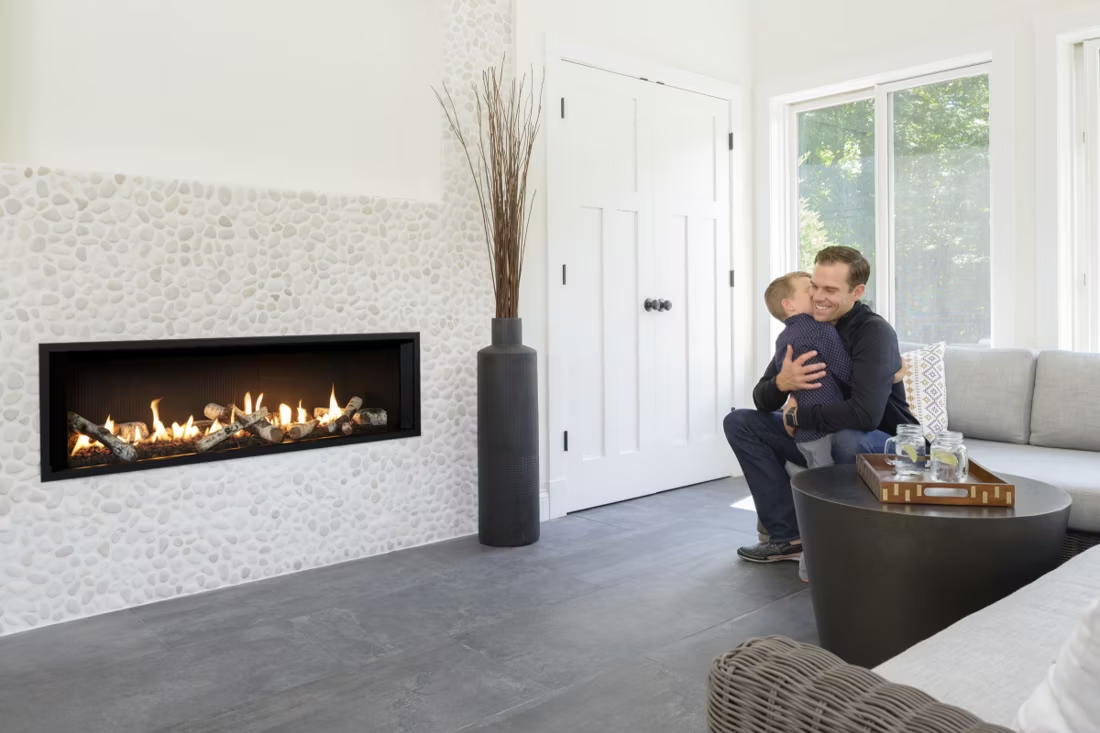
Cheval sits in climate zone 2A, where the average winter low hovers around 53°F and the entire heating season is short and mild—a fraction of what a place like Bozeman, MT logs in a single January. Wood stoves and pellet stoves have essentially no place here; the county's building patterns and daily reality just don't call for them. Gas fireplaces are a different story. In Cheval's golf-course neighborhoods and newer subdivisions, a gas fireplace or linear insert is usually installed for the look and feel of real flame—a focal point in a great room, a media wall accent, or a lanai upgrade—with genuine heat output treated as a bonus for the handful of nights each winter that dip into the 30s and 40s.
One thing shapes almost every gas project in Cheval: this part of unincorporated Hillsborough County isn't within a piped natural gas utility's footprint, so nearly every gas fireplace here runs on propane rather than piped gas. Tampa Electric and Duke Energy Florida serve the area's electric needs, but for a real-flame fireplace, homeowners work with a local propane supplier for tank setup and delivery. A trusted local dealer will know exactly how to size the tank, run the gas line, and choose a direct-vent or vent-free unit that fits Cheval's building code and your home's layout.
Three steps. No salesperson until you're ready.
Tell us about your project
Your zip code, your situation, and the fuel you're leaning toward—or let the answers point you to one.
See what's actually available
The brands dealers within 100 miles genuinely carry—real options, never a catalog mirage.
Get your dealer & Project Guide
A trusted local dealer, plus the free Project Guide & Parts List that names every component of the job.
Frequently Asked Questions
How much does a gas fireplace installation cost in Cheval?
Because Cheval falls outside the piped natural gas service area, most gas fireplace installs here are propane-fueled, and typical costs run $3,500 to $8,500. A vent-free propane insert added to an existing family room with an accessible propane tank sits at the lower end. A new direct-vent gas fireplace built into a great room or lanai—with a new propane tank installation, buried gas line, and venting—lands at the higher end. Your local dealer will quote a firm number after seeing your framing and tank situation.
Do I need natural gas, or does my gas fireplace run on propane?
In Cheval, plan on propane. Piped natural gas lines don't extend into this part of unincorporated Hillsborough County, so nearly every gas fireplace installed here—vented or vent-free—runs on propane from either a portable exchange tank or a buried residential tank. The good news is that essentially every gas fireplace on the market today is available in a propane configuration; your dealer simply sets the correct orifice and regulator for propane rather than natural gas.
Should I choose a vented or vent-free gas fireplace?
Florida's building code allows both, and in Cheval it often comes down to where the unit sits in the house. Vent-free propane units are popular for retrofits into an existing family room wall or media center, since they don't require any new venting through the roof or exterior wall. Direct-vent units cost more to install but exhaust combustion byproducts outside, which is worth it for larger rooms, bedrooms, or homes where indoor air quality is a priority. Given the humidity here, some homeowners also prefer direct-vent for its drier heat output. A local dealer will walk you through both for your specific room.
Will my gas fireplace still work if the power goes out?
For most models, yes—and that matters in a hurricane-prone part of Florida like Hillsborough County. Gas fireplaces with a standing pilot or intermittent pilot ignition (IPI) with battery backup will light and run without grid power, since the flame itself doesn't depend on electricity. The exception is fireplaces with fully electronic ignition and no battery backup, which won't light during an outage. If storm-season reliability matters to you, ask your dealer specifically about battery backup or millivolt pilot systems when choosing a unit.
What size gas fireplace do I need for a Cheval home?
Given the mild climate here—an average winter low around 53°F and a heating season that barely runs half the year—most Cheval homeowners don't need a high-BTU unit to actually heat the house. A 20,000 to 30,000 BTU direct-vent or vent-free fireplace is plenty to warm a great room on the occasional cold snap, and many homeowners choose a smaller linear or see-through model purely for its look in an open-concept living space. Oversizing for a Florida home usually just means a fireplace that runs too hot to sit near.
Do I need a permit to install a gas fireplace in Cheval?
Yes. Cheval is unincorporated, so gas fireplace installations go through the Hillsborough County Building and Construction Services Center rather than a city building department. Because propane fuel lines and gas appliances both fall under county code, you'll typically need both a building permit and a mechanical/gas permit, along with inspection of the propane tank installation if one is being added. Most local hearth dealers handle the permit filing and inspection scheduling as part of the installation.
How often should a gas fireplace be serviced in Florida's climate?
An annual inspection before the cooler months, roughly November through February, is the standard recommendation, even in a low-use climate like Cheval's. Tampa Bay's humidity can accelerate corrosion on venting components and pilot assemblies faster than it would in a drier climate, so a yearly check of the burner, gas connections, and glass seals is worth keeping on schedule even if you only light the fireplace a dozen times a winter.
Can I add a gas fireplace to an existing Cheval home, or is it easier in new construction?
Both are common in Cheval's mix of 1980s-and-90s golf-course homes and newer construction. Retrofitting a vent-free propane insert into an existing family room or media wall is usually the simplest and least invasive option, since it doesn't require new venting. Adding a direct-vent fireplace to an existing home is more involved—it usually means running new venting through an exterior wall—but it's a standard project for local installers. New construction and major remodels give you the most flexibility, including linear or see-through designs between a living room and lanai.
Gas vs. electric fireplace—which makes more sense in Cheval?
Electric fireplaces are worth serious consideration here: they need no propane tank, no gas line, and often no permit for a simple plug-in unit, and Tampa Electric and Duke Energy Florida both serve the area at competitive residential rates, around 14.7 to 16.6 cents per kWh. For homeowners who want a true flame appearance, real heat output, and the resale appeal of an actual gas hearth, propane gas fireplaces remain the more traditional choice for a primary living-room focal point. Many Cheval homeowners use electric in secondary rooms or bedrooms and reserve gas for the main gathering space.
What's the difference between an insert and a zero-clearance fireplace?
An insert is a fireplace that slides into a pre-existing wood-burning fireplace—if you don't have one, there's nothing to insert it into. A zero-clearance fireplace is built into a framed wall, which makes it the answer for remodels and new construction. Simple test: existing masonry fireplace means insert; blank or framed wall means zero-clearance.
Why is a fireplace insert so efficient?
An insert does two things: it seals the chimney completely, so you stop losing air you already paid to heat, and it radiates warmth into the room through the firebox and glass. Most add a heat-exchange fan that pulls cool room air underneath, wraps it around the hot firebox, and pushes it back out warm. Your home is more efficient before you've even lit the first fire.
How much should I budget for a fireplace?
For an average home—covering the fireplace, the vent pipe, and basic installation—a budget between $3,900 and $5,500 gives you a lot of options across wood, gas, and pellet. By the time you add finish work, gas line, and electrical, the average complete installation lands between $5,000 and $12,000 all-in. In a remodel or new build, a good rule is to put about 2.5% of the total project cost toward the fireplace.
What is an in-home preview and do I need one?
It's a visit where a hearth professional measures your space, confirms the model you picked actually works in your home, and walks the specs—framing, gas line, venting, finish work—before anything is ordered. Some details you just can't know until you see the house. Never make a down payment without one; it's the single most-skipped step that burns buyers.
Nearby Dealers
Hearth shops serving Cheval and the surrounding area. Every listing shows whether it is a WhyFire partner, a dealer we have verified as authorized for the brands we recommend, or a local business carrying hearth products. No manufacturer pays for placement. How we verify dealers →
We’ve paused dealer listings for this connection today. Enter your zip or postal code above to find dealers near you, or come back tomorrow.
Popular Gas Brands
Where each brand came from, what's inside it today, and every current model. No brand pays to be here. Not every dealer carries every brand, so enter your zip code to see what's sold near Cheval.
Kozy Heat
Kozy Heat was founded in 1976 by Dudley Hussong in Lakefield, Minnesota, and incorporated as Hussong Manufacturing Co., Inc. in 1978.
28 gas models →Fireplace Xtrordinair
Fireplace Xtrordinair, now often called FireplaceX, is the fireplace brand of Travis Industries, Inc., of Mukilteo, Washington.
25 gas models →Town & Country
Town & Country Fireplaces is the luxury gas fireplace brand of Pacific Energy Fireplace Products Ltd., of Duncan, British Columbia.
14 gas models →Lopi
Lopi is a wood, pellet, and gas stove brand founded by Kurt Rumens in Bellevue, Washington, in 1979.
7 gas models →Forge & Flame
Forge & Flame is the stove brand Hearth & Home Technologies introduced in August 2023 to bring Vermont Castings, Harman, and Quadra-Fire under one name.
6 gas models →Vermont Castings
Vermont Castings was founded in 1975 by Duncan Syme, the designer, and his brother-in-law Murray Howell, the business partner, in Randolph, Vermont.
6 gas models →Find your gas fireplace in Cheval.
Tell us a bit about your Cheval home and we'll help you find the right gas fireplace or insert, plus a free Project Guide & Parts List with the exact parts, including the vent kit, and a trusted local dealer to install it.
Find Your Fireplace →