
Add real warmth to your Camden home—no chimney required.
Zone heat and ambiance for Kent County's mild Mid-Atlantic winters, without gas lines, wood smoke, or masonry work. Find the right unit and connect with a trusted local dealer.
Every Project Starts From One of These Five Situations
Modern convenience for Mid-Atlantic winters.
Camden sits low and flat in Kent County at just 50 feet of elevation, with a climate zone 4A profile that keeps things relatively mild. Winter lows average around 28°F and the town has a winter heating season that's roughly half as demanding as what a home in Burlington, VT or Duluth, MN has to work through each winter. That's a climate where a full wood-burning or pellet setup is often more infrastructure than the weather demands, which is exactly why electric fireplaces have become a practical, popular choice here.
Camden homes are served by a mix of Delmarva Power, Delaware Electric Cooperative, and the City of Dover's municipal utility, with residential rates running roughly 14.2 to 16.4 cents per kWh depending on which provider serves your address. That rate spread matters for how you think about an electric fireplace: as a zone heater for a sunroom, converted garage, or bedroom addition, it's an efficient way to add targeted warmth without running central heat harder. Add in the fact that plug-in and built-in electric units need no venting, no gas line, and minimal structural work, and it's easy to see why they show up in older Camden homes, rentals, and additions where a masonry chimney or gas line was never in the plan.
Three steps. No salesperson until you're ready.
Tell us about your project
Your zip code, your situation, and the fuel you're leaning toward—or let the answers point you to one.
See what's actually available
The brands dealers within 100 miles genuinely carry—real options, never a catalog mirage.
Get your dealer & Project Guide
A trusted local dealer, plus the free Project Guide & Parts List that names every component of the job.
Frequently Asked Questions
How much does an electric fireplace installation cost in Camden?
Costs vary widely because electric fireplaces span a big range of product types. A plug-in freestanding or wall-mounted unit can run $200 to $800 installed, since it just needs a standard outlet. A built-in electric insert or linear electric fireplace set into a wall or existing mantel typically runs $1,500 to $3,500 once framing, trim work, and any electrical upgrades are included. If your unit needs a dedicated 20-amp circuit—common for larger linear models—budget an extra $150 to $400 for a licensed electrician to run it. Local dealers will scope this out during an in-home visit before you commit to a model.
Do electric fireplaces actually put out heat, or are they just for looks?
Most electric fireplaces sold today include a real heating element, typically 1,500 watts, which is enough to noticeably warm a single room—around 400 to 1,000 square feet depending on insulation and ceiling height. Given Camden's relatively moderate winter heating needs, an electric unit works well as the primary heat source for an addition, sunroom, or converted garage, or as a supplement to central heat in a main living area on colder nights. It won't replace whole-home heating in a larger house, but for zone heating in a mild Mid-Atlantic climate like Kent County's, it's genuinely functional, not just decorative.
Do I need a permit to install an electric fireplace in Camden?
A simple plug-in unit that runs off an existing outlet doesn't require a permit. If you're installing a built-in electric fireplace that requires new wiring or a dedicated circuit, that electrical work typically needs a permit through Kent County or the City of Camden's building code office, and should be pulled by a licensed electrician. Framing or drywall work around a built-in unit may also fall under a standard building permit. Most hearth dealers who sell built-in electric fireplaces can point you to an electrician who handles this routinely.
What's the difference between a plug-in electric fireplace and a built-in electric insert?
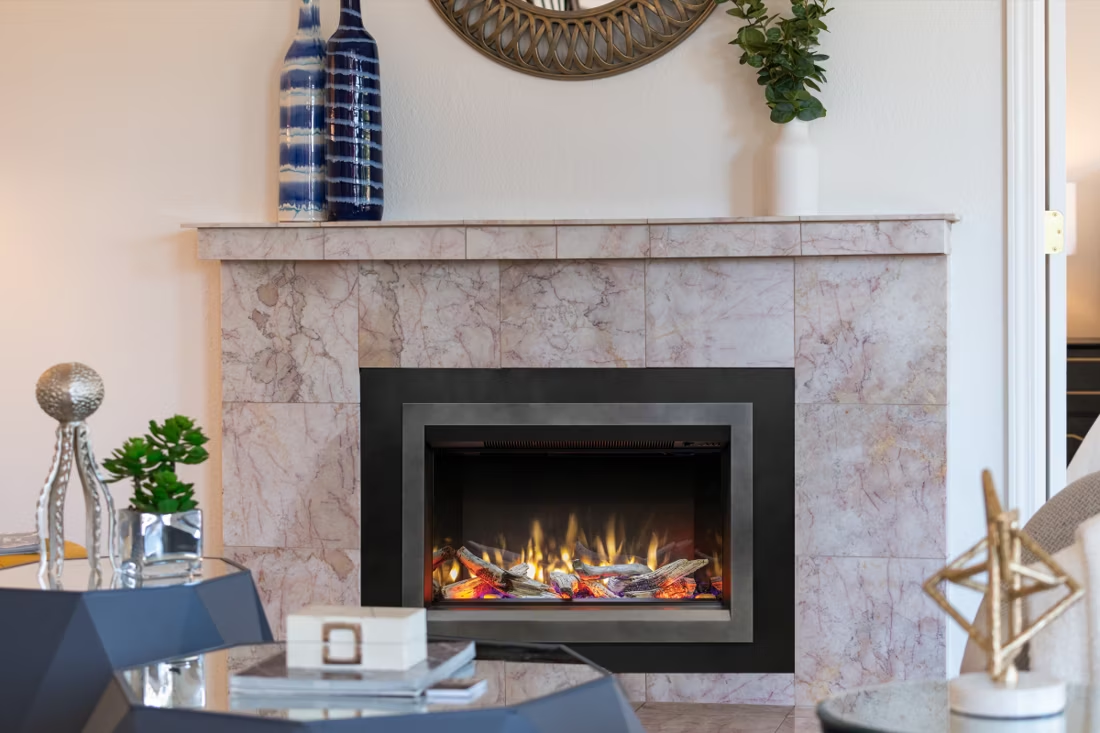
A plug-in electric fireplace is freestanding or wall-mounted, requires no modification to your home, and can be moved if you relocate. A built-in electric insert is designed to be recessed into a wall, existing masonry opening, or custom mantel surround, giving a more finished, permanent look similar to a real fireplace. For Camden homes with an old, unused wood-burning fireplace opening, an electric insert is a popular retrofit—it fills the existing opening, requires no chimney work, and can often run off a standard outlet or a simple dedicated circuit. Renters and condo owners tend to go with plug-in models since they're not modifying the structure.
What are good electric fireplace brands to look for?
Dimplex, Napoleon, and Touchstone are widely available brands with strong track records for both plug-in and built-in electric fireplaces, and local hearth dealers in the Dover-Camden area typically carry at least one of these lines. Look for models with a realistic flame effect, a thermostat rather than just high/low settings, and—if you want supplemental heat, not just ambiance—a stated heating capacity in square feet rather than just watts. A local dealer can show you the flame effect and heat output in person, which matters more with electric units than with wood or gas, since quality varies a lot between budget and mid-range models.
How much does it cost to run an electric fireplace in Camden?
At a typical 1,500-watt heat setting, running an electric fireplace costs roughly 21 to 25 cents per hour depending on whether you're billed by Delmarva Power (16.37 cents/kWh), Delaware Electric Cooperative (14.22 cents/kWh), or the City of Dover's municipal utility (15.52 cents/kWh). Run eight hours a day through a cold snap, that's about $1.70 to $2 a day—noticeably cheaper than heating an entire home with electric resistance heat, since you're only warming the room you're in. Flame-only mode with the heater off uses negligible power, so ambiance-only use costs almost nothing.
Is wood heat an option in Camden, or does everyone go electric or gas?
Wood-burning stoves and fireplaces are uncommon in Camden. The town's mild 4A climate, modest winter heating needs, and lack of nearby public forest land with cutting permit programs mean there's little of the wood-heat infrastructure you'd find in a mountain or forest region. A handful of Kent County homeowners still install wood stoves for backup heat or aesthetic reasons, but most local hearth demand splits between gas (where a gas line is available) and electric, which fits Camden's flat, suburban housing stock and milder winters without requiring a chimney or firewood supply chain.
Will my electric fireplace work during a power outage?
No—electric fireplaces are entirely dependent on grid power, so they'll shut off the moment power drops, whether your account is with Delmarva Power, Delaware Electric Cooperative, or the City of Dover. If backup heat during outages is a priority for your Camden home, a battery backup or a small generator sized to your fireplace's wattage (usually 1,500 watts) is the practical workaround, or you might consider pairing an electric unit for daily zone heat with a propane or gas appliance for emergency heat. Local dealers can talk through both approaches if outage resilience matters to your household.
Why buy an electric fireplace instead of just using a space heater?
Functionally, many electric fireplaces use the same 1,500-watt heating element as a standard space heater, so the heat output is comparable. The difference is in build quality, safety, and finish: electric fireplaces typically have cool-touch glass fronts, are UL-listed for closer clearances to combustibles, include a realistic flame effect that most freestanding space heaters lack, and are designed to be a permanent piece of furniture or built-in feature rather than something you store in a closet. For a Camden living room, bedroom, or converted space where you want both the heat and the look of a fireplace, that combination is usually worth the price difference over a bare space heater.
Does an electric fireplace need a vent or chimney?
No—that's its superpower. An electric fireplace needs a wall and an outlet, period. No vent pipe, no gas line, no clearances to design around, which is why it works in bedrooms, offices, apartments, and walls where venting a gas or wood unit would be impractical or impossible. Installation is typically the simplest and least expensive of any fireplace type.
Do electric fireplaces actually produce heat?
Yes—most put out around 4,800–5,000 BTUs from a standard outlet, which comfortably warms a bedroom, office, or den as a comfort-zone heater. What they won't do is carry a whole house the way wood, gas, or pellet can. Think of electric as ambiance-first with honest supplemental heat: flames on with no heat in July, flames plus warmth in January.
How much should I budget for a fireplace?
For an average home—covering the fireplace, the vent pipe, and basic installation—a budget between $3,900 and $5,500 gives you a lot of options across wood, gas, and pellet. By the time you add finish work, gas line, and electrical, the average complete installation lands between $5,000 and $12,000 all-in. In a remodel or new build, a good rule is to put about 2.5% of the total project cost toward the fireplace.
Does a fireplace add value to my home?
On average, a fireplace adds back to the home about the same amount you spent installing it. Add the monthly savings from heating the rooms you actually use instead of the whole house—often hundreds of dollars a year—and the value case is strong before you even count what a fire does for how your family uses the room.
Nearby Dealers
Hearth shops serving Camden and the surrounding area. Every listing shows whether it is a WhyFire partner, a dealer we have verified as authorized for the brands we recommend, or a local business carrying hearth products. No manufacturer pays for placement. How we verify dealers →
Delaware Brick
Byler's Stove Shoppe, Inc
Walls Farm & Garden Center Inc
Tri-Gas & Oil
Electric Service in Camden
An electric fireplace's heater draws about 1,500 watts—pennies per hour at local rates.
Delmarva Power
Delaware Electric Cooperative
City Of Dover - (De)
Find your electric fireplace in Camden.
Tell us about your Camden home and we'll match you with a trusted local dealer, plus a free Project Guide & Parts List with the right unit, wiring needs, and everything else specific to your space.
Find Your Fireplace →