
Warm Up Bridgeport Homes With Clean-Burning Gas Heat.
Instant, thermostat-controlled heat for Bridgeport's coastal winters—built for the city's dense mix of Victorian multi-families and newer waterfront construction. Find the right unit and connect with a trusted local dealer.
Every Project Starts From One of These Five Situations
Instant heat for Connecticut's largest city.
Bridgeport sits at just 23 feet above sea level on Long Island Sound, and the moderating coastal effect keeps winters milder than inland Connecticut—a moderate heating season with average lows near 24°F. But mild by New England standards still means real winter, and the Greater Bridgeport area's housing stock (a dense patchwork of century-old Victorians and multi-families in neighborhoods like the East Side and Black Rock, plus newer construction near Steelpointe Harbor) leans heavily on gas for both primary and supplemental heat rather than cordwood. Many of those older homes still have a decorative masonry fireplace built for oak, maple, or birch, but with nearly 910,000 people across the metro area living close together, cutting and storing firewood simply isn't practical the way it is in rural Connecticut.
That's a big part of why gas has become the default upgrade for Bridgeport's unused fireplaces—a direct-vent insert turns a drafty, rarely-used hearth into real, controllable heat without any wood handling or venting redesign in a tight urban lot. It also pairs well with the reality of local electric rates: United Illuminating, which serves the city proper, charges residential customers roughly $0.31 per kWh, and Connecticut Light & Power (Eversource) customers in the surrounding Greater Bridgeport towns pay around $0.25—both well above the national average. A gas fireplace zone-heating the room you actually live in can meaningfully offset those electric heating costs.
Three steps. No salesperson until you're ready.
Tell us about your project
Your zip code, your situation, and the fuel you're leaning toward—or let the answers point you to one.
See what's actually available
The brands dealers within 100 miles genuinely carry—real options, never a catalog mirage.
Get your dealer & Project Guide
A trusted local dealer, plus the free Project Guide & Parts List that names every component of the job.
Frequently Asked Questions
How much does a gas fireplace installation cost in Bridgeport?
Most Bridgeport-area gas fireplace projects run between roughly $4,000 and $10,000. A direct-vent gas insert dropped into an existing masonry fireplace—common in the city's Victorian and colonial-era housing—sits toward the lower end, especially if a gas line already reaches the house for a range or water heater. New direct-vent gas fireplaces built into a wall for a renovation, or installations in homes without existing gas service that need a new line run from the street, land toward the higher end. A local hearth dealer will give you a firm number after seeing your chimney and gas service situation in person.
I have an old fireplace that just sits there—can it be converted to gas?
Yes, and it's one of the most common calls local dealers get in Bridgeport. Much of the city's housing stock was built with a masonry fireplace that hasn't burned real wood in decades, if ever functionally. A gas insert slides into that opening, uses your existing chimney as the vent path with a stainless liner, and turns a decorative feature into a real heat source you control with a remote or wall switch. Costs typically run $4,500 to $9,000 depending on the insert and whether the flue needs relining. It's a popular renovation project in the East Side and Black Rock's older housing stock in particular.
Do I need natural gas service, or is propane an option in Bridgeport?
Both work. Bridgeport's urban core, along with much of the surrounding Greater Bridgeport region, has natural gas mains already in the ground, so if your home already has gas for cooking or water heating, adding a fireplace usually just means a branch line to the new appliance. In outlying pockets of the metro area where gas mains don't reach, propane is the standard fallback, with a tank installed on the property by a local propane supplier. Nearly every gas fireplace on the market can be set up for either fuel—your installer configures the correct orifice and regulator for whichever you have.
Will my gas fireplace still work if the power goes out?
Bridgeport sits right on Long Island Sound and takes its share of nor'easters and coastal storms that knock out United Illuminating and Eversource service for stretches at a time. Most modern gas fireplaces with intermittent pilot ignition (IPI) include a battery backup that keeps the unit firing on demand during an outage—just make sure the batteries in the unit are fresh going into storm season. Valor fireplaces go a step further: their pilot assembly generates its own electricity through the thermocouple, so there's no battery to remember at all. For a coastal city where outages can stretch for days, that's a meaningful difference worth asking your local dealer about.
What's the difference between a gas fireplace, insert, and stove for my Bridgeport home?
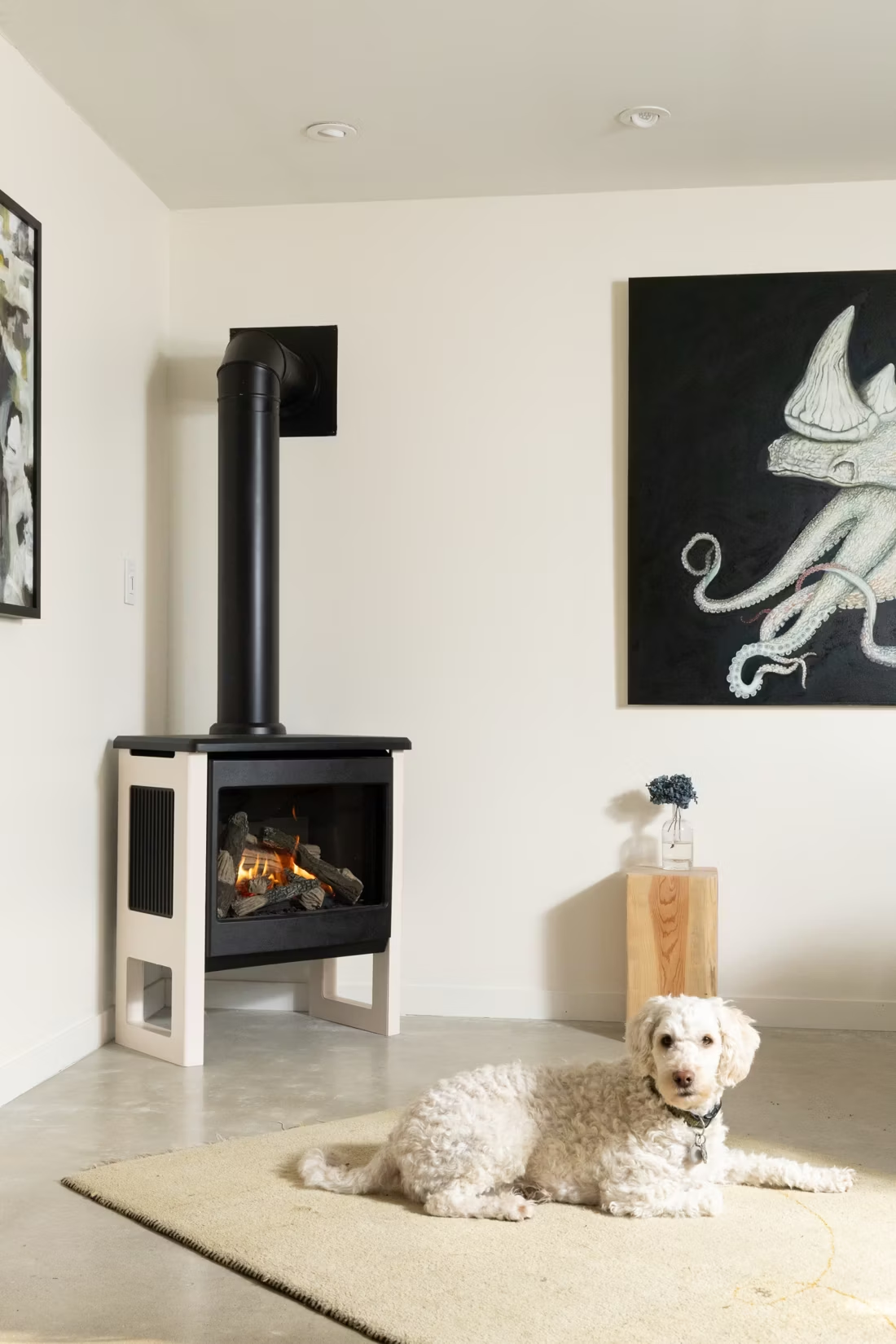
A gas fireplace is a fully built-in unit framed into a wall—the right call for new construction near the waterfront redevelopment or a full renovation. A gas insert is sized to slide into an existing masonry firebox, which fits the vast majority of Bridgeport's older Victorian and multi-family housing where a fireplace already exists but rarely gets used. A gas stove is freestanding, sits on its own hearth pad, and can go almost anywhere with the right clearances—useful in homes without an existing fireplace opening at all. For most Bridgeport homeowners working with an existing hearth, an insert is the straightforward answer.
Do I need a permit to install a gas fireplace in Bridgeport?
Yes—the City of Bridgeport requires a building permit for the fireplace installation and a separate gas permit for the fuel line work, and the gas piping itself must be run by a licensed gas fitter. Most established hearth dealers handle both permits as part of the installation and schedule the required inspections, so homeowners typically don't have to navigate the permitting process themselves. This is one of the clearest reasons to avoid a big-box or unlicensed install—gas line work done without permits and inspection is a real safety and insurance liability.
Should I get a vented or vent-free gas fireplace in Bridgeport?
Vented (direct-vent) units draw combustion air from outside and exhaust exhaust gases back outside through a sealed pipe—they're the safest option and the one most local installers recommend by default. Vent-free units burn without any outside venting and are legal in Connecticut within strict room-size and ventilation limits, but they release moisture and combustion byproducts into the living space. Given how much of Bridgeport's housing stock is older multi-family construction with shared walls and limited airflow between units, direct-vent is generally the better fit—it delivers strong heat output without any indoor air quality tradeoffs. Ask your dealer to walk through both if you're deciding.
How often does a gas fireplace need to be serviced?
Plan on an annual inspection, ideally before the heating season ramps up in the fall. A qualified technician checks the burner, pilot assembly, venting, and gas connections, and cleans the glass and interior components. This is a much lighter lift than wood-stove chimney sweeping, but it's just as important—a neglected pilot or ignition system is the most common reason a gas fireplace stops working right when you need it most. Local gas appliance service providers typically charge $150 to $250 for a standard annual visit.
Gas vs. electric fireplace—which makes more sense in Bridgeport?
Electric fireplaces cost far less to install—often under $1,000, with no venting or gas line required—which makes them attractive for condos and apartments common throughout the city. But at United Illuminating's roughly $0.31 per kWh rate (or Eversource's $0.25 in the surrounding Greater Bridgeport towns), running an electric unit as real supplemental heat gets expensive fast, and electric heat output tops out lower than gas. A gas insert or fireplace costs more upfront but delivers stronger, cheaper-to-run heat over a Connecticut winter, and it keeps working during a power outage if it has battery or millivolt ignition. For a room you actually plan to heat regularly, gas is usually the better long-term value; for ambiance in a rental or a room where installing gas isn't practical, electric is a reasonable choice.
Why is a fireplace insert so efficient?
An insert does two things: it seals the chimney completely, so you stop losing air you already paid to heat, and it radiates warmth into the room through the firebox and glass. Most add a heat-exchange fan that pulls cool room air underneath, wraps it around the hot firebox, and pushes it back out warm. Your home is more efficient before you've even lit the first fire.
Can I put a TV above my fireplace?
Yes—with an asterisk. Fireplaces are hot and TVs don't like heat. Either put a mantel between them to deflect rising warmth, or choose a fireplace with heat-management technology that creates a cool zone on the wall above—the wall stays around 125 degrees, barely warm, while the room still gets full heat. If you like clean lines and don't want a mantel, heat management is the answer.
How much should I budget for a fireplace?
For an average home—covering the fireplace, the vent pipe, and basic installation—a budget between $3,900 and $5,500 gives you a lot of options across wood, gas, and pellet. By the time you add finish work, gas line, and electrical, the average complete installation lands between $5,000 and $12,000 all-in. In a remodel or new build, a good rule is to put about 2.5% of the total project cost toward the fireplace.
Can a fireplace actually lower my heating bill?
Yes—by creating a comfort zone. A furnace heats every square foot of the house just to warm the one room you're in; a gas fireplace on low burns roughly a sixth of the gas a typical furnace does. Set the furnace around 55–60 degrees as a baseline, then heat the rooms your family actually uses. Families who heat this way commonly save $20–$60 a month.
Nearby Dealers
Hearth shops serving Bridgeport and the surrounding area. Every listing shows whether it is a WhyFire partner, a dealer we have verified as authorized for the brands we recommend, or a local business carrying hearth products. No manufacturer pays for placement. How we verify dealers →
Hearth Products, LLC
Best In Backyards
Hocon Gas Of Norwalk
New Haven Masonry
Leahy’s Metered Gas Service
Black Swan Fireside Hearth & Home
Nordic Stove And Fireplace Center
Fireplace Surplus
Costello's Hearth & Spa - Smithtown
Find your gas fireplace in Bridgeport.
Tell us a bit about your home and we'll put together a free Project Guide & Parts List—the right gas fireplace or insert, the exact venting parts your Bridgeport home needs, and a trusted local dealer to install it.
Find Your Fireplace →