
Dependable heat for Thornton's Front Range winters.
Instant, reliable heat for a fast-growing Denver-metro suburb where winter lows average 19°F. Find the right gas fireplace or insert and connect with a trusted local dealer.
Every Project Starts From One of These Five Situations
New homes, new rules—gas is the default.
Thornton sits at 5,209 feet on the northern edge of the Denver metro, in climate zone 5B with a solid winter heating season and average winter lows around 19°F—cold enough for a real heating season, though not as brutal as Minneapolis or Fargo. As one of Colorado's fastest-growing cities, most of Thornton's housing stock is newer construction, and that matters for fuel choice: the Denver metro's winter inversions trap wood smoke low in the valley, and many subdivisions and HOAs built in the last two decades simply don't permit new wood-burning fireplaces. Gas filled that gap and became the standard hearth appliance here.
Public Service Company of Colorado—Xcel Energy's Colorado utility—provides both natural gas and electric service across nearly all of Thornton's zip codes, from the core 80229 and 80233 areas out to the newer 80602 and 80023 growth corridors. That means gas line access is rarely the limiting factor. What does require attention is elevation: at 5,209 feet, gas appliances need altitude-rated components to burn correctly, which is one more reason to work with a dealer who installs at Front Range elevations every week rather than a big-box crew unfamiliar with the adjustment.
Three steps. No salesperson until you're ready.
Tell us about your project
Your zip code, your situation, and the fuel you're leaning toward—or let the answers point you to one.
See what's actually available
The brands dealers within 100 miles genuinely carry—real options, never a catalog mirage.
Get your dealer & Project Guide
A trusted local dealer, plus the free Project Guide & Parts List that names every component of the job.
Frequently Asked Questions
How much does a gas fireplace installation cost in Thornton?
Most gas fireplace and insert installations in Thornton run $3,800 to $9,500, depending on the unit, the venting path, and whether new gas line work is needed. A direct-vent insert going into an existing masonry fireplace with gas already run to that wall lands on the lower end. New construction or a remodel that requires framing, a new gas line from the meter, and full venting sits toward the middle to upper end. Because Thornton sits above 5,000 feet, budget for a high-altitude conversion kit as well—most dealers include it in the quote, but it's worth confirming up front.
Does Thornton's elevation affect how a gas fireplace performs?
Yes. Thornton sits at roughly 5,209 feet, and manufacturers rate BTU output and flame characteristics at sea level. Above about 4,500 feet, most gas fireplaces need a factory high-altitude orifice kit or a field conversion to maintain proper combustion, flame height, and efficiency—running an uncorrected unit at this elevation can mean a weak flame, incomplete combustion, or a fireplace that never quite performs like the showroom model. A local dealer who regularly installs along the Front Range will already stock the correct altitude-rated parts for your specific model rather than special-ordering them after the fact.
Can I convert an old wood-burning fireplace to gas in Thornton?
In many cases, yes, and it's one of the more common projects local dealers see. Some Thornton homes built before the newer subdivisions went up still have a traditional masonry wood fireplace, but wood-burning appliances are increasingly restricted here—the Denver metro issues winter inversion burn advisories, and most newer HOAs and building codes across Thornton no longer allow new wood installations. Converting to a gas insert typically runs $4,000 to $8,500, using your existing chimney with a stainless liner. If you specifically want wood heat, cutting permits are available through the Arapaho-Roosevelt National Forest in the foothills west of town ($5-$20 per cord, May-October season), but that's a drive into the mountains, not a Thornton hearth conversion.
Is natural gas available everywhere in Thornton, or do some homes need propane?
Public Service Company of Colorado (Xcel Energy) serves natural gas across nearly all of Thornton, including the established 80229, 80233, and 80241 zip codes and most of the newer growth areas like 80023 and 80602. If your address already has a gas water heater, furnace, or range, adding a fireplace is usually a straightforward tap into existing service. A small number of properties in the outer edges of the 80614 and 80602 zips near unincorporated Adams County may sit beyond the gas main and rely on propane instead—your dealer can confirm gas availability at your specific address before you buy.
Will my gas fireplace still work if the power goes out?
Most direct-vent gas fireplaces with IPI (intermittent pilot ignition) run on a battery backup—typically standard AA batteries inside the unit—so they'll still light and operate even if Xcel Energy's grid drops during a Front Range windstorm or winter outage. Valor fireplaces take a slightly different approach: their pilot assembly generates its own electricity through the thermocouple, so there's no battery to remember at all. Given how far Thornton's wind events can knock out power along the northern metro, it's worth asking your dealer about the ignition system on any unit you're considering.
What's the difference between a gas fireplace, gas insert, and gas stove?
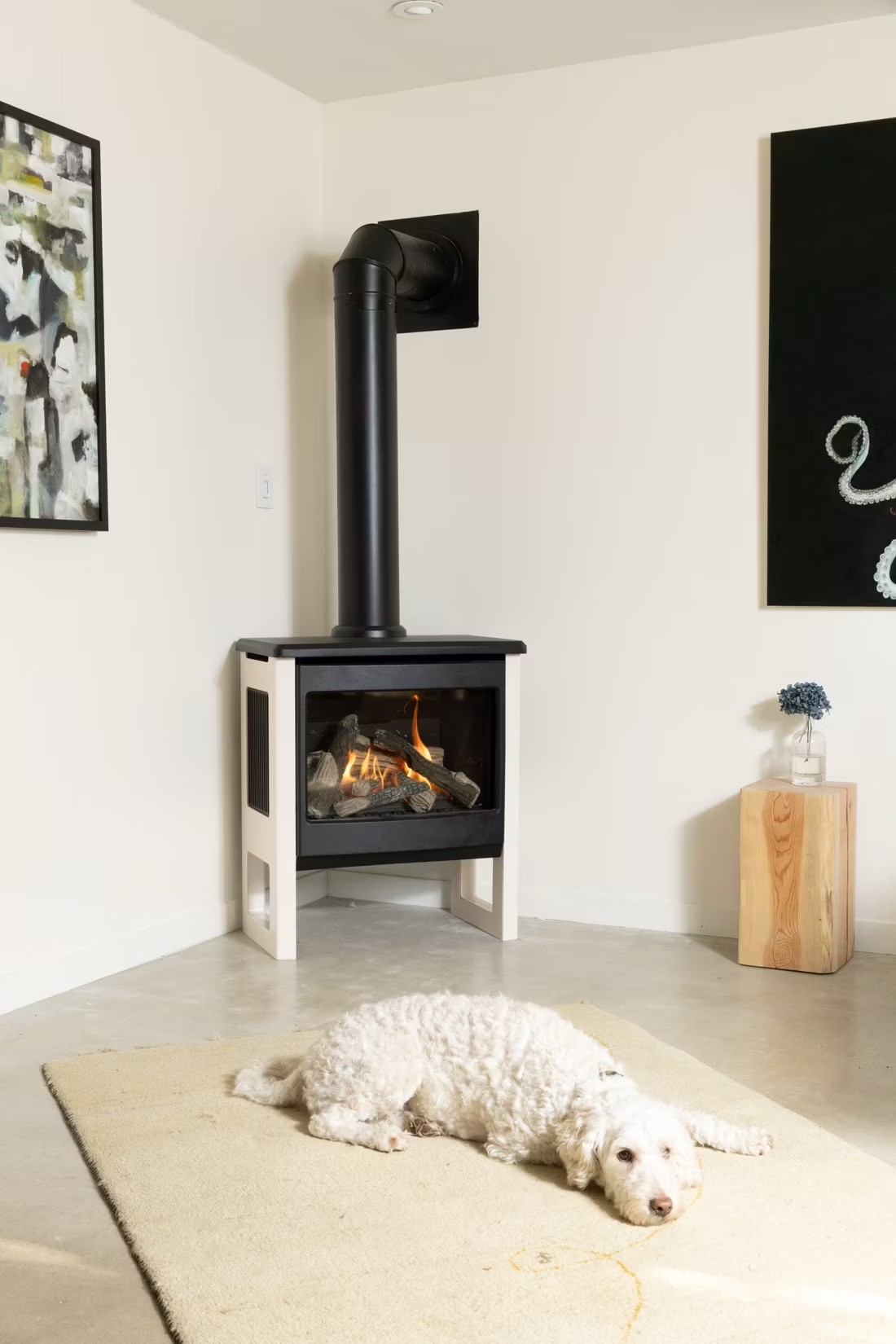
A gas fireplace is a fully built-in, zero-clearance unit framed into a wall—the right choice for new construction or a remodel without an existing fireplace, which describes a lot of Thornton's newer homes. A gas insert slides into an existing masonry firebox and uses the current chimney as its vent path, which suits Thornton's older housing stock along the 80229 corridor. A gas stove is a freestanding, cast-iron-look unit that sits on the floor and can go almost anywhere with proper clearance, often used in basements or additions. Most Thornton homeowners upgrading an existing fireplace choose an insert; those building new or finishing a basement usually go with a built-in unit or freestanding stove.
Do I need a permit to install a gas fireplace in Thornton?
Yes. Properties within city limits need a building permit and a gas permit through the City of Thornton Building Division, and the gas line work has to be done by a licensed gas fitter. A handful of Thornton-area zip codes stretch into unincorporated Adams County, where permitting instead runs through the Adams County Building Safety Division. Most established hearth dealers handle the permit filing and inspection scheduling as part of the install, along with confirming the high-altitude kit meets code for Thornton's elevation.
Should I get a vented or vent-free gas fireplace in Thornton?
Vented (direct-vent) gas fireplaces pull combustion air from outside and exhaust it back outside through sealed venting, which is the standard, code-friendly choice across Colorado. Vent-free units burn directly into the room air and are legal in Colorado, but they come with strict room-size and oxygen-depletion-sensor requirements—and those sensors are calibrated differently at altitude, so a unit that reads fine at sea level may shut down more often at Thornton's 5,209 feet. Combined with the Denver metro's winter inversion pattern, which already keeps outdoor air quality on the radar in this area, most local dealers steer homeowners toward direct-vent units for both performance and indoor air quality reasons.
Gas vs. wood vs. electric—what actually makes sense for a Thornton home?
Wood-burning fireplaces are largely off the table for new installations here—winter inversion advisories across the Denver metro restrict burning on high-pollution days, and most of Thornton's newer subdivisions and HOAs don't permit new wood units at all. That leaves gas and electric as the real comparison. Gas delivers genuine radiant heat, typically 25,000 to 40,000 BTU depending on the unit, and with the right ignition system can keep running through a power outage—a real consideration given how often Front Range wind events knock out Xcel Energy service. Electric fireplaces install for a few hundred to around $1,500, need no venting or gas line at all, and are simple to add to a bedroom or basement, but they produce far less actual heat and go dark the moment the grid does. For a primary heat source in a climate averaging 19°F winter lows, gas is the more practical choice for most Thornton homes; electric works well as a secondary, low-commitment accent elsewhere in the house.
Why is a fireplace insert so efficient?
An insert does two things: it seals the chimney completely, so you stop losing air you already paid to heat, and it radiates warmth into the room through the firebox and glass. Most add a heat-exchange fan that pulls cool room air underneath, wraps it around the hot firebox, and pushes it back out warm. Your home is more efficient before you've even lit the first fire.
What's the difference between an insert and a zero-clearance fireplace?
An insert is a fireplace that slides into a pre-existing wood-burning fireplace—if you don't have one, there's nothing to insert it into. A zero-clearance fireplace is built into a framed wall, which makes it the answer for remodels and new construction. Simple test: existing masonry fireplace means insert; blank or framed wall means zero-clearance.
Does a fireplace add value to my home?
On average, a fireplace adds back to the home about the same amount you spent installing it. Add the monthly savings from heating the rooms you actually use instead of the whole house—often hundreds of dollars a year—and the value case is strong before you even count what a fire does for how your family uses the room.
What is an in-home preview and do I need one?
It's a visit where a hearth professional measures your space, confirms the model you picked actually works in your home, and walks the specs—framing, gas line, venting, finish work—before anything is ordered. Some details you just can't know until you see the house. Never make a down payment without one; it's the single most-skipped step that burns buyers.
Nearby Dealers
Hearth shops serving Thornton and the surrounding area. Every listing shows whether it is a WhyFire partner, a dealer we have verified as authorized for the brands we recommend, or a local business carrying hearth products. No manufacturer pays for placement. How we verify dealers →
Spa Brokers
Rio Grande Co.
Distinctive Mantel Designs
Spa Brokers
Fireplace And Grill Experts - Service Only
Paramount Remodeling Co
Aria Custom Design
Spa Brokers (Corporate)
Spa Brokers V
Outdoor Kitchen Dist. Inc
Proud Souls Barbecue & Provisions
Spa Brokers
Find your gas fireplace in Thornton.
Tell us about your home and we'll put together a free Project Guide & Parts List—sized correctly for Thornton's elevation—and match you with a trusted local dealer who can install it right.
Find Your Fireplace →