
Warm up the Grand Valley without the smoke.
Clean, on-demand heat for Grand Junction homes, sized correctly for our elevation and connected to a trusted local dealer.
Every Project Starts From One of These Five Situations
Reliable heat that skips the woodpile.
Grand Junction sits at roughly 4,650 feet in the Grand Valley, hemmed in by the Grand Mesa, the Bookcliffs, and the Colorado River. Winters here bring average lows around 19°F and a solid, moderate heating season—cold enough to matter, but nowhere near the brutal stretch you'd see in a place like Bozeman, Montana. Mesa County has a long history of burning pinyon, juniper, aspen, and ponderosa pine cut from the Grand Mesa-Uncompahgre-Gunnison and White River National Forests, but late-summer wildfire smoke has become a recurring air quality concern in the valley, and it's pushed a growing number of homeowners toward gas as a cleaner, curtailment-free alternative for daily use.
Black Hills Energy provides natural gas service through most of the Grand Junction city limits and the surrounding Clifton and Fruita corridor; homes further out in rural Mesa County—around De Beque, Whitewater, or the Glade Park mesa—more commonly run on propane. One detail that trips up out-of-town installers: at 4,651 feet, gas appliances need altitude-derated orifices and regulator adjustments to burn correctly, and manufacturers require it. A trusted local dealer already knows the Mesa County inspection process, sizes the venting for our elevation, and pulls the right permits—no big-box guesswork on a detail that actually affects how your fireplace performs.
Three steps. No salesperson until you're ready.
Tell us about your project
Your zip code, your situation, and the fuel you're leaning toward—or let the answers point you to one.
See what's actually available
The brands dealers within 100 miles genuinely carry—real options, never a catalog mirage.
Get your dealer & Project Guide
A trusted local dealer, plus the free Project Guide & Parts List that names every component of the job.
Frequently Asked Questions
How much does a gas fireplace installation cost in Grand Junction?
Local dealers typically quote $4,500 to $10,500 for a gas fireplace installation in Grand Junction, with the spread driven by whether you're installing a direct-vent insert into an existing masonry fireplace (lower end) or a new built-in unit that requires framing, a fresh gas line run, and roof or wall penetration for venting (higher end). Because Grand Junction sits above 4,500 feet, expect your installer to also account for altitude-derated orifices and regulator settings—most reputable dealers build that into the quote rather than surprising you after the fact.
Can I convert my existing wood fireplace to gas?
Yes, and it's a common project in older Grand Junction neighborhoods like the Redlands and Orchard Mesa where many homes still have their original masonry fireplace. A gas insert is fitted into the existing firebox with a stainless liner run up the chimney for venting, which keeps the exterior look of the fireplace while eliminating ash and the need to haul in pinyon or juniper rounds each winter. Homes already on a Black Hills Energy natural gas line are usually the cheapest conversions; homes relying on propane need a tank in place first, which adds to the timeline.
Do I need natural gas, or can I run a fireplace on propane?
Either works, and most gas fireplace models can be configured for one or the other. Inside Grand Junction proper, Black Hills Energy's distribution network covers most neighborhoods, so if your home already has a gas water heater or furnace, tying in a fireplace is usually straightforward. Out toward the mesa tops, De Beque, or other unincorporated parts of Mesa County where the gas main doesn't reach, propane is the standard, either from an existing tank or a new one set by a local propane supplier.
Will my gas fireplace still work if the power goes out?
Most direct-vent gas fireplaces with intermittent pilot ignition (IPI) include a battery backup—typically a set of AA batteries in the control compartment—that keeps the unit firing normally when Grand Valley Power or Xcel service drops. It's worth checking those batteries every fall before heating season. A handful of brands, including Valor, skip batteries entirely and generate their own current off the pilot's thermocouple, so the fireplace works during an outage indefinitely. With winter storms occasionally knocking out power along the I-70 corridor, that's a detail worth asking your local dealer about.
What's the difference between a gas fireplace, insert, and stove?
A gas fireplace is a fully built-in unit framed into a wall, typically chosen for new construction or a remodel. A gas insert drops into an existing masonry firebox and uses the current chimney as its vent path, which is the more common route for the older housing stock around downtown Grand Junction and the Redlands. A gas stove is a freestanding cabinet-style unit that vents through a wall or existing flue without needing a built-in enclosure—a good fit for homes without a fireplace at all. Your local dealer can tell you within minutes which category fits your floor plan.
Do I need a permit to install a gas fireplace in Grand Junction?
Yes. New gas fireplace installations inside city limits require a building permit and a separate gas piping permit through the City of Grand Junction Building Department; unincorporated Mesa County addresses go through the Mesa County Building Department instead. Both require the gas line work to be done by a licensed gas fitter and typically call for a rough-in inspection before drywall goes back up and a final inspection after. Most established hearth dealers coordinate all of this as part of the install, so you're not stuck scheduling separate trades and inspections yourself.
Should I choose a vented or vent-free gas fireplace at this altitude?
Vented (direct-vent) units draw combustion air from outside and exhaust it back outside through a sealed pipe—they're the standard choice in Grand Junction and work reliably at any elevation. Vent-free models burn directly into the room and are legal in Colorado, but manufacturers derate their BTU output above 4,500 feet, which describes essentially all of Grand Junction, so a vent-free unit rated for sea level won't perform the same here and needs a properly sized replacement or adjustment. Given that derating and the added indoor air quality considerations, most local dealers steer Grand Valley customers toward direct-vent units, especially in bedrooms or smaller rooms where vent-free sizing rules get restrictive.
How often should a gas fireplace be serviced in Grand Junction?
Plan on an annual inspection, ideally in late summer before wildfire smoke season and the first cold snap hit the valley. A technician checks the burner, pilot assembly, venting, and gas connections, and cleans the glass and interior—a lighter job than wood chimney sweeping but still important, since a decade of Grand Junction's dusty, dry summers can work grit into components faster than in wetter climates. Local gas appliance service providers typically charge $150 to $250 for a standard annual visit.
Gas or wood—which makes more sense for a Grand Junction home?
Wood still has a following here thanks to cheap Forest Service cutting permits—$5 to $20 per cord through the Grand Mesa-Uncompahgre-Gunnison and White River National Forests—and the abundance of pinyon, juniper, aspen, and ponderosa pine in the surrounding hills. But wood smoke compounds the wildfire smoke problem the valley already deals with most late summers, and gas avoids that entirely while delivering instant, consistent heat with none of the ash or stacking. For a primary living space where you want reliable daily heat without adding to inversion-season air quality, gas is usually the better call; for a cabin on the mesa or a backup heat source during outages, wood still holds real appeal. Plenty of Grand Junction homes end up with both.
Can I put a TV above my fireplace?
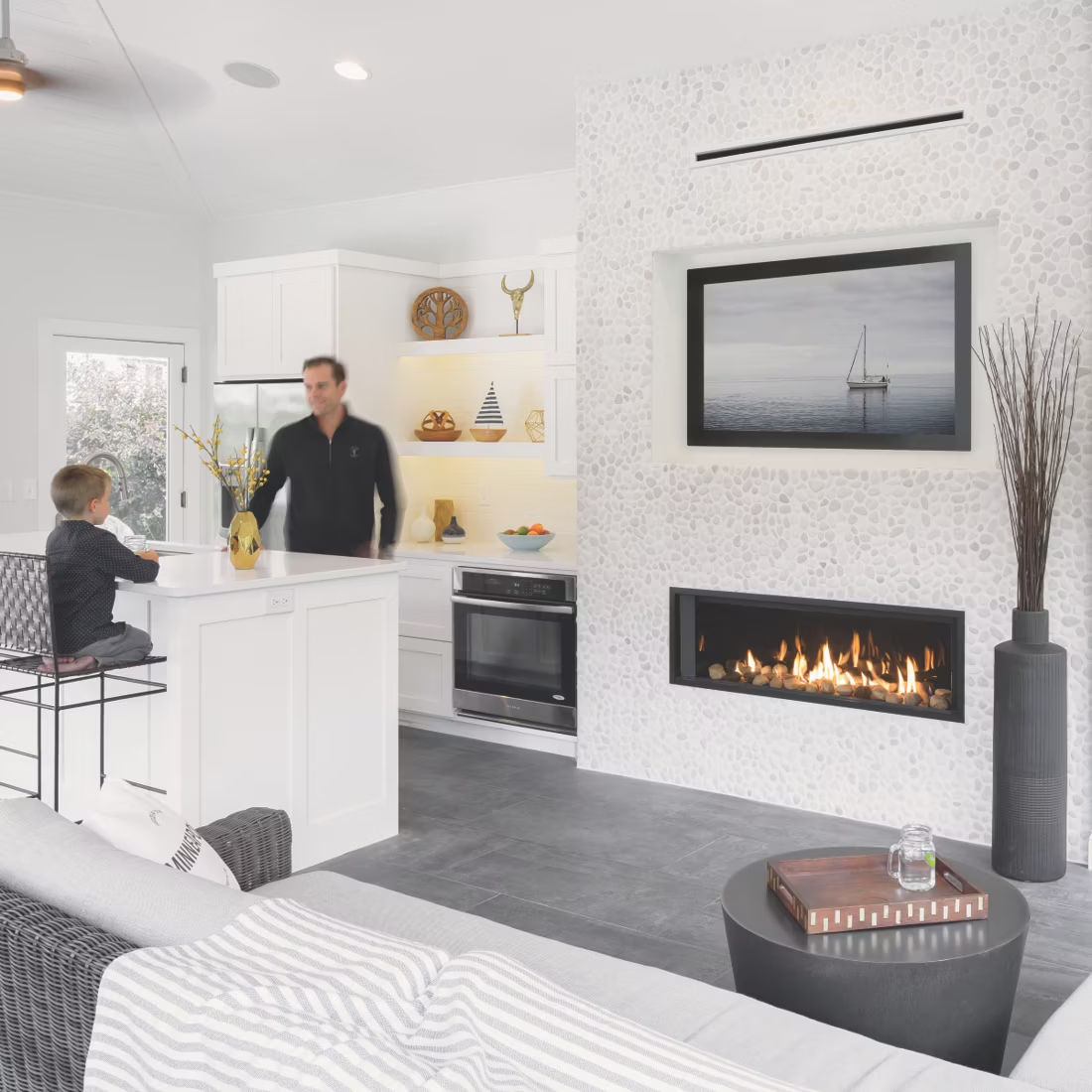
Yes—with an asterisk. Fireplaces are hot and TVs don't like heat. Either put a mantel between them to deflect rising warmth, or choose a fireplace with heat-management technology that creates a cool zone on the wall above—the wall stays around 125 degrees, barely warm, while the room still gets full heat. If you like clean lines and don't want a mantel, heat management is the answer.
Is my gas fireplace wasting gas?
If it was installed more than 15 years ago, probably. Older gas fireplaces keep a standing pilot light burning all the time, and that little flame can cost a couple hundred dollars a year. Newer models use pilot-on-demand ignition—the pilot lights only when you use the fireplace and goes out when you turn it off.
Can a fireplace actually lower my heating bill?
Yes—by creating a comfort zone. A furnace heats every square foot of the house just to warm the one room you're in; a gas fireplace on low burns roughly a sixth of the gas a typical furnace does. Set the furnace around 55–60 degrees as a baseline, then heat the rooms your family actually uses. Families who heat this way commonly save $20–$60 a month.
Does a fireplace add value to my home?
On average, a fireplace adds back to the home about the same amount you spent installing it. Add the monthly savings from heating the rooms you actually use instead of the whole house—often hundreds of dollars a year—and the value case is strong before you even count what a fire does for how your family uses the room.
Nearby Dealers
Hearth shops serving Grand Junction and the surrounding area.
Find your gas fireplace in Grand Junction.
Tell us about your home and we'll match you with a trusted local dealer and a free Project Guide & Parts List—sized correctly for Grand Junction's elevation, with the vent kit and parts spelled out.
Find Your Fireplace →