
Reliable heat for a town that logs an eight-plus-month heating season each year.
At 7,926 feet with winter lows averaging 10°F, Aspen sits in climate zone 7—territory that rivals International Falls, Minnesota for sheer heating demand. We'll help you find a trusted local dealer who understands altitude-rated equipment and what's actually installable in Pitkin County.
Every Project Starts From One of These Five Situations
Instant heat for a mountain town that earns every one of its long, cold winters.
Aspen's elevation and climate zone 7 rating put it among the coldest incorporated towns in the Lower 48—an eight-plus-month heating season means furnaces and fireplaces here run longer and harder than almost anywhere else gas service reaches. Wood heat has deep roots in this valley, with ponderosa pine, aspen, pinyon, and juniper cut under permits from White River National Forest and the Grand Mesa-Uncompahgre-Gunnison National Forest at $5 to $20 a cord, but a lot of homeowners—particularly in condos, remodels, and newer construction up the valley—want heat that starts at the flip of a switch rather than a trip to split and stack wood at altitude.
Because Aspen's utility footprint leans on City of Aspen electric service rather than a widespread municipal natural gas network, many homes here run on propane for fireplace service, with tank placement and line runs becoming a real part of the installation conversation rather than an afterthought. Either fuel path gets you a sealed, direct-vent unit, and at 7,926 feet that detail matters more than usual: gas appliances need to be rated or adjusted for high-altitude combustion, something a generic big-box fireplace often isn't configured for out of the box. A local installer who works this valley routinely will already know which models ship altitude-correct and which need field adjustment.
Three steps. No salesperson until you're ready.
Tell us about your project
Your zip code, your situation, and the fuel you're leaning toward—or let the answers point you to one.
See what's actually available
The brands dealers within 100 miles genuinely carry—real options, never a catalog mirage.
Get your dealer & Project Guide
A trusted local dealer, plus the free Project Guide & Parts List that names every component of the job.
Frequently Asked Questions
How much does a gas fireplace installation cost in Aspen?
Expect install costs toward the higher end of what you'd see in a typical Colorado mountain town—Aspen's labor rates and remote-valley logistics add to the baseline cost of material and appliance. A straightforward propane insert into an existing masonry opening runs less than a full new-construction unit requiring a fresh propane tank set, buried line run, and through-wall venting. Altitude-rated or field-adjusted appliances also factor into the quote, since standard sea-level units often need conversion kits or orifice changes to burn correctly at 7,926 feet. Get a firm number from a local dealer who's installed at this elevation before—it's not a line item every out-of-area installer handles correctly.
Is my home on natural gas or propane in Aspen?
Most homes in Aspen and the surrounding Pitkin County valley run on propane rather than piped natural gas, since the town's utility infrastructure centers on City of Aspen electric service. If you're not sure what your home already uses, check your water heater or range—if those run on propane, your fireplace install is a straightforward tie-in or tank addition. If you're building new or doing a major remodel, your dealer can help you size a propane tank appropriately for a fireplace that may run several hours a day through a heating season this long.
Can I convert an existing wood fireplace to gas in Aspen?
Yes, and it's common in older homes around the West End and downtown core that were originally built with masonry fireboxes for burning local aspen, ponderosa pine, or pinyon. A propane insert with a stainless liner run through the existing chimney is usually the cleanest retrofit, and it eliminates the need to haul and split wood at altitude—a real consideration once winter makes even short outdoor tasks harder. If you're also dealing with wildfire smoke concerns during fall fire season, converting to gas removes one more source of particulate from your own chimney during those stretches.
Will a gas fireplace still work during a power outage in Aspen?
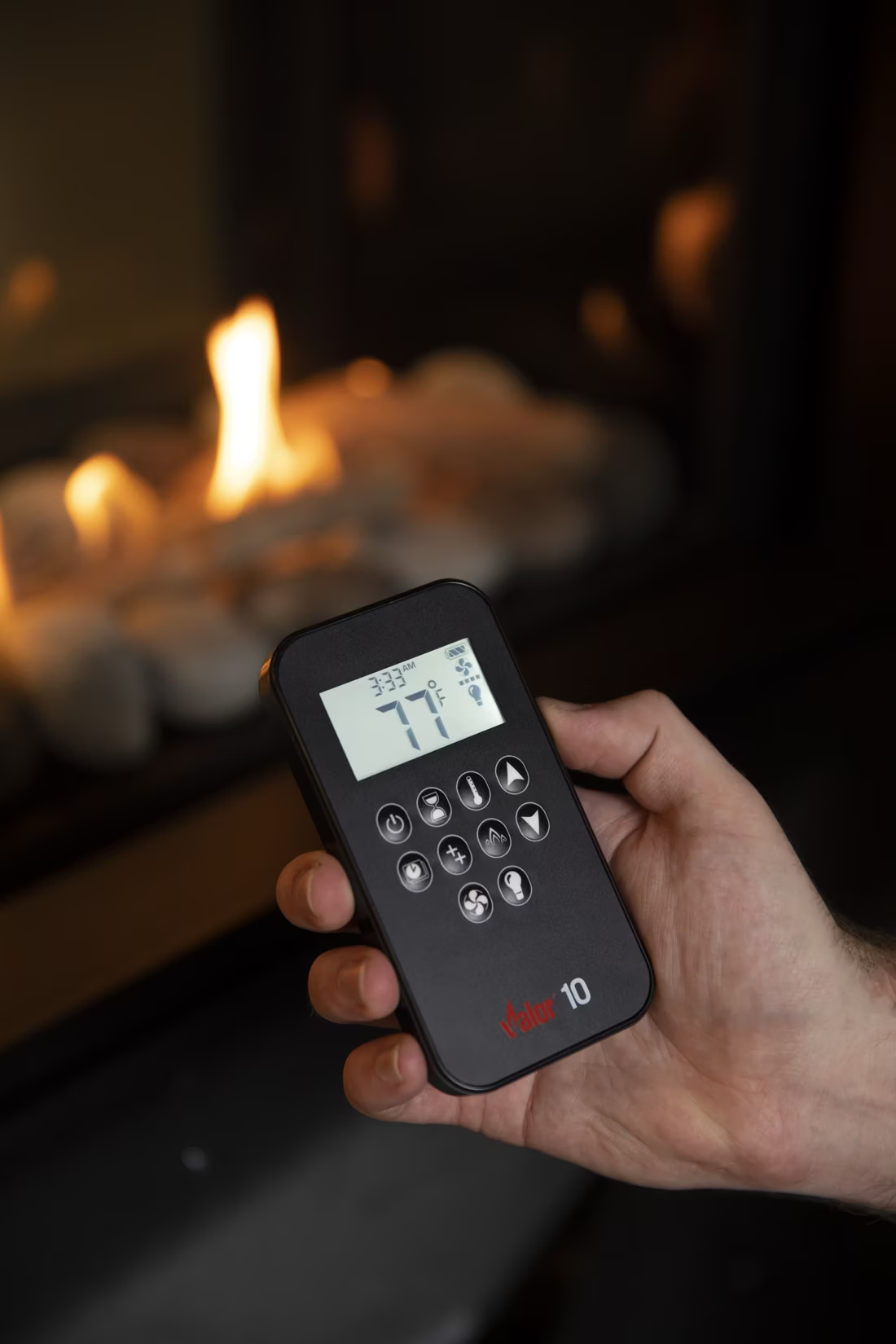
Most will, which is worth knowing given how exposed mountain power lines are to winter storms and heavy snow loads around Aspen. Units with intermittent pilot ignition (IPI) run on AA battery backup that kicks in automatically when utility power drops. Valor units go a step further and don't need a battery at all—their pilot's thermocouple generates its own current. For a town where the City of Aspen electric grid can be knocked out by a single serious snow event, this is a genuine decision point when comparing models, not a minor spec.
What's the difference between a gas fireplace, insert, and stove for an Aspen home?
A gas fireplace is a built-in unit framed into new construction or a remodel—common in the newer homes and condos going up around town. A gas insert fits inside an existing masonry firebox, the usual route for older downtown homes that originally burned pinyon or juniper and still have the chimney chase in place. A gas stove is freestanding on a hearth pad, similar footprint to a wood stove but running on propane instead of cordwood—a good fit for a cabin or secondary residence up the valley that doesn't have an existing chimney at all.
Do I need a permit to install a gas fireplace in Aspen?
Yes. The City of Aspen Community Development Department handles building permits within city limits, and Pitkin County handles unincorporated areas up-valley; either way you'll also need a propane line permit tied to licensed gas-fitter work. Most local hearth dealers who install regularly in Aspen are familiar with both review processes and the inspection requirements, and they'll typically fold permit coordination into the project rather than leaving it on the homeowner.
Should I get a vented or vent-free gas fireplace in Aspen?
Direct-vent is the strong recommendation here. Vent-free units burn into the room and are legal in many jurisdictions, but they're a poor match for a tightly sealed, high-altitude home where combustion efficiency is already affected by thinner air—and Aspen's wildfire smoke concerns during fire season are one more reason not to add indoor combustion byproducts on top of it. A sealed direct-vent unit also performs more predictably once you factor in the altitude adjustment most gas appliances need above 7,000 feet.
How often does a gas fireplace need servicing in Aspen?
Plan on an annual check, ideally in late summer or early fall before the first real cold snap rather than mid-winter when local technicians are booked solid serving a town with an eight-plus-month heating season. A technician should check the burner, pilot assembly, propane connections, and venting, and confirm the unit is still running correctly for the altitude—high-elevation combustion can drift out of adjustment over time in ways it wouldn't at sea level. Given how many hours these units run across such a long heating season, skipping a year isn't worth the risk of an ignition failure on the coldest night.
Gas vs. wood—which makes more sense for a home in Aspen?
Wood—cut under a White River National Forest or GMUG permit for as little as $5 to $20 a cord, often ponderosa pine, aspen, or pinyon—still wins on raw fuel cost and keeps a home warm without any utility at all during an outage. Gas wins on convenience, instant heat, and not adding to wildfire-smoke-season air quality concerns with your own chimney. A fair number of Aspen households run propane gas in the main living space for everyday use and keep a wood stove or insert in a den or secondary unit as backup heat and ambiance, particularly on properties already set up with existing masonry chimneys.
Is my gas fireplace wasting gas?
If it was installed more than 15 years ago, probably. Older gas fireplaces keep a standing pilot light burning all the time, and that little flame can cost a couple hundred dollars a year. Newer models use pilot-on-demand ignition—the pilot lights only when you use the fireplace and goes out when you turn it off.
What's the difference between an insert and a zero-clearance fireplace?
An insert is a fireplace that slides into a pre-existing wood-burning fireplace—if you don't have one, there's nothing to insert it into. A zero-clearance fireplace is built into a framed wall, which makes it the answer for remodels and new construction. Simple test: existing masonry fireplace means insert; blank or framed wall means zero-clearance.
Can a fireplace actually lower my heating bill?
Yes—by creating a comfort zone. A furnace heats every square foot of the house just to warm the one room you're in; a gas fireplace on low burns roughly a sixth of the gas a typical furnace does. Set the furnace around 55–60 degrees as a baseline, then heat the rooms your family actually uses. Families who heat this way commonly save $20–$60 a month.
What is an in-home preview and do I need one?
It's a visit where a hearth professional measures your space, confirms the model you picked actually works in your home, and walks the specs—framing, gas line, venting, finish work—before anything is ordered. Some details you just can't know until you see the house. Never make a down payment without one; it's the single most-skipped step that burns buyers.
Nearby Dealers
Hearth shops serving Aspen and the surrounding area. Every listing shows whether it is a WhyFire partner, a dealer we have verified as authorized for the brands we recommend, or a local business carrying hearth products. No manufacturer pays for placement. How we verify dealers →
We’ve paused dealer listings for this connection today. Enter your zip or postal code above to find dealers near you, or come back tomorrow.
Popular Gas Brands
Where each brand came from, what's inside it today, and every current model. No brand pays to be here. Not every dealer carries every brand, so enter your zip code to see what's sold near Aspen.
Kozy Heat
Kozy Heat was founded in 1976 by Dudley Hussong in Lakefield, Minnesota, and incorporated as Hussong Manufacturing Co., Inc. in 1978.
28 gas models →Fireplace Xtrordinair
Fireplace Xtrordinair, now often called FireplaceX, is the fireplace brand of Travis Industries, Inc., of Mukilteo, Washington.
25 gas models →Town & Country
Town & Country Fireplaces is the luxury gas fireplace brand of Pacific Energy Fireplace Products Ltd., of Duncan, British Columbia.
14 gas models →Lopi
Lopi is a wood, pellet, and gas stove brand founded by Kurt Rumens in Bellevue, Washington, in 1979.
7 gas models →Forge & Flame
Forge & Flame is the stove brand Hearth & Home Technologies introduced in August 2023 to bring Vermont Castings, Harman, and Quadra-Fire under one name.
6 gas models →Vermont Castings
Vermont Castings was founded in 1975 by Duncan Syme, the designer, and his brother-in-law Murray Howell, the business partner, in Randolph, Vermont.
6 gas models →Get your free Project Guide & Parts List for an Aspen gas fireplace.
Tell us about your home, your elevation on the valley, and whether you're already set up for propane, and we'll help you find a trusted local dealer and send a free Project Guide & Parts List with the exact altitude-rated parts and vent kit your project needs.
Find Your Fireplace →