
Warmth and ambiance, without adding smoke to the canyon.
Toro Canyon's mild winters don't call for a wood-burning furnace. They call for clean, flexible electric heat. Find the right unit and connect with a trusted local dealer.
Every Project Starts From One of These Five Situations
Mild winters, real wildfire exposure. Electric fits both.
Toro Canyon sits in the foothills between Santa Barbara and Carpinteria at just over 800 feet in climate zone 3C, where the average winter low is a mild 46 degrees and the area has a very light winter heating need overall. Compare that to Bozeman, Montana, which racks up more winter heating need before Thanksgiving than Toro Canyon sees all winter. Nobody here needs a stove roaring at 2 a.m. to keep pipes from freezing. The demand for a fireplace in this community is almost entirely about ambiance, resale appeal, and the occasional evening chill off the Pacific.
What Toro Canyon does have is wildfire exposure. The community backs up to Los Padres National Forest, and this stretch of Santa Barbara County has lived through the Thomas Fire, the Cave Fire, and repeated red flag warnings that already flag wildfire smoke as a standing air quality concern. Adding wood smoke to that picture is a hard sell for a lot of homeowners here, and it's part of why wood and pellet appliances see so little demand locally. An electric fireplace sidesteps the ember and creosote risk entirely, and even at Southern California Edison's residential rate of roughly $0.28 per kWh, running a 1,500-watt unit for ambiance a few evenings a week costs only pennies per hour.
Three steps. No salesperson until you're ready.
Tell us about your project
Your zip code, your situation, and the fuel you're leaning toward—or let the answers point you to one.
See what's actually available
The brands dealers within 100 miles genuinely carry—real options, never a catalog mirage.
Get your dealer & Project Guide
A trusted local dealer, plus the free Project Guide & Parts List that names every component of the job.
Frequently Asked Questions
How much does an electric fireplace installation cost in Toro Canyon?
Most electric fireplace projects in Toro Canyon fall between $500 and $3,000. A plug-in insert or wall-mounted unit on the low end just needs a standard outlet and a mounting bracket. A built-in electric fireplace with a custom mantel, recessed wall framing, or a dedicated 120V/240V circuit run by an electrician costs more, especially in Toro Canyon's hillside homes where wiring paths aren't always simple. Because there's no venting, chimney, or gas line to install, electric projects are consistently the least expensive fireplace category a local dealer will quote.
Why isn't wood heat common in Toro Canyon?
Two things work against it: climate and fire risk. With average winter lows around 46 degrees and only a light overall winter heating need, there's little practical need for a heat source that can carry a home through a hard freeze. On top of that, Toro Canyon sits against Los Padres National Forest in a part of Santa Barbara County that's had serious wildfire activity in recent years, and wildfire smoke is already a recognized regional air quality issue. Adding a wood-burning chimney and stored cordwood to a home in this setting doesn't appeal to most owners or their insurers, which is why wood and pellet appliances see almost no local demand.
What does it actually cost to run an electric fireplace here?
Southern California Edison's residential rate runs about $0.2825 per kWh, among the higher rates in the state. A typical 1,500-watt electric fireplace on high costs roughly 42 cents per hour to run. Most owners use theirs a few hours a night for ambiance or light supplemental warmth rather than as a whole-home heat source, which keeps the monthly cost modest even at SCE's rate. If you're using one for consistent zone heating in a den or bonus room, ask your dealer about models with adjustable wattage settings so you're not running full output when you only need the flame effect.
Do I need a permit to install an electric fireplace in Toro Canyon?
Toro Canyon is unincorporated, so permitting runs through Santa Barbara County Building & Safety rather than a city building department. A simple plug-in unit generally doesn't require a permit. A built-in installation that involves new electrical circuits, wall framing, or work near a hillside setback typically does require an electrical permit, and depending on the scope, sign-off from the county. A local dealer who regularly installs in the Santa Barbara County foothills will know which projects trigger a permit and can pull it as part of the job.
Built-in electric fireplace vs. a plug-in insert—which should I get?
A plug-in insert or wall-mount unit is the faster, lower-cost route: it works with a standard outlet, requires no construction, and can be moved if you relocate. A built-in electric fireplace is recessed into a wall or custom-built mantel for a more finished, permanent look, but it usually needs a dedicated circuit and some carpentry. For a Toro Canyon remodel or new build where the fireplace is a focal point in the living room, built-in is the more common choice; for a bedroom, office, or rental unit, a plug-in model gets you most of the visual effect for a fraction of the cost and effort.
Can an electric fireplace actually heat a room, or is it just for looks?
Both, depending on the model. Every electric fireplace produces a flame effect with the heater off, but most also include a fan-forced heater rated to comfortably warm 400 to 1,000 square feet. Given Toro Canyon's mild winters, a mid-range unit is more than enough to take the edge off a cool evening in a den or living room. If you want it to double as a legitimate backup heat source for a home office or guest suite, ask your dealer about units with a higher BTU rating and a built-in thermostat rather than a fixed on/off heat setting.
How does an electric fireplace affect my home's wildfire risk or insurance?
It's about as low-risk as fireplace options get. There's no open flame, no chimney to maintain, no embers, and no creosote buildup—the issues that insurers and fire officials in wildland-urban interface areas like Toro Canyon actually worry about. Because there's no venting penetration through the roof or exterior wall, an electric fireplace also doesn't create the kind of ember entry point that a wood chimney can during a wildfire. It won't lower your homeowner's insurance premium by itself, but it also won't raise the kinds of red flags that a wood-burning appliance can in this fire-prone stretch of Santa Barbara County.
Will my electric fireplace work during a power outage or PSPS event?
No—and this is worth planning around in Toro Canyon specifically. Southern California Edison has called Public Safety Power Shutoffs during high fire-danger conditions in this part of the county, sometimes for a day or more. An electric fireplace goes dark along with everything else on the circuit during a PSPS. If backup heat during an outage matters to you, that's a real point in favor of pairing an electric fireplace for daily ambiance with a propane or natural gas appliance elsewhere in the home for actual outage resilience. A local dealer can walk you through both options in the same visit.
Electric vs. gas fireplace—which fits a Toro Canyon home better?
Gas is the standard alternative here and delivers real heat output plus the option of a battery-backed pilot that keeps working during a power outage, which matters given SCE's occasional PSPS shutoffs in this area. Electric is simpler and cheaper to install since there's no gas line or venting involved, and it carries none of the ember or maintenance concerns that come with any combustion appliance in a wildfire-exposed canyon. For a primary living space where you want dependable heat, gas is often the better fit. For a bedroom, office, rental, or secondary room where ambiance and low install cost matter more than backup heating capacity, electric is usually the easier call. A local dealer can help you weigh both against your specific room and budget.
Can I put a TV above my fireplace?
Yes—with an asterisk. Fireplaces are hot and TVs don't like heat. Either put a mantel between them to deflect rising warmth, or choose a fireplace with heat-management technology that creates a cool zone on the wall above—the wall stays around 125 degrees, barely warm, while the room still gets full heat. If you like clean lines and don't want a mantel, heat management is the answer.
Does an electric fireplace need a vent or chimney?
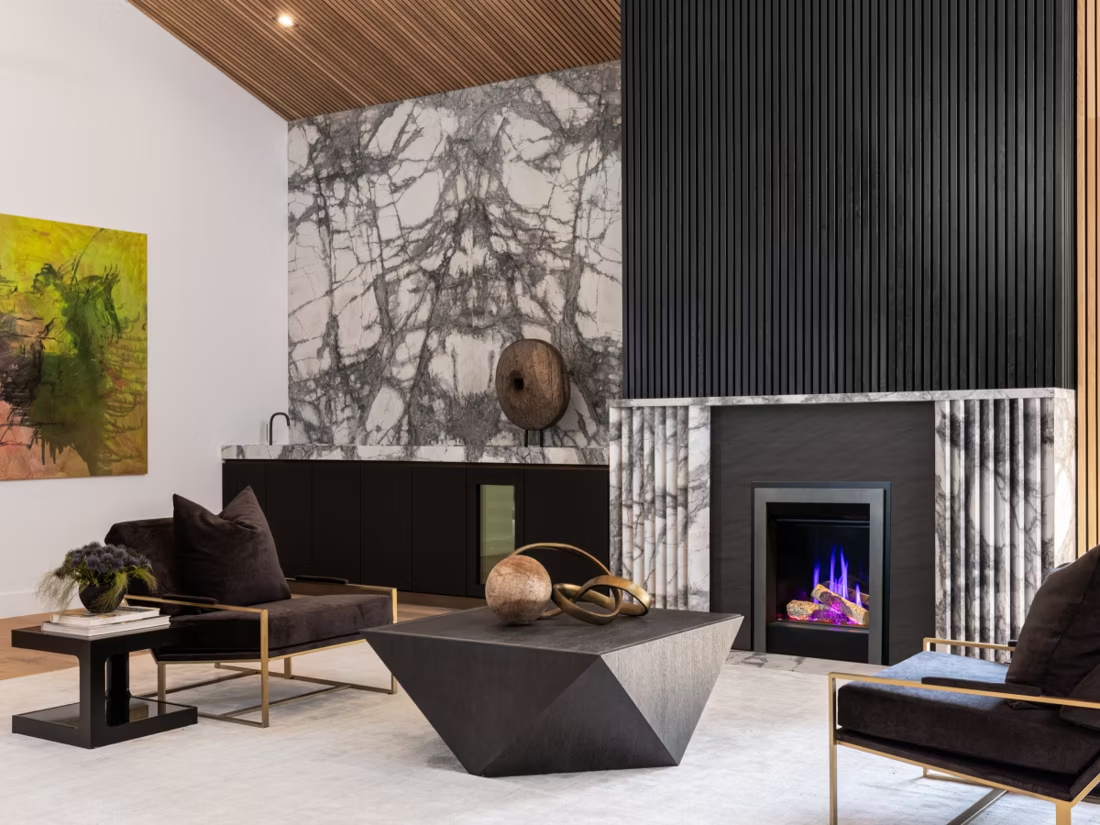
No—that's its superpower. An electric fireplace needs a wall and an outlet, period. No vent pipe, no gas line, no clearances to design around, which is why it works in bedrooms, offices, apartments, and walls where venting a gas or wood unit would be impractical or impossible. Installation is typically the simplest and least expensive of any fireplace type.
Does a fireplace add value to my home?
On average, a fireplace adds back to the home about the same amount you spent installing it. Add the monthly savings from heating the rooms you actually use instead of the whole house—often hundreds of dollars a year—and the value case is strong before you even count what a fire does for how your family uses the room.
How much should I budget for a fireplace?
For an average home—covering the fireplace, the vent pipe, and basic installation—a budget between $3,900 and $5,500 gives you a lot of options across wood, gas, and pellet. By the time you add finish work, gas line, and electrical, the average complete installation lands between $5,000 and $12,000 all-in. In a remodel or new build, a good rule is to put about 2.5% of the total project cost toward the fireplace.
Nearby Dealers
Hearth shops serving Toro Canyon and the surrounding area. Every listing shows whether it is a WhyFire partner, a dealer we have verified as authorized for the brands we recommend, or a local business carrying hearth products. No manufacturer pays for placement. How we verify dealers →
We’ve paused dealer listings for this connection today. Enter your zip or postal code above to find dealers near you, or come back tomorrow.
Popular Electric Brands
Where each brand came from, what's inside it today, and every current model. No brand pays to be here. Not every dealer carries every brand, so enter your zip code to see what's sold near Toro Canyon.
Fireplace Xtrordinair
Fireplace Xtrordinair, now often called FireplaceX, is the fireplace brand of Travis Industries, Inc., of Mukilteo, Washington.
5 electric models →DaVinci
DaVinci Custom Fireplaces is a brand of Travis Industries, Inc., of Mukilteo, Washington, the company behind Lopi and Fireplace Xtrordinair.
5 electric models →Kozy Heat
Kozy Heat was founded in 1976 by Dudley Hussong in Lakefield, Minnesota, and incorporated as Hussong Manufacturing Co., Inc. in 1978.
3 electric models →Forge & Flame
Forge & Flame is the stove brand Hearth & Home Technologies introduced in August 2023 to bring Vermont Castings, Harman, and Quadra-Fire under one name.
1 electric model →Electric Service in Toro Canyon
An electric fireplace's heater draws about 1,500 watts—pennies per hour at local rates.
Southern California Edison Co
Find your electric fireplace in Toro Canyon.
Tell us a bit about your home and we'll help you find the right electric fireplace or insert, plus a free Project Guide & Parts List and a trusted local dealer who can install it.
Find Your Fireplace →