
Electric warmth for Sierra County's high country—no chimney required.
From the Yuba River canyon at Downieville up to Sierraville and Loyalton, electric units offer the fastest, least invasive way to add heat to a remote cabin or second home. Find the right unit and connect with a trusted local dealer.
Every Project Starts From One of These Five Situations
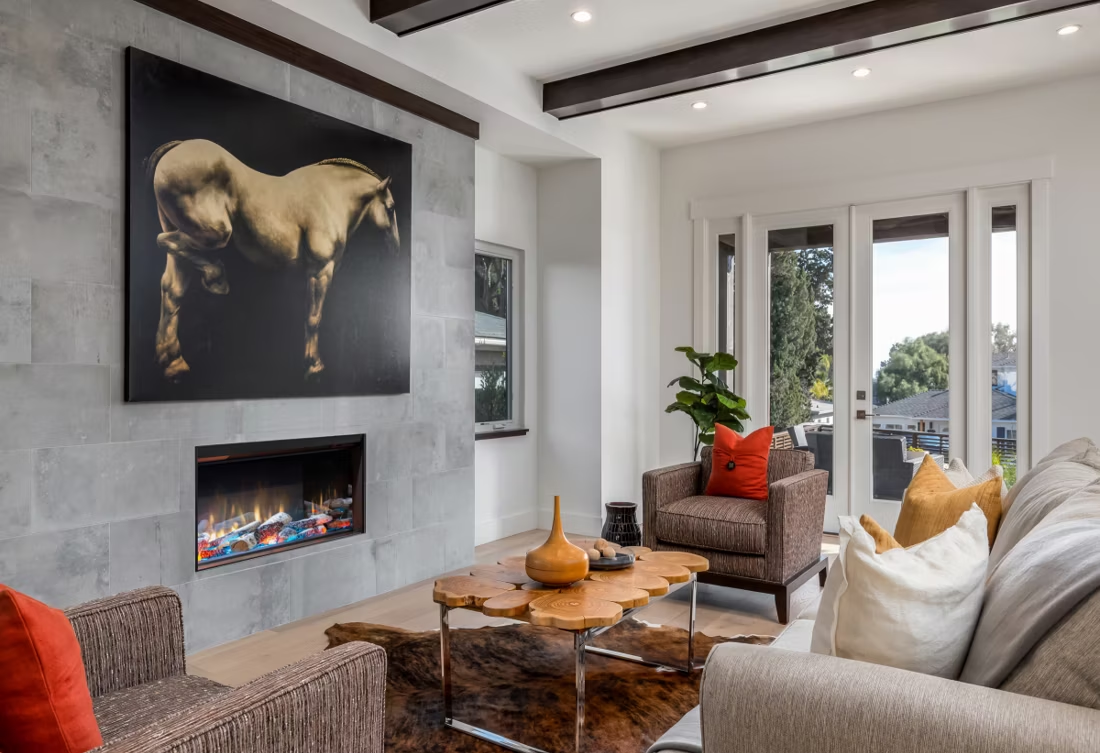
The easiest fireplace to add to a remote mountain home.
Sierra County is one of California's smallest and most remote counties by population—just 2,498 people spread across rugged Sierra Nevada terrain that ranges from roughly 2,000 feet along the Yuba River at Downieville to over 8,000 feet near the Sierra Buttes, with Sierraville and Loyalton sitting in the higher, colder valleys to the east. Climate zone 5B means real winters here, and generations of local homes have relied on wood—oak, madrone, and douglas fir are the common local species—for primary heat. But in a county this remote, with Tahoe National Forest and Plumas National Forest bordering nearly every community, getting a full masonry chimney or gas line built can mean a long wait for contractors and material deliveries.
That's where electric fireplaces fill a real gap. A plug-in insert or wall-mount unit needs no venting, no gas line trenching, and in most cases no chimney work at all—a meaningful advantage when the nearest full-service hearth dealer may be a drive to Truckee, Grass Valley, or across the state line to Reno. PG&E serves most of Sierra County, and because wildfire smoke is a recognized regional air quality concern, an electric unit's zero on-site emissions are a plus during smoke-heavy stretches of the year. The tradeoff worth understanding up front: electric fireplaces run on the grid, and Sierra County sees Public Safety Power Shutoffs during high fire-risk conditions—so most local homeowners treat electric as zone heat or ambiance, not their sole source of emergency warmth.
Three steps. No salesperson until you're ready.
Tell us about your project
Your zip code, your situation, and the fuel you're leaning toward—or let the answers point you to one.
See what's actually available
The brands dealers within 100 miles genuinely carry—real options, never a catalog mirage.
Get your dealer & Project Guide
A trusted local dealer, plus the free Project Guide & Parts List that names every component of the job.
Frequently Asked Questions
How much does an electric fireplace installation cost in Sierra County?
A plug-in electric insert or wall-mount unit typically runs $400 to $1,200 installed in Sierra County, since most models simply need a standard 120V outlet and no venting or masonry work. Larger built-in units or linear electric fireplaces that call for a dedicated 240V circuit can run higher—often $1,200 to $2,500—especially on older rural properties where a panel upgrade or new circuit run is needed. Because electrical work in outlying areas like Sierraville, Loyalton, or Sierra City can involve travel time for the electrician, expect installers to factor that into a quote.
Do I need a permit to install an electric fireplace in Sierra County?
A basic plug-in electric fireplace or insert that uses an existing 120V outlet generally doesn't trigger a building permit through the Sierra County Planning & Building Department. If your installation requires new wiring—a dedicated 240V circuit, a new outlet, or a panel upgrade—that electrical work does need a permit and should be pulled by a licensed electrician. Unlike wood stoves or gas inserts, there's no venting or chimney inspection involved, which is part of why electric is often the fastest option to get approved and installed in this county.
Will my electric fireplace work during a PG&E power outage?
No—and this is the most important thing to understand before choosing electric as your primary heat plan in Sierra County. Electric fireplaces run entirely on grid power, and Sierra County is subject to PG&E Public Safety Power Shutoffs during red-flag fire-weather conditions, on top of ordinary winter storm outages. For that reason, most homeowners here use electric fireplaces for supplemental zone heat, ambiance, or a secondary living space, and keep a wood stove or propane appliance as their actual backup heat source when the grid goes down. If your electric fireplace is your only heat source in a cabin, it's worth pairing it with a battery backup or a wood-burning alternative for the outage-prone months.
What size electric fireplace or insert do I need for my home?
Because electric units are built for zone heating rather than whole-house heat, sizing is less about square footage and more about the room. A compact insert or small wall unit (400 to 750 watts of usable heat) comfortably takes the chill off a single room in a Downieville cabin or a Sierraville bedroom addition. Larger linear or built-in models with higher wattage output can supplement heat in an open living area, but in a climate zone 5B county with real winter lows, don't expect an electric unit to replace your main furnace or wood stove—it's a comfort layer, not a whole-home heat source.
Can I convert my existing wood-burning fireplace to electric?
Yes, and it's a common project for older masonry fireplaces around Sierra County that are drafty, rarely used, or no longer meet current emissions standards. An electric insert slides into the existing firebox opening, plugs into a nearby outlet (or a new dedicated circuit for higher-output models), and typically costs $500 to $1,500 installed. Unlike a wood-to-gas conversion, there's no venting, gas line, or liner work needed—the existing chimney can simply be capped or left as-is, which simplifies the project considerably for a remote property.
Electric fireplace vs. wood stove—which makes sense for a Sierra County cabin?
Wood stoves remain the practical choice for primary heat and true power-outage backup in Sierra County, and with oak, madrone, and douglas fir readily available locally, fuel isn't hard to come by. Electric fireplaces win on convenience: no ash, no chimney maintenance, no combustion emissions during wildfire smoke season, and installation that doesn't require a contractor trip up from Truckee or Grass Valley. Many local cabin owners end up with both—a wood stove for genuine winter reliability, and an electric insert or wall unit in a bedroom or den for easy, mess-free supplemental warmth.
Do electric fireplaces need special wiring?
It depends on the unit. Most compact electric inserts and freestanding stoves run on a standard 120V household outlet and need no special wiring at all. Larger built-in or linear electric fireplaces, especially those rated for higher heat output, often call for a dedicated 20-amp circuit or 240V line. On older Sierra County homes and cabins—particularly in Sierra City or the more remote parts of the Yuba River canyon—it's worth having an electrician confirm your panel has capacity before you buy a larger unit, since a service upgrade adds meaningfully to the project cost.
Where can I find electric fireplace dealers near Sierra County?
Sierra County's small population (under 2,500 residents) means there isn't a hearth retailer based in-county—most homeowners work with dealers in Truckee, Grass Valley, Nevada City, or even Reno, all of which carry electric inserts, wall units, and built-ins and can arrange installation trips into Downieville, Loyalton, Sierraville, and surrounding areas. A trusted local-to-the-region dealer who already knows the drive and the permitting process is worth more here than a big-box option that has never worked in the Sierra Nevada backcountry.
Are electric fireplaces a good fit for rental cabins and vacation homes in Sierra County?
Often, yes. Vacation cabins around Sierra City, Bassetts, and the Lakes Basin area frequently sit empty for stretches, and an electric fireplace can be switched on remotely or by a renter with zero risk of an untended fire, no ash to clean between guests, and no chimney to inspect before each rental turnover. The caveat is the same one that applies countywide: if the property loses power during a storm or a PSPS event, the electric unit goes dark too, so owners who want the cabin to stay livable through an outage typically keep a wood stove or propane heater on hand as well.
Can I put a TV above my fireplace?
Yes—with an asterisk. Fireplaces are hot and TVs don't like heat. Either put a mantel between them to deflect rising warmth, or choose a fireplace with heat-management technology that creates a cool zone on the wall above—the wall stays around 125 degrees, barely warm, while the room still gets full heat. If you like clean lines and don't want a mantel, heat management is the answer.
Does an electric fireplace need a vent or chimney?
No—that's its superpower. An electric fireplace needs a wall and an outlet, period. No vent pipe, no gas line, no clearances to design around, which is why it works in bedrooms, offices, apartments, and walls where venting a gas or wood unit would be impractical or impossible. Installation is typically the simplest and least expensive of any fireplace type.
Can I install a fireplace myself?
If you're putting a fire in your house on purpose, it's best to work with an expert. Unless you're genuinely experienced in framing, gas line, vent pipe, and the national code on clearances to combustibles, have a professional do it—and ideally the same company that sells you the fireplace, so warranty, service, and liability all live under one roof.
What is an in-home preview and do I need one?
It's a visit where a hearth professional measures your space, confirms the model you picked actually works in your home, and walks the specs—framing, gas line, venting, finish work—before anything is ordered. Some details you just can't know until you see the house. Never make a down payment without one; it's the single most-skipped step that burns buyers.
Find your electric fireplace in Sierra County.
Tell us a bit about your cabin or home and we'll match you with the right electric fireplace, insert, or wall unit—plus a free Project Guide & Parts List and a trusted local dealer who can get it installed.
Find Your Fireplace →