
Warmth and ambiance without the smoke, soot, or permits.
Rolling Hills winters rarely dip below the mid-40s, so the case for electric heat here is about clean, flexible ambiance more than survival warmth. Find the right unit and connect with a trusted local dealer.
Every Project Starts From One of These Five Situations
The cleanest heat option for a hillside community with real fire restrictions.
At just over 1,000 feet on the Palos Verdes Peninsula, Rolling Hills sees one of the mildest winter climates in the country—an average winter low near 47°F and a winter heating load that's just a small fraction of what a place like Bozeman, MT or Duluth, MN racks up in a single cold snap. This is not a community built around holding a fire through subzero nights; it's a community where a fireplace is mostly about atmosphere in the great room and light supplemental warmth on the occasional 40-degree evening.
Wood and pellet appliances are essentially off the table here—the South Coast Air Quality Management District's non-attainment status and Rolling Hills' chaparral hillside terrain make solid-fuel burning both heavily regulated and genuinely risky given local wildfire smoke concerns. That leaves electric and gas as the practical choices, and electric has a distinct advantage: no venting, no chimney, no spark risk, and generally no exterior modification for the Rolling Hills Community Association's architectural review to weigh in on. Power comes from Southern California Edison, and while the residential rate here (about $0.2825/kWh) is on the higher end for the state, electric fireplaces draw modest wattage compared to whole-home HVAC, so the cost of running one for ambiance or zone heat stays reasonable.
Three steps. No salesperson until you're ready.
Tell us about your project
Your zip code, your situation, and the fuel you're leaning toward—or let the answers point you to one.
See what's actually available
The brands dealers within 100 miles genuinely carry—real options, never a catalog mirage.
Get your dealer & Project Guide
A trusted local dealer, plus the free Project Guide & Parts List that names every component of the job.
Frequently Asked Questions
How much does an electric fireplace installation cost in Rolling Hills?
Plug-in electric fireplace inserts or mantel units typically run $400 to $1,200 installed, since most just need an existing 120V outlet—no venting, gas line, or chimney work required. Built-in wall units or linear electric fireplaces designed into a custom hearth wall run higher, often $1,500 to $3,000, mostly due to carpentry, framing, and sometimes a dedicated 20-amp circuit run by a licensed electrician. Given the size and custom finish level common in Rolling Hills homes, built-in linear units into a stone or plaster surround are the most common request local dealers see here.
Do I need a permit to install an electric fireplace in Rolling Hills?
In most cases, no—a plug-in unit on an existing circuit doesn't trigger a building or electrical permit. If your installer needs to add a new dedicated circuit or do structural framing for a built-in unit, that electrical work does require a permit through the LA County Department of Public Works Building and Safety Division, which has jurisdiction here. Because Rolling Hills is a gated community with strict private covenants, any change visible from the street or affecting the exterior of the home should also go through Rolling Hills Community Association architectural review before work starts—your local dealer can tell you whether your specific project needs it.
Why don't more homes in Rolling Hills use wood-burning fireplaces?
Two things work against wood here. First, the South Coast Air Quality Management District classifies the region as a non-attainment area, and wood smoke is one of the pollutants it specifically targets—new wood-burning installations face real regulatory hurdles. Second, Rolling Hills sits in chaparral hillside terrain with a genuine wildfire smoke concern; ember-producing appliances and spark risk are taken seriously by both the county and the community association. Electric fireplaces sidestep both issues entirely, which is a big part of why they're the practical default for ambiance-focused fireplace projects here.
What's the best type of electric fireplace for a home in Rolling Hills?
Since heating load is light and appearance matters more than raw BTU output, wall-mounted linear electric fireplaces or built-in units from brands like Dimplex, Napoleon, and Amantii are the most popular choice locally—they give a wide, modern flame presentation that suits open great rooms and can be framed into stone, tile, or plaster to match custom finish work. For a den or bedroom where you want occasional supplemental warmth, a smaller insert or mantel-style unit with a 1,500-watt heater element is usually plenty for the mild temperatures Rolling Hills sees.
How much does it cost to run an electric fireplace in Rolling Hills?
Most electric fireplaces use a 1,500-watt heater element on high. At Southern California Edison's residential rate of about $0.2825 per kWh, running the heater for five hours costs roughly $2.10, or around $60 a month if used daily. Most Rolling Hills homeowners run the flame effect alone—which draws only a few watts—far more often than the heater, since the mild climate rarely calls for supplemental warmth, which keeps actual operating costs well below that ceiling in practice.
What size electric fireplace do I need for my room?
A standard 1,500-watt electric fireplace heater is rated to supplement warmth in roughly 400 to 500 square feet, which covers most living rooms, dens, and primary bedrooms. Given the mild Rolling Hills climate—average winter lows around 47°F—sizing here is driven more by the visual scale of the flame display relative to your wall or hearth than by BTU heating capacity. A local dealer can help match a linear unit's width to your room's proportions during a quick in-home or virtual consultation.
Electric fireplace vs. built-in insert vs. freestanding stove—what's the difference?
An electric insert drops into an existing fireplace opening or is framed into a wall, giving a built-in, permanent look. A freestanding electric stove sits on the floor like a traditional wood stove but plugs into an outlet, which is a good option for renters or homes without existing hearths. A mantel package combines an electric firebox with a surrounding cabinet or mantel shelf for a furniture-style installation that needs no wall modification at all. For Rolling Hills homes with existing masonry fireplaces that were never converted, an insert is usually the cleanest upgrade; for new construction or remodels, a built-in linear unit gives the most design flexibility.
Electric vs. gas fireplace—which makes more sense for a Rolling Hills home?
Gas fireplaces, typically fed by SoCalGas service in this part of the South Bay, deliver more visible flame realism and real radiant heat output, which some homeowners prefer for a great room focal point. Electric fireplaces install without any gas line, venting, or combustion byproducts, cost less upfront, and can go virtually anywhere in the house, including interior walls with no outside access—an easier fit for RHCA architectural review since there's no exterior vent termination to approve. Given how mild winters are here, many Rolling Hills homeowners choose electric specifically because they want the flame and glow without needing serious heat output, and skip the added complexity of gas entirely.
Can an electric fireplace serve as a real backup heat source during a power outage?
No—electric fireplaces need power to run, so they won't help during an outage, unlike a wood stove or a battery-backed gas unit. Rolling Hills' outage risk is mostly tied to Southern California Edison's Public Safety Power Shutoffs during high fire-danger conditions, which can occasionally cut power for a day or more. Given that wood-burning options are impractical here for air-quality and wildfire-smoke reasons, most homeowners treat their electric fireplace purely as an ambiance and comfort feature and rely on a portable generator or battery system, not the fireplace itself, for outage backup.
Can I put a TV above my fireplace?
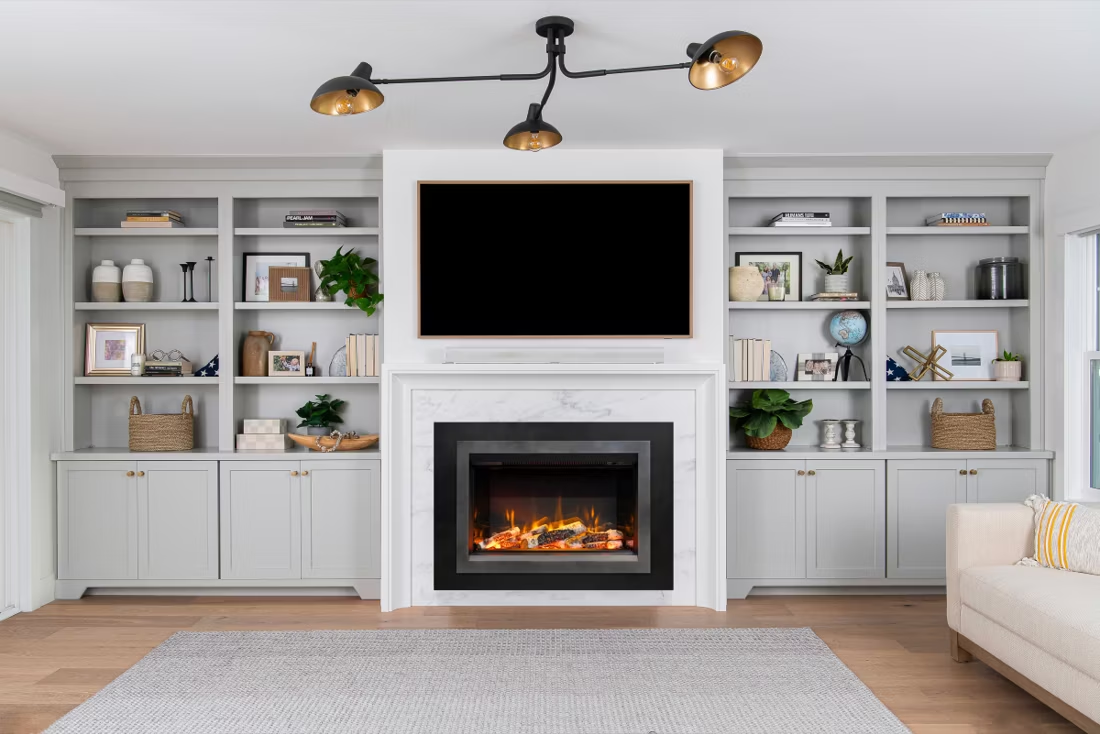
Yes—with an asterisk. Fireplaces are hot and TVs don't like heat. Either put a mantel between them to deflect rising warmth, or choose a fireplace with heat-management technology that creates a cool zone on the wall above—the wall stays around 125 degrees, barely warm, while the room still gets full heat. If you like clean lines and don't want a mantel, heat management is the answer.
Does an electric fireplace need a vent or chimney?
No—that's its superpower. An electric fireplace needs a wall and an outlet, period. No vent pipe, no gas line, no clearances to design around, which is why it works in bedrooms, offices, apartments, and walls where venting a gas or wood unit would be impractical or impossible. Installation is typically the simplest and least expensive of any fireplace type.
How much should I budget for a fireplace?
For an average home—covering the fireplace, the vent pipe, and basic installation—a budget between $3,900 and $5,500 gives you a lot of options across wood, gas, and pellet. By the time you add finish work, gas line, and electrical, the average complete installation lands between $5,000 and $12,000 all-in. In a remodel or new build, a good rule is to put about 2.5% of the total project cost toward the fireplace.
Can I install a fireplace myself?
If you're putting a fire in your house on purpose, it's best to work with an expert. Unless you're genuinely experienced in framing, gas line, vent pipe, and the national code on clearances to combustibles, have a professional do it—and ideally the same company that sells you the fireplace, so warranty, service, and liability all live under one roof.
Nearby Dealers
Hearth shops serving Rolling Hills and the surrounding area. Every listing shows whether it is a WhyFire partner, a dealer we have verified as authorized for the brands we recommend, or a local business carrying hearth products. No manufacturer pays for placement. How we verify dealers →
We’ve paused dealer listings for this connection today. Enter your zip or postal code above to find dealers near you, or come back tomorrow.
Popular Electric Brands
Where each brand came from, what's inside it today, and every current model. No brand pays to be here. Not every dealer carries every brand, so enter your zip code to see what's sold near Rolling Hills.
Fireplace Xtrordinair
Fireplace Xtrordinair, now often called FireplaceX, is the fireplace brand of Travis Industries, Inc., of Mukilteo, Washington.
5 electric models →DaVinci
DaVinci Custom Fireplaces is a brand of Travis Industries, Inc., of Mukilteo, Washington, the company behind Lopi and Fireplace Xtrordinair.
5 electric models →Kozy Heat
Kozy Heat was founded in 1976 by Dudley Hussong in Lakefield, Minnesota, and incorporated as Hussong Manufacturing Co., Inc. in 1978.
3 electric models →Forge & Flame
Forge & Flame is the stove brand Hearth & Home Technologies introduced in August 2023 to bring Vermont Castings, Harman, and Quadra-Fire under one name.
1 electric model →Electric Service in Rolling Hills
An electric fireplace's heater draws about 1,500 watts—pennies per hour at local rates.
Southern California Edison Co
Find your electric fireplace in Rolling Hills.
Tell us a bit about your home and we'll put together a free Project Guide & Parts List for your electric fireplace project—helping you find a trusted local dealer who can install it right the first time.
Find Your Fireplace →