
Instant warmth without the smoke, for Rancho Santa Fe evenings.
With winters this mild, the right gas fireplace is about ambiance and instant heat on demand—not survival heat. Find the right unit and connect with a trusted local dealer.
Every Project Starts From One of These Five Situations
A fireplace built for ambiance first, heat second.
Rancho Santa Fe sits on a coastal mesa at just 236 feet elevation in climate zone 3B, where the average winter low is 46°F and the entire season adds up to a mild, short heating season—just a small fraction of what a place like Bozeman, MT racks up before Thanksgiving. That climate math is exactly why wood stoves and pellet stoves are essentially absent here: there's no sustained cold to justify a 24-hour catalytic burn, and open wood burning sits uneasily alongside the wildfire smoke concerns that already shape air quality across San Diego County in late summer and fall. Gas is the fuel that actually matches the local climate and the local lifestyle—instant on for a cool December evening in the great room or on a covered loggia, off again with a remote, no cordwood stacked next to the barn.
Most Covenant and 92067-area homes already run natural gas through San Diego Gas & Electric for ranges, water heaters, and pool equipment, so extending a line to a new fireplace location is usually a modest add rather than a major utility project. Because Rancho Santa Fe is unincorporated, building permits run through San Diego County Planning & Development Services, and homes inside the Covenant also go through Rancho Santa Fe Association design review—which pays close attention to how a chimney chase or direct-vent termination reads against a tile roofline or a neighboring pasture fence. A local installer who has already worked inside the Covenant knows which details the Association will flag before you ever submit drawings.
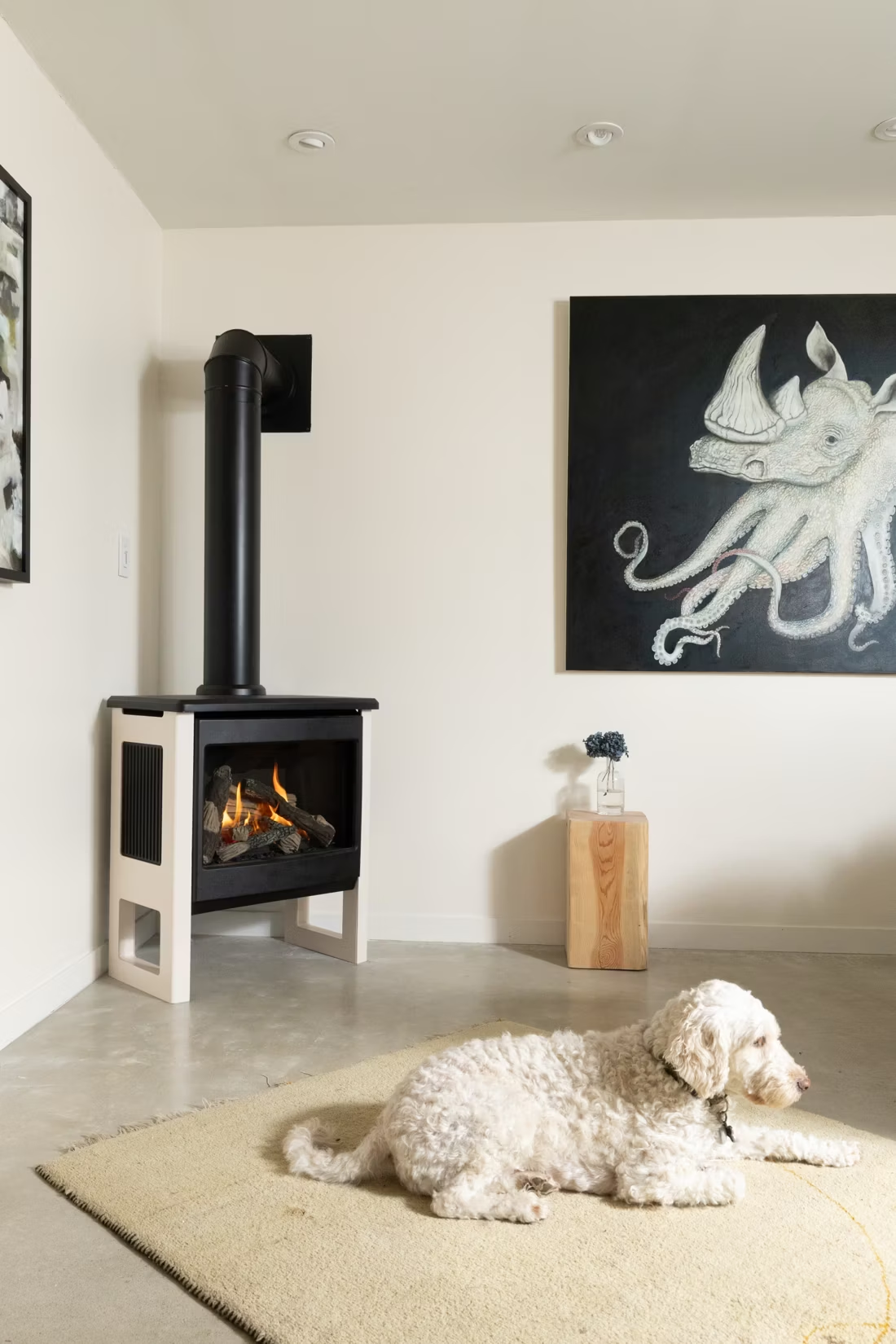
Three steps. No salesperson until you're ready.
Tell us about your project
Your zip code, your situation, and the fuel you're leaning toward—or let the answers point you to one.
See what's actually available
The brands dealers within 100 miles genuinely carry—real options, never a catalog mirage.
Get your dealer & Project Guide
A trusted local dealer, plus the free Project Guide & Parts List that names every component of the job.
Frequently Asked Questions
How much does a gas fireplace installation cost in Rancho Santa Fe?
A straightforward gas insert into an existing masonry fireplace, with a gas line already nearby, typically runs $4,500 to $9,000. Custom built-in units and the large linear or see-through fireplaces common in Rancho Santa Fe's newer great rooms and outdoor loggias run considerably higher—often $8,000 to $18,000 once you factor in custom stone or plaster surrounds, longer gas line runs across larger lots, and the framing work that estate-scale rooms require. Local retailers who work regularly in the Covenant can give you a firm number after seeing the room and the roofline.
Can I convert my existing wood-burning fireplace to gas?
Yes, and it's a common project on the older estates around Rancho Santa Fe that were built with traditional masonry fireplaces decades ago and rarely get used for wood now. A gas insert drops into the existing firebox and vents through a stainless liner run up your existing chimney, typically for $4,500 to $9,500 depending on the insert and whether new gas line work is needed. It keeps the exterior masonry and chimney silhouette the Association is used to seeing, while giving you instant heat and none of the ash or smoke.
Is natural gas available everywhere in Rancho Santa Fe, or do I need propane?
Most homes within the 92067 zip code and the Covenant have natural gas service through San Diego Gas & Electric, and if your home already has a gas range or pool heater, you almost certainly have gas at the meter. A handful of larger, more remote equestrian parcels on the edges of the community are still on propane, supplied by regional tank services. Either fuel works in nearly every direct-vent gas fireplace on the market—your installer just configures the orifice and regulator for whichever you have.
Will my gas fireplace still work if SDG&E shuts off power during a wildfire event?
In most cases, yes. San Diego Gas & Electric calls Public Safety Power Shutoffs during Santa Ana wind events, and those outages can stretch for a day or more in the hills around Rancho Santa Fe. Gas fireplaces with IPI (intermittent pilot ignition) run on a small battery backup that kicks in automatically when grid power drops, so the fireplace still lights on demand. Valor units go a step further—their pilot's thermocouple generates its own electricity, so there's no battery to check at all. If PSPS events are a real concern for your property, ask your local dealer to spec an IPI or Valor unit specifically.
Do I need a permit to install a gas fireplace in Rancho Santa Fe?
Yes. Because Rancho Santa Fe is unincorporated, building and gas line permits go through San Diego County Planning & Development Services rather than a city building department. If your property sits inside the Covenant, you'll also need sign-off from the Rancho Santa Fe Association's Art Jury or staff review for anything visible from the exterior, including chimney chases and vent terminations. Most established local installers coordinate both the county permit and the Association submittal as part of the job, which saves you from managing two separate approval processes.
What's the difference between vented and vent-free gas fireplaces, and can I install a vent-free unit here?
Vented (direct-vent) gas fireplaces draw combustion air from outside and exhaust it back outside through a sealed pipe—they're the standard, code-compliant choice in nearly every jurisdiction. Vent-free units burn gas directly into the room without external venting, and California is one of the states that prohibits vent-free gas fireplaces in residential construction, so they're not an option for a Rancho Santa Fe installation regardless of room size. This isn't a limitation in practice: direct-vent units deliver strong heat output and a clean glass front, and they're what every local retailer will spec for you anyway.
How often does a gas fireplace need to be serviced?
Plan on an annual inspection, ideally in early fall before the fireplace sees regular use through the cooler months. A technician checks the burner, pilot assembly, venting, and any battery backup, and cleans the glass and interior. It's a lighter job than wood-stove chimney sweeping—most gas service visits in the area run $150 to $250—but it matters just as much for safety, especially on units that sit unused for long stretches during Rancho Santa Fe's warm season.
Why don't more homes in Rancho Santa Fe use wood-burning fireplaces or stoves?
With an average winter low of 46°F and only a mild, short heating season each year, there's simply no sustained cold that calls for a wood stove's long, high-BTU burn—this isn't a climate where you need a fire going at 2am to keep pipes from freezing. On top of that, wildfire smoke is already a recognized air quality concern across San Diego County in late summer and fall, which makes routine wood burning a harder sell locally even where it's technically allowed. A few larger equestrian properties still keep a traditional wood-burning fireplace going occasionally with oak cut on their own land, and Cleveland National Forest does issue personal-use cutting permits ($5–$20 per cord, May through October) for those who want it—but for daily use and real heat, gas is what the overwhelming majority of local homes install.
Should I choose a gas fireplace or an electric fireplace for a secondary room?
For a bedroom, office, or media room where you want supplemental ambiance rather than a major heat source, electric is worth considering: install cost typically runs just $400 to $1,200, with no venting or gas line required. The tradeoff is operating cost—SDG&E's residential rate runs around $0.32 per kWh, among the highest in the country, so running an electric unit as a primary heat source adds up quickly on the bill. Gas costs more upfront but is far cheaper to operate for regular use and puts out real, sustained heat rather than just a heated-air blower. For a great room or a fireplace you'll actually use most evenings, gas is the better long-term value; for occasional ambiance in a secondary room, electric can make sense.
What's the difference between an insert and a zero-clearance fireplace?
An insert is a fireplace that slides into a pre-existing wood-burning fireplace—if you don't have one, there's nothing to insert it into. A zero-clearance fireplace is built into a framed wall, which makes it the answer for remodels and new construction. Simple test: existing masonry fireplace means insert; blank or framed wall means zero-clearance.
What does it take to replace an existing fireplace?
Fireplaces are like icebergs—bigger behind the wall than in front of it. Replacement means removing the surrounding tile or stone (the finish material laps onto the fireplace face), pulling the old unit, setting the new one in the same enclosure, and re-finishing the wall. A hearth professional can determine what's behind your wall without demolition during an in-home preview.
Does a fireplace add value to my home?
On average, a fireplace adds back to the home about the same amount you spent installing it. Add the monthly savings from heating the rooms you actually use instead of the whole house—often hundreds of dollars a year—and the value case is strong before you even count what a fire does for how your family uses the room.
What is an in-home preview and do I need one?
It's a visit where a hearth professional measures your space, confirms the model you picked actually works in your home, and walks the specs—framing, gas line, venting, finish work—before anything is ordered. Some details you just can't know until you see the house. Never make a down payment without one; it's the single most-skipped step that burns buyers.
Nearby Dealers
Hearth shops serving Rancho Santa Fe and the surrounding area. Every listing shows whether it is a WhyFire partner, a dealer we have verified as authorized for the brands we recommend, or a local business carrying hearth products. No manufacturer pays for placement. How we verify dealers →
We’ve paused dealer listings for this connection today. Enter your zip or postal code above to find dealers near you, or come back tomorrow.
Popular Gas Brands
Where each brand came from, what's inside it today, and every current model. No brand pays to be here. Not every dealer carries every brand, so enter your zip code to see what's sold near Rancho Santa Fe.
Kozy Heat
Kozy Heat was founded in 1976 by Dudley Hussong in Lakefield, Minnesota, and incorporated as Hussong Manufacturing Co., Inc. in 1978.
28 gas models →Fireplace Xtrordinair
Fireplace Xtrordinair, now often called FireplaceX, is the fireplace brand of Travis Industries, Inc., of Mukilteo, Washington.
25 gas models →Town & Country
Town & Country Fireplaces is the luxury gas fireplace brand of Pacific Energy Fireplace Products Ltd., of Duncan, British Columbia.
14 gas models →Lopi
Lopi is a wood, pellet, and gas stove brand founded by Kurt Rumens in Bellevue, Washington, in 1979.
7 gas models →Forge & Flame
Forge & Flame is the stove brand Hearth & Home Technologies introduced in August 2023 to bring Vermont Castings, Harman, and Quadra-Fire under one name.
6 gas models →Vermont Castings
Vermont Castings was founded in 1975 by Duncan Syme, the designer, and his brother-in-law Murray Howell, the business partner, in Randolph, Vermont.
6 gas models →Find your gas fireplace in Rancho Santa Fe.
Tell us a bit about your home and we'll put together a free Project Guide & Parts List—the right gas fireplace or insert, the vent kit it needs, and a trusted local dealer who already knows how to work with the County and the RSF Association.
Find Your Fireplace →