
Instant Heat, No Smoke, No Burn Bans in Pine Canyon.
Zero-emission ambiance and supplemental warmth for Pine Canyon's mild Monterey County winters, without adding to wildfire-season smoke. Find the right unit and connect with a trusted local dealer.
Every Project Starts From One of These Five Situations
Mild winters, wildfire smoke, and the case for electric heat.
At 431 feet in the hills of Monterey County, Pine Canyon sits in climate zone 3C—one of the mildest heating climates in the country. With an average winter low around 38°F and a short, mild heating season, most homes here don't need a serious primary heat source; they need a zone-heat solution for a chilly evening or a fireplace that looks and feels real without the upkeep. That's exactly the niche electric fireplaces fill, and it's why they're a genuinely practical, not just decorative, choice for this area.
Pine Canyon is served by Pacific Gas & Electric for delivery, with Central Coast Community Energy providing generation to most residential accounts by default. PG&E's residential rate runs around $0.317 per kWh—among the higher rates in the country—while CCCE's generation component is roughly $0.1301 per kWh, which softens the blended cost somewhat. Either way, electric fireplaces are cheap to buy and simple to install compared to venting a gas line or building a chimney, but it's worth sizing your usage expectations around California's electricity rates rather than a lower-cost grid. Worth noting too: Monterey County's wildland-urban interface communities like Pine Canyon are subject to PG&E Public Safety Power Shutoffs during high fire-risk conditions, so an electric fireplace won't provide heat when the grid goes down—something to weigh if you're relying on it as more than a supplemental or ambiance unit.
Three steps. No salesperson until you're ready.
Tell us about your project
Your zip code, your situation, and the fuel you're leaning toward—or let the answers point you to one.
See what's actually available
The brands dealers within 100 miles genuinely carry—real options, never a catalog mirage.
Get your dealer & Project Guide
A trusted local dealer, plus the free Project Guide & Parts List that names every component of the job.
Frequently Asked Questions
How much does it cost to install an electric fireplace in Pine Canyon?
Plug-in electric fireplace inserts that slot into an existing firebox or media console typically run $300 to $1,200 installed, since no venting or gas line is needed and often no electrician. Built-in linear electric fireplaces or wall units usually require a dedicated 20-amp circuit, which means an electrician's visit and a Monterey County RMA electrical permit—that combination typically pushes the total to $1,500 to $3,500 depending on how far the unit sits from the panel. Because there's no chimney, no gas line, and no combustion venting to plan around, electric is consistently the least expensive fireplace category to install in Pine Canyon.
Will my electric fireplace still work during a power outage or PSPS event?
No—electric fireplaces require grid power to run the heating element, blower, and flame effect, so they go dark the moment the power does. That matters more in Pine Canyon than in a lot of places, because PG&E regularly initiates Public Safety Power Shutoffs across Monterey County's hillside and wildland-urban interface areas during dry, windy, high fire-risk conditions—sometimes for a day or more. If backup heat during an outage matters to you, pair an electric fireplace for everyday ambiance with a wood stove or battery-backed gas unit for the nights the grid actually goes out.
What does it cost to run an electric fireplace given Pine Canyon's electric rates?
A typical 1,500-watt electric fireplace heater running on high draws 1.5 kWh per hour. At PG&E's residential rate of roughly $0.317 per kWh, that's about $0.48 an hour to run at full heat. If your account draws generation from Central Coast Community Energy at its lower $0.1301 rate, the generation portion drops, but PG&E's delivery charges still apply on top, so real-world savings are modest rather than dramatic. Most owners run these units on the flame-only, no-heat setting for ambiance most of the year given Pine Canyon's mild climate, which costs only a few cents an hour, and reserve the heat function for the handful of genuinely cold evenings.
Do I need a permit to install an electric fireplace in Pine Canyon?
A simple plug-in insert or freestanding electric stove that uses an existing standard outlet typically doesn't require a permit. A built-in or wall-mounted electric fireplace that needs a new dedicated circuit does require an electrical permit through Monterey County RMA—Building Services, since Pine Canyon is unincorporated. Most local electricians and hearth dealers handle that paperwork as part of the installation, so it rarely falls on the homeowner to file it directly.
Electric vs. wood—which makes more sense in Pine Canyon?
Wood is genuinely available here—oak, madrone, and douglas fir all grow locally, and a wood stove or insert delivers real radiant heat and works without power. But Pine Canyon's mild winters (a short, mild heating season) mean most homes don't need wood as a primary heat source, and wildfire smoke is already a seasonal air quality concern in this part of Monterey County, which makes some homeowners hesitant to add wood smoke to the mix on already hazy days. Electric fireplaces sidestep that entirely—zero emissions, no smoke, no ash—at the cost of losing heat output during a grid outage. Many Pine Canyon homes end up choosing wood for a rustic focal room and electric for everyday, low-maintenance ambiance elsewhere in the house.
Electric vs. gas fireplace—what's the better fit here?
Gas fireplaces deliver more heat output and can run during a power outage if equipped with a battery-backed ignition system, but installing one in Pine Canyon generally means running or maintaining a propane setup, since natural gas mains don't reach many pockets of unincorporated Monterey County. That adds tank installation and delivery costs that electric simply avoids. For a home that mainly wants supplemental warmth and a realistic flame picture without fuel storage, delivery scheduling, or gas line work, electric is the simpler, lower-commitment option. For a primary heat source that also needs to function when the power's out, gas with battery backup is worth the extra investment.
What type of electric fireplace works best in a Pine Canyon home?
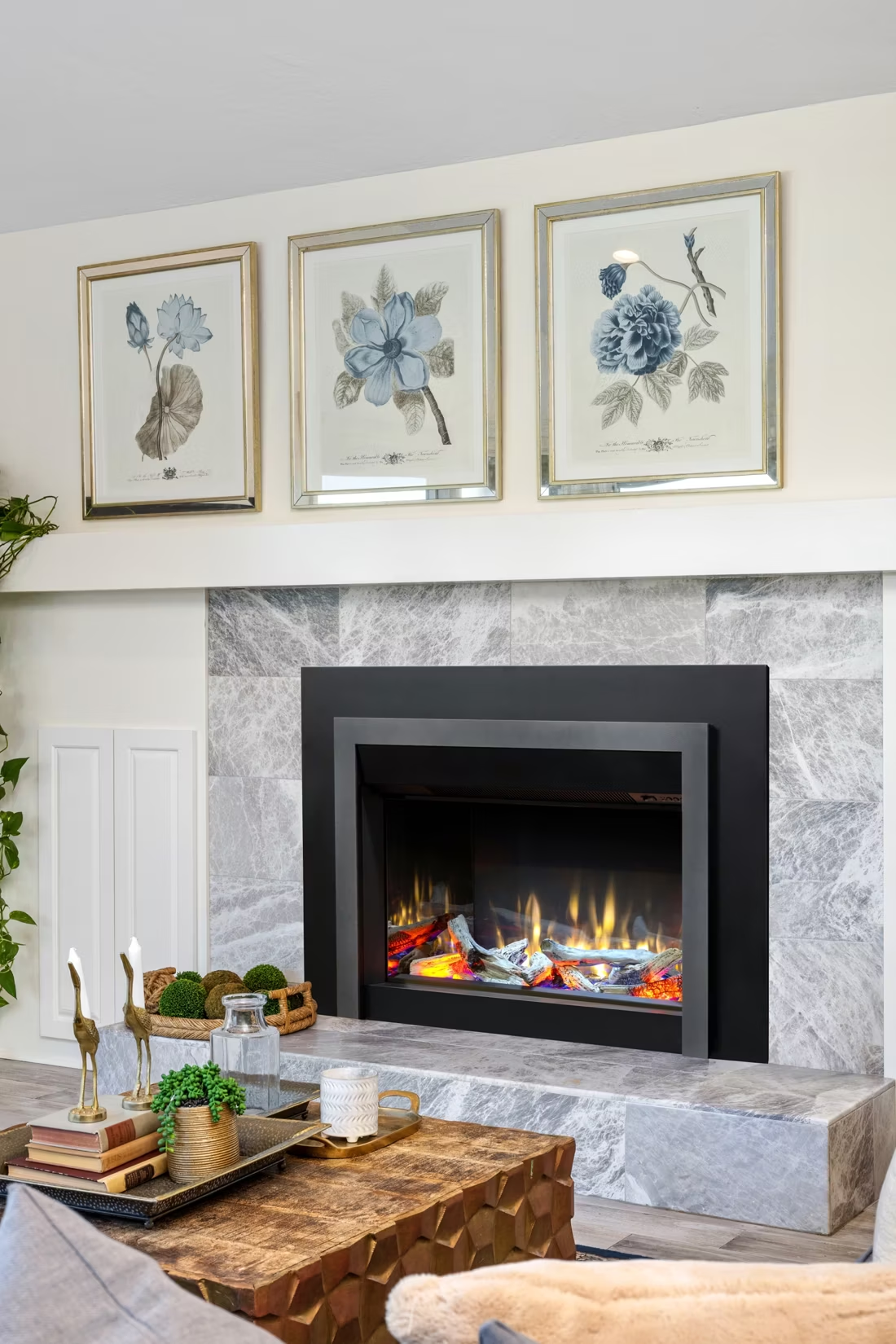
For homes with an existing wood-burning fireplace that's rarely used, a zero-clearance electric insert that slides into the firebox is the easiest upgrade—no chimney work, no venting, and it can be unplugged or removed later. For newer construction or remodels, a linear wall-mounted electric fireplace on a dedicated circuit gives a clean, modern look and better heat distribution for open-concept living areas. Given the mild climate here, sizing for supplemental heat rather than whole-home heating is the right approach—a local dealer can walk through wattage and placement for your specific room.
Can an electric fireplace actually heat a room, or is it just for looks?
A standard 1,500-watt electric fireplace puts out roughly 5,000 BTUs, enough to comfortably take the chill off a 300 to 400 square foot room—which lines up well with Pine Canyon's mild 38°F average winter low. It won't replace a central heating system in a larger or poorly insulated home, but as supplemental heat for a living room, bedroom, or converted garage, it's genuinely effective, not purely decorative. Homeowners who want it to double as a real heat source should size the wattage and room fit with a local dealer rather than guessing off a big-box display model.
What is Central Coast Community Energy, and does it change my fireplace's running cost?
Central Coast Community Energy (CCCE) is the default electricity generation provider for most Monterey County residents, including Pine Canyon, while PG&E continues to own the wires and handle delivery and billing. CCCE's generation rate, around $0.1301 per kWh, is lower than PG&E's own generation rate, which brings down part of your total bill—but PG&E's delivery, transmission, and various fixed charges still apply on top, so the total cost per kWh for running an electric fireplace lands well above the CCCE generation number alone. You can opt out of CCCE and return to full PG&E generation service, but most residential accounts stay enrolled since it typically saves money without changing anything about how power reaches the house.
Can I put a TV above my fireplace?
Yes—with an asterisk. Fireplaces are hot and TVs don't like heat. Either put a mantel between them to deflect rising warmth, or choose a fireplace with heat-management technology that creates a cool zone on the wall above—the wall stays around 125 degrees, barely warm, while the room still gets full heat. If you like clean lines and don't want a mantel, heat management is the answer.
Do electric fireplaces actually produce heat?
Yes—most put out around 4,800–5,000 BTUs from a standard outlet, which comfortably warms a bedroom, office, or den as a comfort-zone heater. What they won't do is carry a whole house the way wood, gas, or pellet can. Think of electric as ambiance-first with honest supplemental heat: flames on with no heat in July, flames plus warmth in January.
Can a fireplace actually lower my heating bill?
Yes—by creating a comfort zone. A furnace heats every square foot of the house just to warm the one room you're in; a gas fireplace on low burns roughly a sixth of the gas a typical furnace does. Set the furnace around 55–60 degrees as a baseline, then heat the rooms your family actually uses. Families who heat this way commonly save $20–$60 a month.
Can I install a fireplace myself?
If you're putting a fire in your house on purpose, it's best to work with an expert. Unless you're genuinely experienced in framing, gas line, vent pipe, and the national code on clearances to combustibles, have a professional do it—and ideally the same company that sells you the fireplace, so warranty, service, and liability all live under one roof.
Nearby Dealers
Hearth shops serving Pine Canyon and the surrounding area. Every listing shows whether it is a WhyFire partner, a dealer we have verified as authorized for the brands we recommend, or a local business carrying hearth products. No manufacturer pays for placement. How we verify dealers →
We’ve paused dealer listings for this connection today. Enter your zip or postal code above to find dealers near you, or come back tomorrow.
Popular Electric Brands
Where each brand came from, what's inside it today, and every current model. No brand pays to be here. Not every dealer carries every brand, so enter your zip code to see what's sold near Pine Canyon.
Fireplace Xtrordinair
Fireplace Xtrordinair, now often called FireplaceX, is the fireplace brand of Travis Industries, Inc., of Mukilteo, Washington.
5 electric models →DaVinci
DaVinci Custom Fireplaces is a brand of Travis Industries, Inc., of Mukilteo, Washington, the company behind Lopi and Fireplace Xtrordinair.
5 electric models →Kozy Heat
Kozy Heat was founded in 1976 by Dudley Hussong in Lakefield, Minnesota, and incorporated as Hussong Manufacturing Co., Inc. in 1978.
3 electric models →Forge & Flame
Forge & Flame is the stove brand Hearth & Home Technologies introduced in August 2023 to bring Vermont Castings, Harman, and Quadra-Fire under one name.
1 electric model →Electric Service in Pine Canyon
An electric fireplace's heater draws about 1,500 watts—pennies per hour at local rates.
Pacific Gas & Electric Co.
Central Coast Community Energy
Find your electric fireplace in Pine Canyon.
Tell us a bit about your home and we'll put together a free Project Guide & Parts List for your Pine Canyon electric fireplace project, along with help finding a trusted local dealer who can size the unit and handle the wiring correctly.
Find Your Fireplace →