
Instant warmth for Malibu's ocean-cooled evenings.
Malibu's coastal canyons rarely see a hard freeze, but cool ocean-driven evenings, wildfire-season power shutoffs, and a near-total ban on new wood-burning fireplaces make gas the default choice here. We'll help you find a trusted local dealer near Pepperdine and a free parts plan.
Every Project Starts From One of These Five Situations
Clean heat that fits a fire-conscious canyon community.
The Pepperdine University area sits in the Santa Monica Mountains above Malibu, at roughly 500 feet elevation in California's mild Climate Zone 3B. Winter lows average around 50°F and the region has a very light winter heating need—a fraction of what a place like Bozeman, MT sees in a single month. Heat here is about comfort and ambiance more than survival, and the canyon setting comes with real constraints: this stretch of Los Angeles County sits in a South Coast Air Basin non-attainment area, and the Woolsey Fire burned directly across the Pepperdine campus and the surrounding hillsides in 2018. Both factors shape what you're allowed to burn and where.
South Coast Air Quality Management District Rule 445 prohibits installing new wood-burning fireplaces or stoves anywhere in the basin, which is why wood shows up on this page as essentially a non-option for Pepperdine-area homes—gas, and less commonly electric, fill that role instead. Many hillside and canyon properties near campus sit far enough from the closest gas main that propane, not piped natural gas, is the practical fuel; other homes closer to Malibu Road or PCH may already have SoCalGas service. Either way, a direct-vent gas fireplace or insert gives you real flame and real heat on the rare cold, damp night, plus something increasingly valuable in this area: heat that keeps working when Southern California Edison cuts power during a Public Safety Power Shutoff.
Three steps. No salesperson until you're ready.
Tell us about your project
Your zip code, your situation, and the fuel you're leaning toward—or let the answers point you to one.
See what's actually available
The brands dealers within 100 miles genuinely carry—real options, never a catalog mirage.
Get your dealer & Project Guide
A trusted local dealer, plus the free Project Guide & Parts List that names every component of the job.
Frequently Asked Questions
How much does a gas fireplace installation cost near Pepperdine University?
Plan on roughly $5,500 to $13,000 for a gas fireplace or insert installation in the Malibu hills, which runs higher than the statewide average because of coastal labor rates, canyon-access logistics, and California's seismic requirements for gas appliance connections (flexible, seismically-rated gas lines and shutoff valves are standard here). A direct-vent insert into an existing masonry fireplace with gas already run to the hearth sits at the lower end. A new built-in unit that requires a fresh gas or propane line, framing, and venting through a tile or shake roof runs toward the higher end. Get a firm number from a local installer after they've seen your roofline and gas source.
Can I install a wood-burning fireplace instead of gas near Pepperdine University?
In almost all cases, no. This part of Los Angeles County falls under South Coast Air Quality Management District Rule 445, which bars new wood-burning fireplaces and wood stoves basin-wide—new construction and most remodels are required to use gas, pellet, or EPA-certified alternatives instead. Combined with the area's wildfire history (the Woolsey Fire burned across the Pepperdine campus and surrounding canyons in 2018) and strict defensible-space rules, open wood burning is discouraged even where legacy fireplaces already exist. If you already own an older wood-burning fireplace, a gas insert is the most common upgrade path—it keeps the masonry surround but replaces the open flame with a sealed, code-compliant gas unit.
Is my home on natural gas or propane near Pepperdine University?
It depends on where you sit in the canyon. Homes closer to Malibu Road and Pacific Coast Highway are more likely to have SoCalGas service already run to the property. Many hillside and canyon homes near campus, including a fair number in the 90263 and 90265 zips, are far enough from the nearest main that propane—supplied from an on-site tank—is the standard fuel instead. Both fuels work in the same gas fireplace models; your installer sets the orifice and regulator for whichever you have. If you're not sure which you have, check for an existing meter (natural gas) or a tank in the yard (propane), or ask your local dealer to confirm before you shop.
Will a gas fireplace still work during a Public Safety Power Shutoff?
Most will, which matters a lot in this area. Southern California Edison proactively cuts power to parts of the Santa Monica Mountains, including the roads around Pepperdine, during high fire-risk wind events—sometimes for a day or more. Gas fireplaces with intermittent pilot ignition (IPI) run on AA battery backup that kicks in the moment the power drops, so the unit still lights on demand. Valor's lineup goes a step further: its pilot assembly generates its own electricity through the thermocouple, so there's no battery to remember at all. Either option gives you real, standalone heat and light during a shutoff, which is worth asking about when you compare units.
What's the difference between a gas fireplace, insert, and stove?
A gas fireplace is a fully built-in unit framed into a wall—the right call for new construction or a remodel without an existing hearth. A gas insert drops into an existing masonry fireplace opening and uses the chimney as its vent chase, which is common in the older ranch-style and split-level homes scattered through the hills around Pepperdine. A gas stove is a freestanding cabinet-style unit that sits on the floor on its own hearth pad, useful in a room without any existing fireplace opening. For most homes near campus with an existing but rarely-used masonry fireplace, an insert is the simplest and least invasive upgrade.
Do I need a permit to install a gas fireplace near Pepperdine University?
Yes. Properties in the Malibu zip codes fall under the City of Malibu's Building Safety Division, which requires a building permit and a separate gas line permit for any new gas fireplace or insert, along with inspection of the seismic gas shutoff valve and flexible connector. Because much of this area is mapped as a Very High Fire Hazard Severity Zone, you may also need to show compliance with defensible-space and ember-resistant venting requirements if the installation involves exterior wall penetrations. A local installer who already works in Malibu will know how to route both the building and gas permits and get the LA County Fire clearance handled without extra back-and-forth.
Should I choose a vented or vent-free gas fireplace?
Go vented, or direct-vent, for a Malibu-area home. California doesn't ban vent-free units outright, but few local jurisdictions embrace them, and vent-free models release combustion byproducts into the room—a bigger concern in a coastal canyon where windows already stay shut for long stretches during wildfire smoke events. Direct-vent units draw combustion air from outside and exhaust it back outside through a sealed pipe, which also plays better with the seismic and code inspections the City of Malibu requires. Nearly every installer working near Pepperdine will point you toward a direct-vent model as the default.
How often does a gas fireplace need to be serviced near Pepperdine University?
Once a year, ideally before the fall Santa Ana wind season when Public Safety Power Shutoffs and wildfire smoke are most likely. A certified technician checks the burner, pilot assembly, glass seal, and venting, and confirms the battery backup or self-generating ignition is working. In this coastal canyon environment, salt-laden air and periods of heavy smoke exposure can accelerate corrosion on exterior venting components, so it's worth having a tech look at the outside termination cap during the same visit. Expect to pay somewhere in the $150 to $250 range for a standard annual inspection.
Gas vs. electric—which fireplace makes more sense here?
Given Pepperdine's mild Climate Zone 3B winters (lows around 50°F and a very light winter heating need), either can work, but the economics point toward gas for anything beyond occasional ambiance. Southern California Edison's residential rate runs about 28 cents per kWh—among the higher rates in the state—so an electric fireplace run for hours as supplemental heat costs noticeably more to operate than a gas unit burning propane or natural gas. Electric fireplaces do win on installation simplicity, often $400 to $1,500 with no venting or gas line required, and are the only realistic option for an interior room with no flue path. Wood, by contrast, isn't really in play here at all—SCAQMD Rule 445 and the area's wildfire risk have made gas the practical default for real flame and real heat near campus.
Can I put a TV above my fireplace?
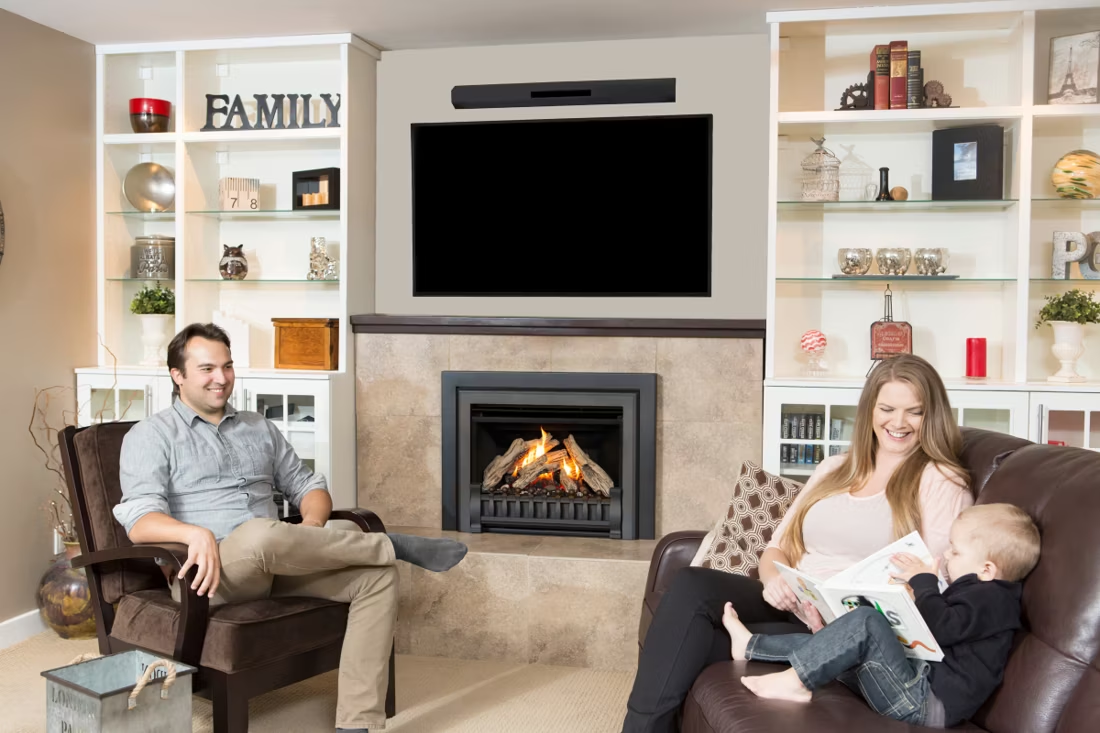
Yes—with an asterisk. Fireplaces are hot and TVs don't like heat. Either put a mantel between them to deflect rising warmth, or choose a fireplace with heat-management technology that creates a cool zone on the wall above—the wall stays around 125 degrees, barely warm, while the room still gets full heat. If you like clean lines and don't want a mantel, heat management is the answer.
What's the difference between an insert and a zero-clearance fireplace?
An insert is a fireplace that slides into a pre-existing wood-burning fireplace—if you don't have one, there's nothing to insert it into. A zero-clearance fireplace is built into a framed wall, which makes it the answer for remodels and new construction. Simple test: existing masonry fireplace means insert; blank or framed wall means zero-clearance.
Does a fireplace add value to my home?
On average, a fireplace adds back to the home about the same amount you spent installing it. Add the monthly savings from heating the rooms you actually use instead of the whole house—often hundreds of dollars a year—and the value case is strong before you even count what a fire does for how your family uses the room.
How much should I budget for a fireplace?
For an average home—covering the fireplace, the vent pipe, and basic installation—a budget between $3,900 and $5,500 gives you a lot of options across wood, gas, and pellet. By the time you add finish work, gas line, and electrical, the average complete installation lands between $5,000 and $12,000 all-in. In a remodel or new build, a good rule is to put about 2.5% of the total project cost toward the fireplace.
Nearby Dealers
Hearth shops serving Pepperdine University and the surrounding area. Every listing shows whether it is a WhyFire partner, a dealer we have verified as authorized for the brands we recommend, or a local business carrying hearth products. No manufacturer pays for placement. How we verify dealers →
We’ve paused dealer listings for this connection today. Enter your zip or postal code above to find dealers near you, or come back tomorrow.
Popular Gas Brands
Where each brand came from, what's inside it today, and every current model. No brand pays to be here. Not every dealer carries every brand, so enter your zip code to see what's sold near Pepperdine University.
Kozy Heat
Kozy Heat was founded in 1976 by Dudley Hussong in Lakefield, Minnesota, and incorporated as Hussong Manufacturing Co., Inc. in 1978.
28 gas models →Fireplace Xtrordinair
Fireplace Xtrordinair, now often called FireplaceX, is the fireplace brand of Travis Industries, Inc., of Mukilteo, Washington.
25 gas models →Town & Country
Town & Country Fireplaces is the luxury gas fireplace brand of Pacific Energy Fireplace Products Ltd., of Duncan, British Columbia.
14 gas models →Lopi
Lopi is a wood, pellet, and gas stove brand founded by Kurt Rumens in Bellevue, Washington, in 1979.
7 gas models →Forge & Flame
Forge & Flame is the stove brand Hearth & Home Technologies introduced in August 2023 to bring Vermont Castings, Harman, and Quadra-Fire under one name.
6 gas models →Vermont Castings
Vermont Castings was founded in 1975 by Duncan Syme, the designer, and his brother-in-law Murray Howell, the business partner, in Randolph, Vermont.
6 gas models →Find your gas fireplace near Pepperdine University.
Tell us a bit about your home in the Malibu hills and we'll help you find a trusted local dealer and send over a free Project Guide & Parts List—the exact unit, vent kit, and gas-line plan for your project, including a Public Safety Power Shutoff-ready ignition option.
Find Your Fireplace →