
Warmth on Demand, No Chimney Required.
Instant, flame-effect heat for Newark's mild bay-side winters—no venting, no gas line, no smoke. Find the right electric fireplace or insert and connect with a trusted local dealer.
Every Project Starts From One of These Five Situations
Mild bay winters, modern convenience.
Newark sits at 16 feet above sea level on the eastern shore of San Francisco Bay, in climate zone 3C—one of the mildest heating climates in the country. With winter lows averaging 43°F and a winter heating load that's just a small fraction of what colder regions see, Newark racks up a fraction of the heating load of a place like Fargo, ND, where furnaces run hard from October through April. Most homes here need supplemental warmth on cool, damp evenings, not a full combustion heating system.
Newark also falls inside the Bay Area Air Quality Management District's non-attainment area, and BAAQMD Regulation 6 restricts new wood-burning fireplace installations across Alameda County—a rule reinforced every fall by wildfire smoke advisories. That combination pushes many Newark homeowners toward electric: no combustion, no particulate emissions, and no chimney or gas line to install. It plugs into an existing outlet or a simple dedicated circuit, delivers real radiant heat with a realistic flame effect, and works in rooms—condos, apartments, upper-floor bedrooms—where venting a gas or wood unit would be impossible.
Three steps. No salesperson until you're ready.
Tell us about your project
Your zip code, your situation, and the fuel you're leaning toward—or let the answers point you to one.
See what's actually available
The brands dealers within 100 miles genuinely carry—real options, never a catalog mirage.
Get your dealer & Project Guide
A trusted local dealer, plus the free Project Guide & Parts List that names every component of the job.
Frequently Asked Questions
How much does it cost to install an electric fireplace in Newark?
Electric fireplace costs in Newark scale with the type of unit rather than venting work, since there's no chimney or gas line involved. A small freestanding or wall-mount unit that plugs into an existing outlet typically runs $200 to $1,500 installed. A built-in electric fireplace or a linear wall unit that needs a dedicated 20-amp circuit run by a licensed electrician usually lands between $1,500 and $4,000, including the trim kit and any surrounding cabinetry. Converting an existing masonry wood-burning fireplace to an electric insert—common in Newark's older ranch-style homes near Cherry Street and Central Avenue—generally falls in the $2,000 to $5,000 range depending on insert size and whether new wiring needs to be pulled to the firebox.
Why can't I install a new wood-burning fireplace in Newark?
Newark falls within the Bay Area Air Quality Management District's non-attainment area, and BAAQMD Regulation 6, Rule 3 bars the installation of new wood-burning fireplaces and stoves in new construction and most remodels across Alameda County. Existing wood-burning fireplaces built before the rule are generally grandfathered but must sit idle during Spare the Air winter advisories. Combined with regular wildfire smoke events in late summer and fall, this is why most Newark homeowners upgrading a fireplace today choose electric or gas rather than wood—both are exempt from burn-day restrictions.
Does an electric fireplace need its own circuit, or can it plug into a regular outlet?
It depends on the unit. Most small to mid-size electric fireplaces run on standard 120V household current and draw around 1,500 watts on high heat—well within the capacity of an existing 15- or 20-amp outlet, so no electrical work is needed beyond plugging it in. Larger built-in units, especially wide linear models over 50 inches, often call for a dedicated 20-amp circuit to avoid tripping breakers shared with other appliances. If new wiring is needed, a licensed electrician pulls a permit through the City of Newark Building Division—most local dealers coordinate this as part of the installation.
What will it cost to run an electric fireplace on PG&E rates?
PG&E's residential rate in Newark runs about $0.317 per kWh—among the highest in the country—so running costs are worth understanding upfront. A typical 1,500-watt unit on high heat costs roughly $0.47 an hour to run. Because Newark's winters are mild (average lows in the 40s, not the teens or single digits), most homeowners use an electric fireplace a few hours a night for a few months rather than as an all-day heat source, which keeps the actual monthly cost modest. Used as supplemental zone heat in a family room or bedroom rather than as a whole-home heating strategy, an electric fireplace is usually cheaper to operate than running central heat to warm the same space.
Can I convert my existing wood-burning fireplace to electric?
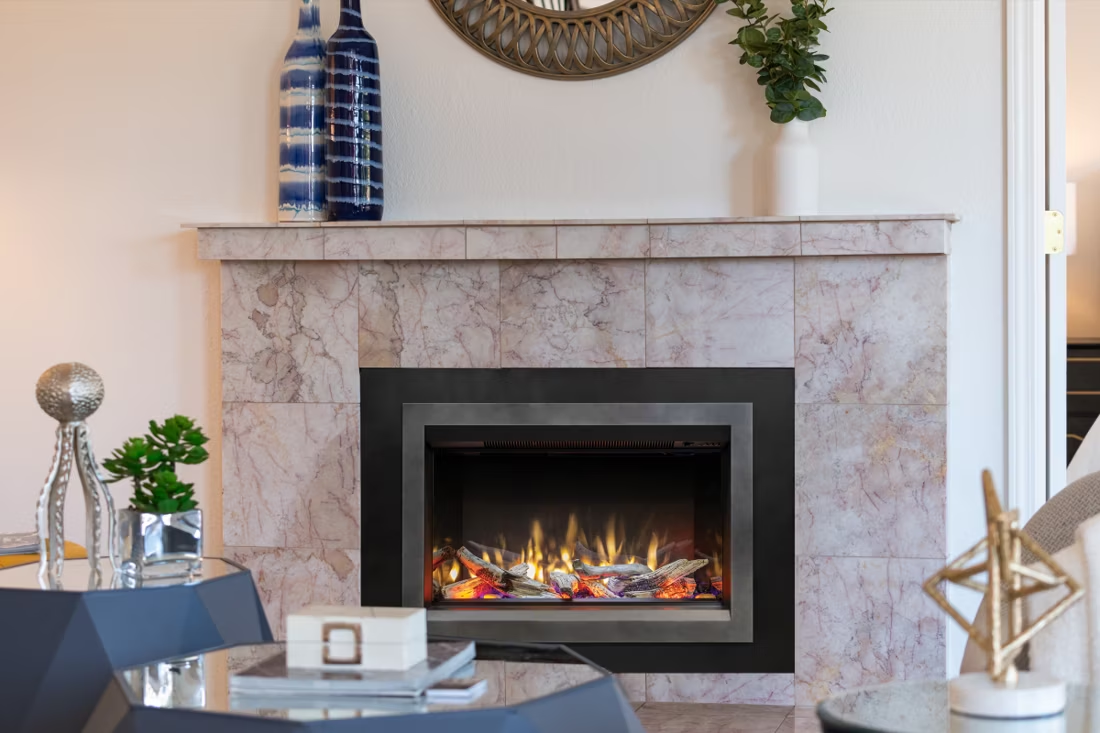
Yes, and it's a common project in Newark's older housing stock, much of it built in the 1960s and 1970s with traditional masonry fireboxes. An electric insert slides into the existing opening, and because there's no combustion, there's no need to reline or even use the chimney—some homeowners cap the flue afterward to stop cold air infiltration. The main installation work is running power to the firebox if there isn't an outlet already inside or near it. This route sidesteps BAAQMD's wood-burning restrictions entirely while keeping the look of the original fireplace surround.
Can an electric fireplace be my primary heat source in Newark?
Not typically, and most local homeowners don't need it to be. Newark's climate zone (3C) is mild enough that winter lows average in the low 40s, and most homes rely on a central furnace or heat pump for whole-house heating. Electric fireplaces are better suited to zone heating—warming the room you're actually in on a cool evening—or pure ambiance, since many models let you run the flame effect with the heater off. If you're trying to meaningfully cut your central heating bill, talk to a local dealer about heat output for the specific room you want to supplement.
Will my electric fireplace work during a power outage?
No—electric fireplaces require power to run both the heater and the flame effect, so they won't function during an outage. This is worth factoring in for Newark, where PG&E has implemented Public Safety Power Shutoffs (PSPS) during high fire-risk weather in nearby hills, occasionally affecting East Bay flatland communities as well. If backup heat during outages matters to you, a local dealer can talk through pairing an electric fireplace for everyday convenience with a separate battery or generator backup, since Newark's air district restrictions make wood-burning backup a non-starter for new installs.
Electric vs. gas fireplace—which makes more sense for a Newark home?
Both are viable in Newark, and the choice usually comes down to venting and use case. A gas fireplace or insert delivers more heat output and can double as meaningful backup heat, but it requires a gas line and, in most cases, venting to the exterior. An electric fireplace needs neither—it installs almost anywhere, costs less upfront, and produces zero emissions, which matters in a non-attainment air district that already restricts wood burning. For a room where running gas line would be difficult or expensive—an upstairs bedroom, a condo, an addition—electric is usually the simpler and cheaper path. For a primary living space where real supplemental heat output matters, gas is worth comparing.
Do I need a permit for an electric fireplace in Newark?
If you're plugging a freestanding unit into an existing outlet, no permit is required. If the installation involves adding a new dedicated circuit, relocating an outlet, or built-in cabinetry work, the City of Newark Building Division requires an electrical permit, and the work should be done by a licensed electrician. Most local hearth and appliance dealers handle this coordination as part of a built-in installation, so homeowners typically don't need to pull the permit themselves.
Do electric fireplaces actually produce heat?
Yes—most put out around 4,800–5,000 BTUs from a standard outlet, which comfortably warms a bedroom, office, or den as a comfort-zone heater. What they won't do is carry a whole house the way wood, gas, or pellet can. Think of electric as ambiance-first with honest supplemental heat: flames on with no heat in July, flames plus warmth in January.
Can I put a TV above my fireplace?
Yes—with an asterisk. Fireplaces are hot and TVs don't like heat. Either put a mantel between them to deflect rising warmth, or choose a fireplace with heat-management technology that creates a cool zone on the wall above—the wall stays around 125 degrees, barely warm, while the room still gets full heat. If you like clean lines and don't want a mantel, heat management is the answer.
How much should I budget for a fireplace?
For an average home—covering the fireplace, the vent pipe, and basic installation—a budget between $3,900 and $5,500 gives you a lot of options across wood, gas, and pellet. By the time you add finish work, gas line, and electrical, the average complete installation lands between $5,000 and $12,000 all-in. In a remodel or new build, a good rule is to put about 2.5% of the total project cost toward the fireplace.
What is an in-home preview and do I need one?
It's a visit where a hearth professional measures your space, confirms the model you picked actually works in your home, and walks the specs—framing, gas line, venting, finish work—before anything is ordered. Some details you just can't know until you see the house. Never make a down payment without one; it's the single most-skipped step that burns buyers.
Nearby Dealers
Hearth shops serving Newark and the surrounding area.
Electric Service in Newark
An electric fireplace's heater draws about 1,500 watts—pennies per hour at local rates.
Pacific Gas & Electric Co.
Find your electric fireplace in Newark.
Tell us a bit about your home and we'll match you with the right electric fireplace or insert, plus a free Project Guide & Parts List—the exact parts and your recommended local Newark dealer.
Find Your Fireplace →