
Ambiance without the ember risk in Malibu.
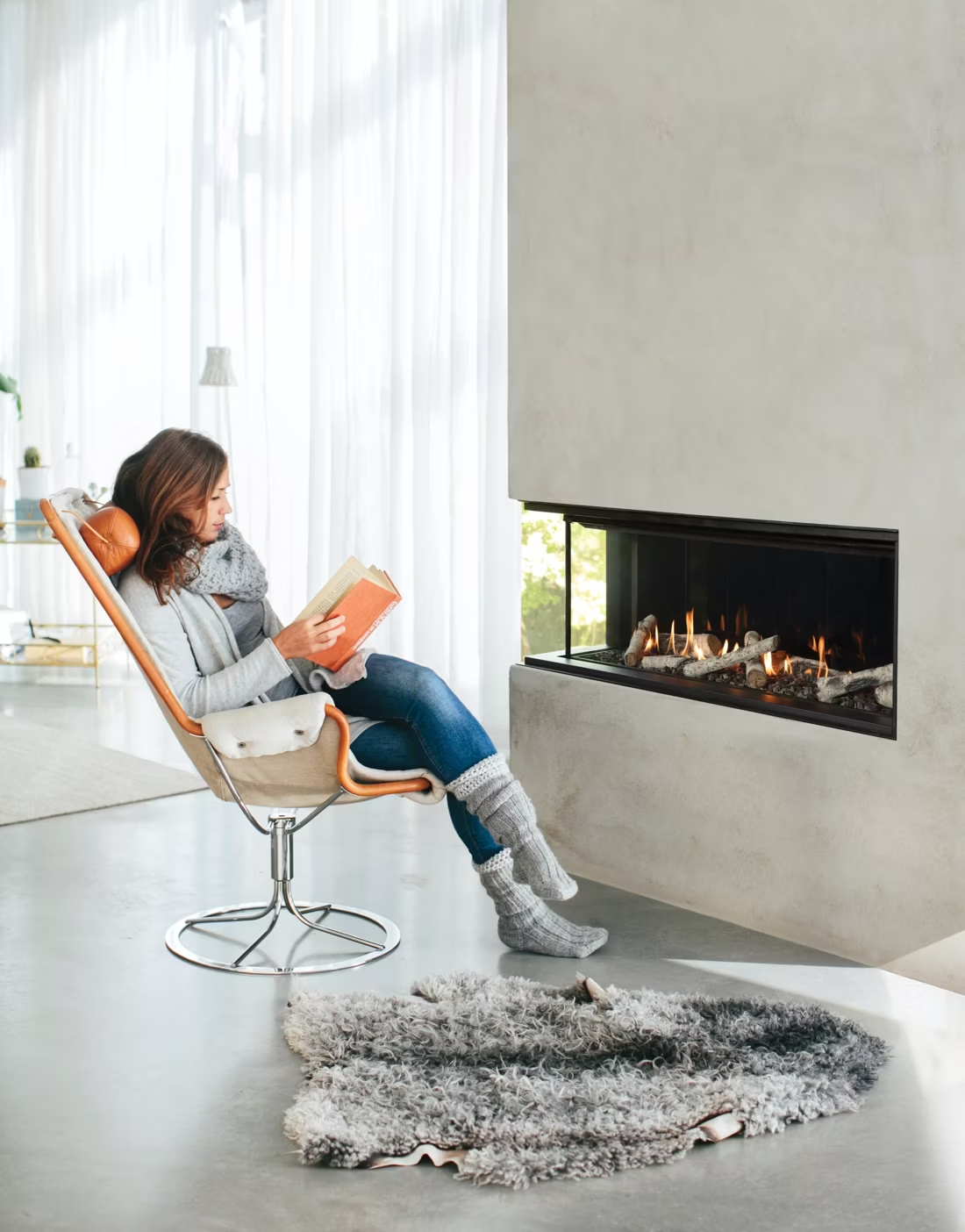
Malibu's canyon and hillside terrain call for careful fuel choices. A direct-vent gas fireplace delivers real flame and warmth without adding wood smoke or open embers to a Very High Fire Hazard Severity Zone.
Every Project Starts From One of These Five Situations
Mild winters, high fire risk, and a clear case for gas.
Malibu's winters are mild by any national standard—average lows sit around 43°F and the city has a very light heating season, only about a tenth of the winter heating load of a place like Bozeman, Montana sees in an average winter. Nobody here is heating a house through a Montana-style cold snap. What actually drives the fireplace decision in Malibu is fire risk, not cold: much of the city sits inside a Very High Fire Hazard Severity Zone, and Los Angeles County's air district has restricted new wood-burning installations for years because of both wildfire smoke and the region's persistent non-attainment status for particulate matter.
That combination makes gas the practical default. A sealed direct-vent gas fireplace produces no floating embers, no chimney sparks, and no smoke plume—the three things fire marshals and neighbors alike worry about in the canyons above Pacific Coast Highway. SoCalGas mains reach much of the coastal strip, though canyon and hillside properties beyond those mains commonly run on propane tanks instead. Either way, a local hearth dealer can size the unit, route the venting, and get it through the City of Malibu's Building Safety Division review—and can talk through an electric option served by Southern California Edison if you're outfitting a rental unit or ADU instead.
Three steps. No salesperson until you're ready.
Tell us about your project
Your zip code, your situation, and the fuel you're leaning toward—or let the answers point you to one.
See what's actually available
The brands dealers within 100 miles genuinely carry—real options, never a catalog mirage.
Get your dealer & Project Guide
A trusted local dealer, plus the free Project Guide & Parts List that names every component of the job.
Frequently Asked Questions
How much does a gas fireplace installation cost in Malibu?
Expect to pay roughly $5,500 to $13,000 for a gas fireplace or insert installed in Malibu, with the spread driven mostly by venting complexity and whether the property already has gas service in place. A direct-vent insert dropped into an existing masonry fireplace on a home already plumbed for natural gas sits at the lower end. A new built-in unit as part of a remodel—especially on a hillside lot where a contractor has to open stucco or stone and run new venting—pushes toward the upper end. Homes relying on propane may also need a new or upgraded tank, which adds to the estimate. A local retailer will walk your specific lot and give a firm number.
Is natural gas available in my part of Malibu, or do I need propane?
It depends on where you are. SoCalGas mains run along much of the Pacific Coast Highway corridor and into some of the flatter neighborhoods, but a lot of Malibu's canyon and hillside terrain—up Malibu Canyon, parts of Point Dume, areas above Carbon Canyon Road—sits beyond practical gas main access. Those properties typically run on a propane tank instead. Most gas fireplace models can be configured for either fuel with the correct orifice and regulator, so the fireplace itself isn't the limiting factor—it's whether a line reaches your lot. A local installer can confirm which utility serves your address and, if it's propane, coordinate the tank setup with a regional supplier.
Can I still install a wood-burning fireplace in Malibu?
Technically yes in some cases, but it's increasingly restricted and rarely the practical choice. Los Angeles County sits in a persistent non-attainment area for particulate air quality, and the South Coast Air Quality Management District's Rule 445 bars new wood-burning fireplaces in new residential construction, with similar pressure on remodels of existing homes. Add in Malibu's Very High Fire Hazard Severity Zone status, where wildfire smoke and ember risk are constant concerns, and most homeowners land on gas instead. A small number of longtime hillside properties keep an existing wood fireplace for occasional use, but new installs are almost exclusively gas or electric now.
What about a pellet stove instead?
Pellet stoves are uncommon in Malibu for much the same reasons wood is discouraged here—the county's air quality restrictions and the city's wildfire hazard zoning both push new installs toward gas or electric appliances instead. Pellet stoves also depend on a hopper and auger running on household power, which matters less locally given how rarely Malibu homes actually need supplemental heat, with winter lows averaging in the low 40s. If you're set on the look, a local dealer can walk you through the regulatory picture for your specific parcel, but most homeowners here end up choosing a direct-vent gas unit instead.
Can I convert my existing wood-burning fireplace to gas?
Yes, and it's one of the more common projects on older Malibu properties that still have a masonry, wood-era firebox. A gas insert or a set of vented gas logs goes into the existing opening, using a liner run through the same chimney. It removes the wood-smoke and ember concern the county cares about while keeping the original stone or brick surround intact. Whether you're on natural gas or propane determines how much line work is involved—homes already on a SoCalGas line are the simpler retrofit, while propane homes need a line run to an existing or new tank.
Will my gas fireplace still work if the power goes out?
Most will, which matters in a place where Public Safety Power Shutoff events from Southern California Edison are a real possibility during red-flag wind conditions. Units with intermittent pilot ignition (IPI) run on a small battery backup that kicks in automatically when grid power drops, so the fireplace still lights on demand. Valor's gas fireplaces go a step further—the pilot's thermocouple generates the small amount of electricity the unit needs, so there's no battery to remember at all. Ask your local dealer about the ignition system on any model you're considering if outage-proof heat matters to you.
Do I need a permit to install a gas fireplace in Malibu?
Yes—the City of Malibu's Building Safety Division requires a building permit for new gas fireplace installations, and any new gas line work needs a licensed gas-fitter signing off as well. Because Malibu enforces stricter fire-hazard building standards than many California cities, plan reviewers will also want to see venting clearances and, on hillside lots, confirmation that the installation doesn't conflict with defensible-space or fire-hazard zone requirements. Most established hearth dealers handle this permitting as part of the install rather than leaving you to coordinate it yourself.
Should I choose a vented or vent-free gas fireplace?
For Malibu, vented direct-vent is the clear recommendation. Vent-free units burn fuel directly into the room and release combustion byproducts indoors—legal in California but subject to strict room-sizing and ventilation rules, and a harder sell in a tightly sealed coastal home. Direct-vent units draw combustion air from outside and exhaust it back outside through a sealed pipe, so they don't add anything to indoor air or interact with the wildfire-smoke concerns that already shape a lot of the region's air-quality thinking. Nearly every installer working in Malibu will steer you toward a direct-vent model as the default.
Gas or electric—which fireplace makes more sense in Malibu?
Given how mild Malibu's winters run—lows average in the low 40s and the city has only a very light heating season—neither option is really about heat output. Gas gives you a real flame and a more authentic fireplace feel for evening ambiance, plus outage resilience with the right ignition system. Electric units plug into a standard outlet, involve no venting or gas line at all, and sidestep any fire-hazard-zone questions entirely, though Southern California Edison's residential rate—currently around 28 cents per kWh—makes electric heat itself relatively pricey to run as anything more than occasional supplemental warmth. For a primary living space, many owners choose gas for the flame; for a bedroom, ADU, or rental unit, electric is often the simpler, code-lighter install.
Can I put a TV above my fireplace?
Yes—with an asterisk. Fireplaces are hot and TVs don't like heat. Either put a mantel between them to deflect rising warmth, or choose a fireplace with heat-management technology that creates a cool zone on the wall above—the wall stays around 125 degrees, barely warm, while the room still gets full heat. If you like clean lines and don't want a mantel, heat management is the answer.
Is my gas fireplace wasting gas?
If it was installed more than 15 years ago, probably. Older gas fireplaces keep a standing pilot light burning all the time, and that little flame can cost a couple hundred dollars a year. Newer models use pilot-on-demand ignition—the pilot lights only when you use the fireplace and goes out when you turn it off.
Does a fireplace add value to my home?
On average, a fireplace adds back to the home about the same amount you spent installing it. Add the monthly savings from heating the rooms you actually use instead of the whole house—often hundreds of dollars a year—and the value case is strong before you even count what a fire does for how your family uses the room.
How much should I budget for a fireplace?
For an average home—covering the fireplace, the vent pipe, and basic installation—a budget between $3,900 and $5,500 gives you a lot of options across wood, gas, and pellet. By the time you add finish work, gas line, and electrical, the average complete installation lands between $5,000 and $12,000 all-in. In a remodel or new build, a good rule is to put about 2.5% of the total project cost toward the fireplace.
Nearby Dealers
Hearth shops serving Malibu and the surrounding area. Every listing shows whether it is a WhyFire partner, a dealer we have verified as authorized for the brands we recommend, or a local business carrying hearth products. No manufacturer pays for placement. How we verify dealers →
We’ve paused dealer listings for this connection today. Enter your zip or postal code above to find dealers near you, or come back tomorrow.
Popular Gas Brands
Where each brand came from, what's inside it today, and every current model. No brand pays to be here. Not every dealer carries every brand, so enter your zip code to see what's sold near Malibu.
Kozy Heat
Kozy Heat was founded in 1976 by Dudley Hussong in Lakefield, Minnesota, and incorporated as Hussong Manufacturing Co., Inc. in 1978.
28 gas models →Fireplace Xtrordinair
Fireplace Xtrordinair, now often called FireplaceX, is the fireplace brand of Travis Industries, Inc., of Mukilteo, Washington.
25 gas models →Town & Country
Town & Country Fireplaces is the luxury gas fireplace brand of Pacific Energy Fireplace Products Ltd., of Duncan, British Columbia.
14 gas models →Lopi
Lopi is a wood, pellet, and gas stove brand founded by Kurt Rumens in Bellevue, Washington, in 1979.
7 gas models →Forge & Flame
Forge & Flame is the stove brand Hearth & Home Technologies introduced in August 2023 to bring Vermont Castings, Harman, and Quadra-Fire under one name.
6 gas models →Vermont Castings
Vermont Castings was founded in 1975 by Duncan Syme, the designer, and his brother-in-law Murray Howell, the business partner, in Randolph, Vermont.
6 gas models →Find your gas fireplace in Malibu.
Tell us about your home and fuel access—natural gas or propane—and we'll help you find a trusted local dealer and send over a free Project Guide & Parts List for your Malibu install.
Find Your Fireplace →