
Real Flame, Real Simple, Right Here in Lompoc.
Instant warmth for the marine-layer chill that rolls off the Santa Ynez Valley most evenings. Find the right gas fireplace or insert and connect with a trusted local dealer.
Every Project Starts From One of These Five Situations
Warmth on demand for coastal California evenings.
Lompoc sits at just 80 feet elevation along the Santa Ynez River, a few miles from the Pacific, where the average winter low hovers around 43°F and the heating season is a short, mild one, adding up to a light winter heating load year to year. Compare that to a place like Duluth, MN, which racks up over four times that load, and it's clear why Lompoc homes don't need a wood-burning furnace to survive January. What they do need is a quick, clean way to take the edge off a foggy evening once the marine layer settles in.
That's why wood stoves and pellet stoves are essentially absent from Lompoc's hearth market—the mild climate doesn't demand them, and Santa Barbara County's air quality rules around wildfire smoke make solid-fuel burning appliances a hard sell for most homeowners here. Gas fills that gap well. Homes inside town with existing gas service can add a direct-vent fireplace or insert with minimal fuss, while properties out toward the vineyards and ranchland beyond city limits often run on propane instead. Either way, a gas fireplace delivers real heat at the flip of a switch—useful given that Lompoc's electric rates, split between Pacific Gas & Electric and the city's own municipal utility, run close to 32 cents per kWh, making electric resistance heat one of the more expensive ways to warm a room here.
Three steps. No salesperson until you're ready.
Tell us about your project
Your zip code, your situation, and the fuel you're leaning toward—or let the answers point you to one.
See what's actually available
The brands dealers within 100 miles genuinely carry—real options, never a catalog mirage.
Get your dealer & Project Guide
A trusted local dealer, plus the free Project Guide & Parts List that names every component of the job.
Frequently Asked Questions
How much does a gas fireplace installation cost in Lompoc?
Most direct-vent gas fireplace or insert installations in Lompoc run between roughly $3,500 and $9,000, with the spread driven mostly by venting complexity and whether a new gas line needs to be run. A gas insert dropped into an existing masonry fireplace with gas already nearby sits at the low end. A new built-in unit in a remodeled family room, or a home that needs a propane tank set because it's outside the in-town gas service area, lands toward the higher end. A local dealer will give you a firm number after seeing the space in person.
Can I convert my wood-burning fireplace to gas?
Yes, and it's a common project in Lompoc, partly because Santa Barbara County's wildfire-smoke concerns and periodic burn restrictions make an open wood fireplace less appealing than it once was. A gas insert typically slides into the existing masonry opening with a stainless liner run up the old chimney, so you keep the look of your fireplace while losing the smoke, ash, and the need to source oak or Douglas fir. Budget roughly $4,000 to $8,500 depending on the insert and whether the flue needs relining.
Do I need natural gas, or is propane the way to go in Lompoc?
It depends on where in Lompoc you are. Homes in the older, in-town neighborhoods around H Street and Ocean Avenue typically already have natural gas service and can add a fireplace with a simple line tap. Properties farther out toward the surrounding ag and vineyard land often aren't on a gas main at all and rely on a propane tank instead. Most gas fireplace models can be configured for either fuel, so the choice usually comes down to what's already running to your house rather than the fireplace itself.
Will a gas fireplace still work if the power goes out?
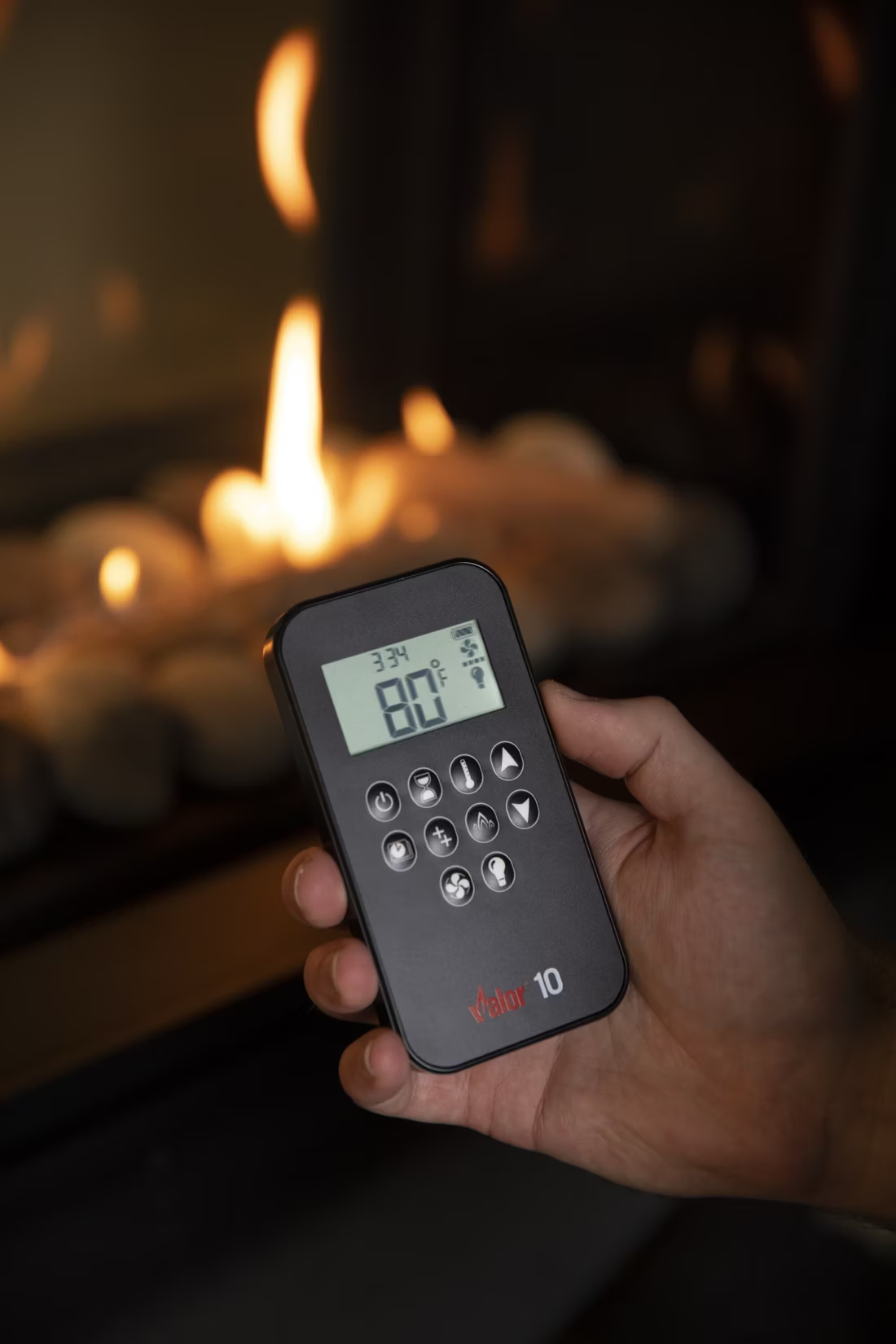
Most will. Units with intermittent pilot ignition (IPI) run on a small battery backup that kicks in the moment power drops, so the fireplace lights normally even during an outage—just remember to swap the batteries occasionally. Valor fireplaces go a step further: their pilot assembly generates its own electricity through the thermocouple, so there's no battery to forget at all. That matters in Lompoc, where winter storms off the coast and occasional high-wind events near Vandenberg can knock out power for a stretch.
What's the difference between a gas fireplace, insert, and stove?
A gas fireplace is a built-in unit framed into a wall, typically used in new construction or a remodel. A gas insert is sized to slide into an existing masonry fireplace opening, converting it into a sealed, efficient unit that vents through the original chimney. A gas stove is a freestanding cabinet-style unit that sits on the floor, similar in footprint to a wood stove but running on gas. For the many Lompoc homes built with a traditional masonry fireplace already in place, an insert is usually the simplest upgrade.
Do I need a permit to install a gas fireplace in Lompoc?
Yes. New gas fireplace and insert installations require a building permit and gas line sign-off, handled through the City of Lompoc Building Division for in-town addresses or Santa Barbara County Building & Safety for county parcels outside city limits. The gas line work itself needs a licensed gas-fitter. Most established hearth dealers coordinate the permit and inspection as part of the installation, so you're not left managing separate trades yourself.
Can I install a vent-free gas fireplace in Lompoc?
California is one of the more restrictive states when it comes to unvented gas appliances—vent-free units are limited by room size, require an oxygen depletion sensor, and can't go in bedrooms or small enclosed spaces under state fire marshal rules. Given those restrictions, most Lompoc installations use direct-vent units instead, which draw combustion air from outside and exhaust it back out through a sealed pipe. They're simpler to get approved and don't raise any indoor air quality questions, which matters in a county that already deals with wildfire smoke concerns for much of the year.
How often does a gas fireplace need servicing?
Plan on an annual inspection, ideally before the fog season ramps up in late fall. A technician checks the burner, pilot assembly, gas connections, and venting, and cleans the glass—a much lighter lift than chimney sweeping for a wood unit, but still important since a cracked seal or blocked vent can let combustion byproducts back into the house. Local gas appliance service techs typically charge somewhere in the $150 to $250 range for a standard inspection.
Why don't more Lompoc homes have wood stoves?
Mostly climate and air quality. With winter lows averaging around 43°F and only a short, mild heating season each year, Lompoc simply doesn't get cold enough long enough to justify a wood stove as a primary heat source the way a place with a real winter would. On top of that, Santa Barbara County's ongoing wildfire smoke concerns make local air districts less permissive of new solid-fuel burning appliances. Oak, madrone, and Douglas fir do grow in the hills around Los Padres National Forest, and you can still pull a personal-use cutting permit there for $5 to $20 a cord during the May-to-October season—but that wood mostly ends up in campfire rings and outdoor fire pits rather than indoor stoves. For actual home heat and ambiance, gas is the practical choice here.
Is my gas fireplace wasting gas?
If it was installed more than 15 years ago, probably. Older gas fireplaces keep a standing pilot light burning all the time, and that little flame can cost a couple hundred dollars a year. Newer models use pilot-on-demand ignition—the pilot lights only when you use the fireplace and goes out when you turn it off.
Why is my open fireplace making my house colder?
Open fireplaces suck—literally. As the fire burns, it consumes air your furnace already paid to heat and pulls it out through the chimney, so the house is actually colder after the fire goes out than before you lit it. An insert fixes this: it seals the chimney, puts fixed glass across the front, and turns that hole in your house into a real heat source.
Can I install a fireplace myself?
If you're putting a fire in your house on purpose, it's best to work with an expert. Unless you're genuinely experienced in framing, gas line, vent pipe, and the national code on clearances to combustibles, have a professional do it—and ideally the same company that sells you the fireplace, so warranty, service, and liability all live under one roof.
Can a fireplace actually lower my heating bill?
Yes—by creating a comfort zone. A furnace heats every square foot of the house just to warm the one room you're in; a gas fireplace on low burns roughly a sixth of the gas a typical furnace does. Set the furnace around 55–60 degrees as a baseline, then heat the rooms your family actually uses. Families who heat this way commonly save $20–$60 a month.
Nearby Dealers
Hearth shops serving Lompoc and the surrounding area.
Find your gas fireplace in Lompoc.
Tell us a bit about your home and we'll put together a free Project Guide & Parts List for your Lompoc gas fireplace project, including the exact parts and vent kit, and match you with a trusted local dealer to install it.
Find Your Fireplace →