
Warmth on Demand for Mild Orange County Evenings.
Ladera Ranch winters rarely get cold, but a gas fireplace still earns its place—instant ambiance on a 44-degree evening, no chimney, no smoke. Get matched with a local dealer who knows the codes and the HOA rules here.
Every Project Starts From One of These Five Situations
Built for ambiance, not survival heat.
At 515 feet in south Orange County, Ladera Ranch has a mild winter heating load—a fraction of what a place like Fargo, ND sees in a single hard winter. Average winter lows hover around 44°F. Nobody here is burning fuel to survive the night. What a gas fireplace does in this climate is different: it takes the edge off a cool coastal evening, anchors a great room in one of the community's builder-grade homes, and turns on with a remote instead of a match.
Ladera Ranch is unincorporated, which means building permits run through Orange County's Community Development/Building Services rather than a city hall, and most neighborhoods here also carry active HOA architectural review—worth checking before you touch venting on an exterior wall. The area sits within South Coast AQMD's non-attainment zone, and wildfire smoke is a real seasonal concern most falls, which is a big part of why wood-burning has faded from new construction here. Gas sidesteps both issues: it's clean-burning, doesn't need a woodpile, and works in tightly sealed, code-modern homes built in the early 2000s like most of Ladera Ranch's housing stock.
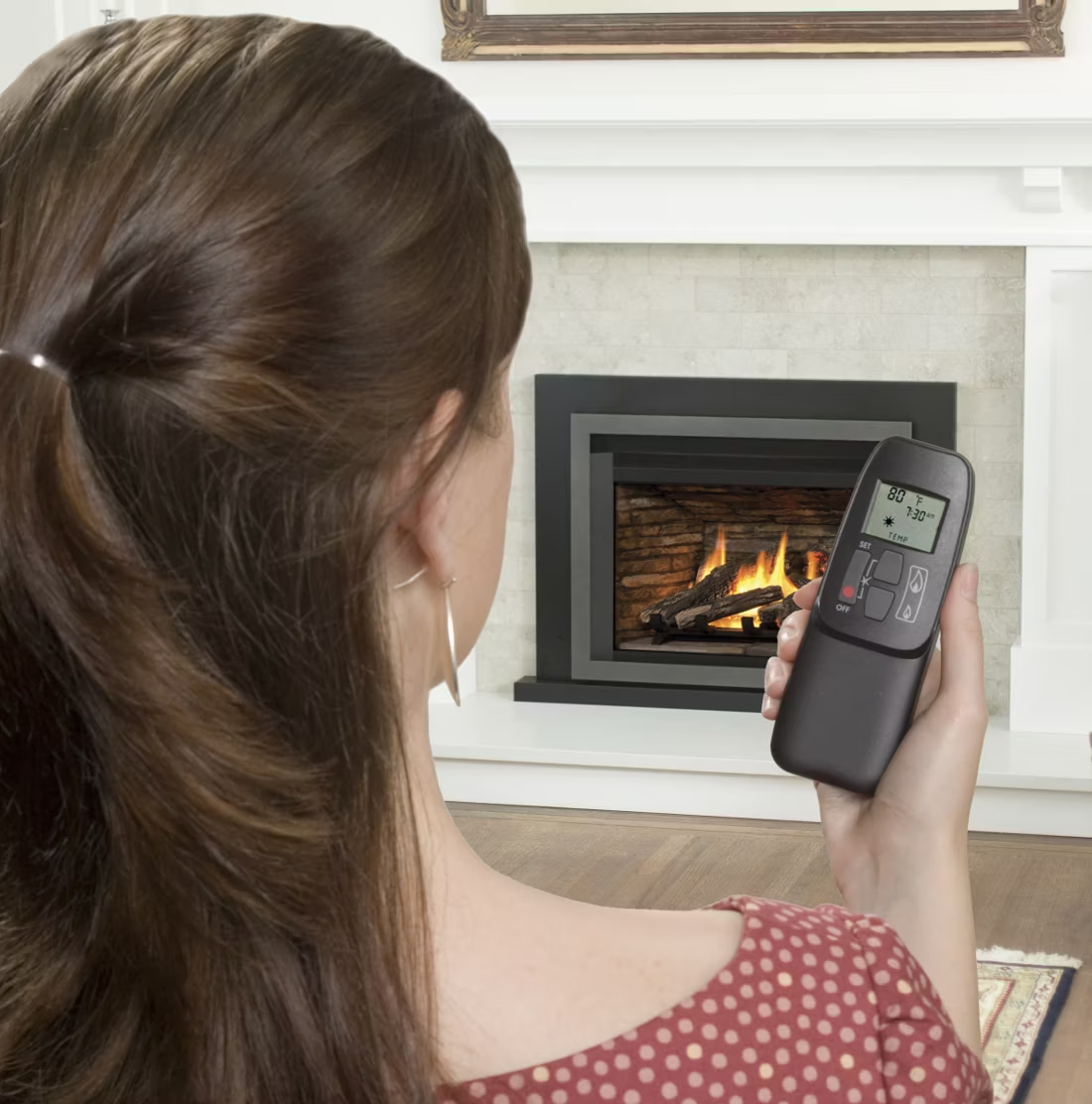
Three steps. No salesperson until you're ready.
Tell us about your project
Your zip code, your situation, and the fuel you're leaning toward—or let the answers point you to one.
See what's actually available
The brands dealers within 100 miles genuinely carry—real options, never a catalog mirage.
Get your dealer & Project Guide
A trusted local dealer, plus the free Project Guide & Parts List that names every component of the job.
Frequently Asked Questions
How much does a gas fireplace installation cost in Ladera Ranch?
For a direct-vent gas insert into an existing builder fireplace with a gas line already stubbed in, expect roughly $3,800 to $6,500 in this market. A new built-in gas fireplace for a remodel—with fresh venting through an exterior wall and possibly new gas line runs—typically lands between $6,500 and $9,500. Because most Ladera Ranch homes were built in the same 2000s construction wave, gas lines are usually already routed to the family room, which keeps a lot of jobs on the lower end of that range. A local dealer can confirm the number after seeing your existing setup.
My home has an old builder-grade wood fireplace. Can I convert it to gas?
Yes, and it's one of the most common requests dealers get in this part of Orange County. Many Ladera Ranch homes shipped with a standard masonry-look wood-burning fireplace that's rarely used, both because of South Coast AQMD's wildfire-smoke-era air quality concerns and because there's just not much cold to justify tending a real fire. A gas log set or gas insert uses your existing firebox and chimney (with a liner), typically running $3,500 to $7,000 depending on whether it's a vented log set or a sealed high-efficiency insert. It's a straightforward weekend-scale project for a licensed installer.
Does Ladera Ranch have natural gas service, or is it propane?
Ladera Ranch's neighborhoods were built out in the 2000s with natural gas plumbed to the home as standard infrastructure, so the overwhelming majority of houses already have a gas line to the kitchen and often the family room fireplace location. That makes adding or converting a fireplace simpler than in older, unpiped construction—your installer taps the existing line rather than coordinating a new tank or service run. Propane is rarely used in this specific community given how universal natural gas hookups already are here.
Will my gas fireplace still work if the power goes out?
Most direct-vent gas fireplaces with intermittent pilot ignition (IPI) run on a small battery backup that kicks in the moment power drops, so the unit still lights on demand—useful during the occasional Santa Ana wind-driven outage that hits south Orange County during fire season. Valor units take it a step further: their pilot assembly generates its own electricity through the thermocouple, so there's no battery to remember at all. Given how much SDG&E's residential rates run here (over 32 cents per kWh), a gas fireplace that keeps working without grid power is also a nice hedge against relying on a space heater during an outage.
Fireplace, insert, or stove—what fits a Ladera Ranch home best?
If you already have a builder fireplace opening, an insert is almost always the right call—it drops into the existing firebox, uses the chimney chase that's already framed into the wall, and needs minimal structural change. A built-in gas fireplace makes more sense for a room addition or full remodel where there's no existing opening. A freestanding gas stove is less common in this community's open-concept great rooms but works well in a casual room or converted garage/bonus space where a fireplace wasn't originally planned.
Do I need a permit—or HOA approval—to install a gas fireplace here?
Yes to both, typically. Because Ladera Ranch is unincorporated, building and gas line permits go through Orange County's Community Development/Building Services rather than a city building department. Separately, most Ladera Ranch neighborhoods are governed by active homeowners associations with architectural review committees, and any change that affects the home's exterior—including new vent termination through a wall or roof—usually needs HOA sign-off before OC will finalize the permit. A dealer who's worked in the community before will already know which HOA forms to file alongside the county permit.
Vented vs. vent-free gas fireplaces—does it matter in California?
Vent-free (ventless) gas units are legal in California but come with strict room-size and ventilation rules since they release combustion byproducts directly into the living space. Direct-vent units, which draw outside air and exhaust outside through a sealed pipe, are far more common in Ladera Ranch's tightly built, energy-code-compliant homes—they don't affect indoor air quality and pair better with modern HVAC systems that already manage the home's air exchange. Given the area's non-attainment air quality designation, most local dealers steer homeowners toward direct-vent as the default and only bring up vent-free for very specific small-room situations.
How often does a gas fireplace need to be serviced?
Plan on an annual inspection, ideally before the fall/winter season when you'll actually use it. A technician checks the burner, pilot assembly, glass seal, and venting termination, and cleans out any dust or spider webs that built up over the mild months when the unit sat idle—a real issue in a coastal climate like Ladera Ranch where fireplaces often go eight or nine months without a flame. Expect to pay in the $150 to $250 range for a standard annual service call from a certified hearth technician.
Should I consider wood or electric instead of gas?
Wood isn't really in play here—South Coast AQMD's wood-burning device rules for this non-attainment area, combined with wildfire smoke concerns most falls, have pushed new and remodeled homes almost entirely away from wood, and most Ladera Ranch houses were never built with the masonry chimneys wood-burning requires anyway. Electric fireplaces are a legitimate alternative for pure ambiance—no venting, no gas line, simple plug-in install—but running one for real heat gets expensive fast given SDG&E's residential rate near 32 cents per kWh. For most Ladera Ranch homeowners who want both a convincing flame and reasonable operating cost, gas remains the practical choice.
Is my gas fireplace wasting gas?
If it was installed more than 15 years ago, probably. Older gas fireplaces keep a standing pilot light burning all the time, and that little flame can cost a couple hundred dollars a year. Newer models use pilot-on-demand ignition—the pilot lights only when you use the fireplace and goes out when you turn it off.
What's the difference between an insert and a zero-clearance fireplace?
An insert is a fireplace that slides into a pre-existing wood-burning fireplace—if you don't have one, there's nothing to insert it into. A zero-clearance fireplace is built into a framed wall, which makes it the answer for remodels and new construction. Simple test: existing masonry fireplace means insert; blank or framed wall means zero-clearance.
How much should I budget for a fireplace?
For an average home—covering the fireplace, the vent pipe, and basic installation—a budget between $3,900 and $5,500 gives you a lot of options across wood, gas, and pellet. By the time you add finish work, gas line, and electrical, the average complete installation lands between $5,000 and $12,000 all-in. In a remodel or new build, a good rule is to put about 2.5% of the total project cost toward the fireplace.
Can a fireplace actually lower my heating bill?
Yes—by creating a comfort zone. A furnace heats every square foot of the house just to warm the one room you're in; a gas fireplace on low burns roughly a sixth of the gas a typical furnace does. Set the furnace around 55–60 degrees as a baseline, then heat the rooms your family actually uses. Families who heat this way commonly save $20–$60 a month.
Nearby Dealers
Hearth shops serving Ladera Ranch and the surrounding area.
Find your gas fireplace in Ladera Ranch.
Tell us about your home and HOA situation, and we'll match you with a trusted local dealer and send over a free Project Guide & Parts List—the exact parts, vent kit, and recommended installer for your Ladera Ranch project.
Find Your Fireplace →