
Fireplace heat that never adds smoke in a valley already watching for advisories.
Cache Creek sits at 464m in a dry interior valley where winter lows average -5.6°C. We'll help you find a trusted local dealer who can size an electric fireplace right for your room and send a free planning packet.
Every Project Starts From One of These Five Situations
Electric fits a small town that already watches its power bill.
Cache Creek sits in one of the driest, hottest valley bottoms in Canada—Thompson-Nicola's summers regularly top 35°C—but at 464m elevation, with a winter low averaging -5.6°C, the cold season still runs long enough to matter, roughly five months of chilly nights each year. That's a milder cold stretch than Prince George or Fort McMurray see, but still enough to make a dependable supplemental heat source worthwhile in a town of just over a thousand people where many homes are manufactured or mobile units set along the highway corridor.
Interior valleys like this one are prone to winter inversions and wildfire smoke advisories—Cache Creek itself was evacuated during the 2017 Elephant Hill fire—so several regional districts, including this one, run wood-stove exchange programs and require CSA- or EPA-certified appliances for anything that burns. An electric fireplace sidesteps that conversation entirely: no combustion, no smoke, no advisory-day restrictions, and no WETT inspection required for insurance. With BC Hydro billing residential power at roughly $0.114 per kWh, running one as a zone heater in a bedroom or den is inexpensive, and FortisBC's electric division also serves part of the area.
Three steps. No salesperson until you're ready.
Tell us about your project
Your postal code, your situation, and the fuel you're leaning toward—or let the answers point you to one.
See what's actually available
The brands dealers within 100 miles genuinely carry—real options, never a catalog mirage.
Get your dealer & Project Guide
A trusted local dealer, plus the free Project Guide & Parts List that names every component of the job.
Frequently Asked Questions
How much does an electric fireplace installation cost in Cache Creek?
Most electric fireplace projects here run $500 to $1,600 CAD. A simple plug-in insert or wall-mount unit that uses an existing outlet sits at the low end—common in the manufactured and mobile homes that make up a good share of Cache Creek's housing stock. A built-in unit that needs a dedicated circuit run by a licensed electrician, or custom millwork around it, lands toward the top of that range. Either way, there's no chimney, no gas line, and no venting to budget for, which is why electric is usually the cheapest fireplace project a homeowner here can take on.
Do I need a permit for an electric fireplace in Cache Creek?
Usually not for the appliance itself. Electric fireplaces don't burn fuel, so they fall outside the CSA B365 rules and the municipal building department permitting that applies to wood and gas installs. If your project needs a new dedicated circuit, that electrical work has to be done by a licensed electrician and is subject to Technical Safety BC's electrical permit requirements—your dealer or electrician typically handles that paperwork directly. No WETT inspection is needed, since that's specific to wood-burning appliances and insurance.
Is electric heat enough for Cache Creek's winters?
It depends on the role you want it to play. With a winter low averaging -5.6°C, Cache Creek's cold season is real but nowhere near what places like Prince George or Fort McMurray see, so an electric fireplace works well as a zone heater for a bedroom, den, or secondary suite rather than as the whole house's primary heat source. Most local buyers pair one with existing baseboard or forced-air heat and use it to take the edge off a specific room without running the whole system, which also keeps BC Hydro bills in check given the roughly $0.114 per kWh residential rate.
How does wildfire smoke and winter inversion affect fireplace choice here?
It matters more than in a lot of BC towns. Cache Creek sits in a valley bottom that traps winter inversions, and the area has lived through serious wildfire smoke seasons—the 2017 Elephant Hill fire forced an evacuation of the townsite itself. On advisory days, wood-burning appliances, even certified ones, add to the smoke load, and some regional wood-stove exchange programs restrict older units. Electric fireplaces produce zero combustion byproducts, so they're never part of that conversation—useful if you want reliable supplemental heat that doesn't add to an already smoky valley.
Electric vs. gas fireplace—which makes more sense in Cache Creek?
Natural gas is available here through FortisBC and Pacific Northern Gas, and a gas fireplace or insert typically runs $6,000 to $15,000 CAD installed—it's the better choice if you want a fireplace that can genuinely heat a living room through a cold snap and keep running on battery-backed ignition during a power outage. Electric fireplaces cost a fraction of that, $500 to $1,600 CAD, go in without a gas line or venting, and suit homeowners who want ambiance and light supplemental heat rather than a primary heat source. In a town this size, a lot of manufactured and rental homes lean electric simply because it's the lower-cost, lower-hassle option.
How does electric compare to the wood heat that's common in this area?
Wood is genuinely popular around Cache Creek—Douglas fir, paper birch, lodgepole pine, and western larch are all cut locally, and FrontCounter BC / the BC Ministry of Forests issues cutting permits free of charge, with a mostly year-round season aside from summer fire restrictions. But wood installs run $6,000 to $12,000 CAD, need a CSA B365-compliant setup, usually a WETT inspection for insurance, and CSA- or EPA-certified appliances given the area's wood-stove exchange programs. Electric skips all of that: no permit hassle, no chimney, no smoke on advisory days, for a fraction of the cost—though it won't run without power and can't match wood's heat output during an extended outage.
What's the best electric fireplace for a manufactured or mobile home in Cache Creek?
A significant share of Cache Creek's housing is manufactured or mobile, and for those homes a wall-mounted or built-in electric insert that runs off a standard outlet or a simple dedicated circuit is usually the practical choice—no roof penetration, no floor bracing for a masonry hearth, and nothing that changes the structure's fire rating the way a wood or gas unit can. Local dealers who work with these home types can confirm your panel has room for the draw before you buy, which matters more in older manufactured units with smaller electrical services.
What does it cost to run an electric fireplace day to day?
At BC Hydro's residential rate of roughly $0.114 per kWh, a typical 1,500-watt electric fireplace costs around 17 cents an hour to run on full heat, or a bit over $4 for a full 24-hour day if left running continuously—which most people don't, since it's usually cycling as a zone heater rather than running non-stop. Used a few hours a night in a bedroom or den through Cache Creek's roughly five-month heating season, the seasonal cost stays modest, especially compared to running a whole-home system harder to compensate.
Are electric fireplaces just for looks, or do they actually heat a room?
Both, depending on the model. Nearly every electric fireplace sold today includes a built-in fan heater, typically rated around 1,500 watts, enough to comfortably heat a single bedroom or den in Cache Creek's climate even on a -5°C night. Many models also let you run the flame effect with the heater switched off, which matters in summer when this valley's daytime highs push past 35°C and nobody wants extra heat in the room. A local dealer can size the unit to the actual room rather than the whole house.
How much does an electric fireplace cost to run?
With the heater on, a typical unit draws about 1,500 watts—at average electric rates that's roughly 20 cents an hour. Run the flame effect alone and it costs pennies; the flames are LED-driven and use about as much power as a light bulb. There's no pilot light, no fuel delivery, and essentially no maintenance.
What fireplace styles should I know before shopping?
Four cover most of the market: screen-front traditional (mesh front, open feel, fits craftsman homes), traditional door set (the classic look you grew up with), modern linear (wide, low, the statement piece for entertaining), and clean face contemporary (no trim—your tile or stone runs right to the fire's edge). Walk in knowing those four terms and you're ahead of most buyers.
Does an electric fireplace need a vent or chimney?
No—that's its superpower. An electric fireplace needs a wall and an outlet, period. No vent pipe, no gas line, no clearances to design around, which is why it works in bedrooms, offices, apartments, and walls where venting a gas or wood unit would be impractical or impossible. Installation is typically the simplest and least expensive of any fireplace type.
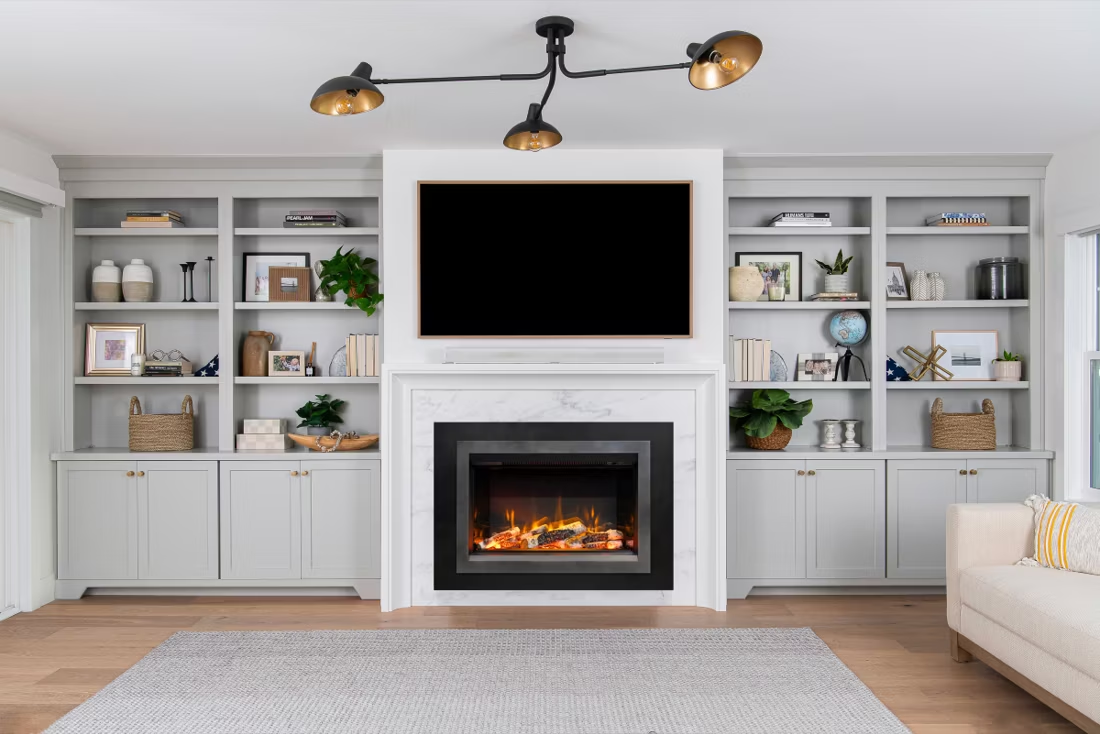
Can I put a TV above my fireplace?
Yes—with an asterisk. Fireplaces are hot and TVs don't like heat. Either put a mantel between them to deflect rising warmth, or choose a fireplace with heat-management technology that creates a cool zone on the wall above—the wall stays around 125 degrees, barely warm, while the room still gets full heat. If you like clean lines and don't want a mantel, heat management is the answer.
Nearby Dealers
Hearth shops serving Cache Creek and the surrounding area. Every listing shows whether it is a WhyFire partner, a dealer we have verified as authorized for the brands we recommend, or a local business carrying hearth products. No manufacturer pays for placement. How we verify dealers →
We’ve paused dealer listings for this connection today. Enter your zip or postal code above to find dealers near you, or come back tomorrow.
Popular Electric Brands
Where each brand came from, what's inside it today, and every current model. No brand pays to be here. Not every dealer carries every brand, so enter your postal code to see what's sold near Cache Creek.
Fireplace Xtrordinair
Fireplace Xtrordinair, now often called FireplaceX, is the fireplace brand of Travis Industries, Inc., of Mukilteo, Washington.
5 electric models →DaVinci
DaVinci Custom Fireplaces is a brand of Travis Industries, Inc., of Mukilteo, Washington, the company behind Lopi and Fireplace Xtrordinair.
5 electric models →Kozy Heat
Kozy Heat was founded in 1976 by Dudley Hussong in Lakefield, Minnesota, and incorporated as Hussong Manufacturing Co., Inc. in 1978.
3 electric models →Forge & Flame
Forge & Flame is the stove brand Hearth & Home Technologies introduced in August 2023 to bring Vermont Castings, Harman, and Quadra-Fire under one name.
1 electric model →Electric Service in Cache Creek
An electric fireplace's heater draws about 1,500 watts—pennies per hour at local rates.
Bc Hydro
FortisBC (Electric)
Get your free Project Guide & Parts List for a Cache Creek electric fireplace.
Tell us about your home in Cache Creek and we'll help you find a trusted local dealer who can help with your project—sizing the unit, confirming your circuit, and sending a free Project Guide & Parts List with everything specified.
Find Your Fireplace →