
Warm, ambient heat for every Sevier County home—no chimney required.
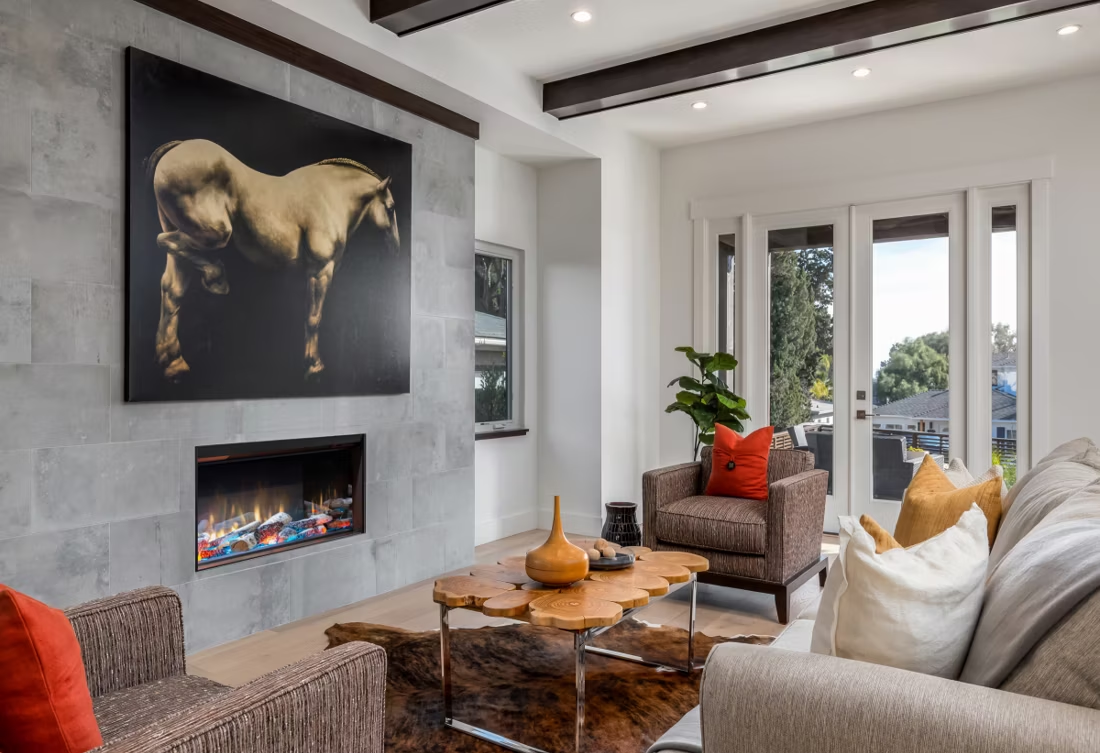
From De Queen to Horatio, Lockesburg, and Gillham, electric fireplaces add real ambiance and supplemental warmth to Sevier County's mild winters. Find the right unit and connect with a trusted local dealer.
Every Project Starts From One of These Five Situations
Mild winters, modern convenience.
Sevier County sits in Arkansas's climate zone 3A, with an average winter low around 30 degrees and a moderate winter heating season compared to much of the country. Most homes here, from De Queen to Horatio and Lockesburg, run on heat pumps or central HVAC as primary heat, which is typical for zone 3A. That leaves plenty of room for an electric fireplace to do what it does best: zone heat a living room or den, take the chill off a cold front, and add the look of a real fire without a flue, a gas line, or a woodpile.
Sevier County has no listed air quality restrictions on burning, so wood stoves using local oak, hickory, or pine remain popular here too—but electric appeals for a different reason. It installs almost anywhere, works in manufactured and site-built homes alike (common throughout rural Sevier County), and doesn't require venting, a masonry chimney, or a dedicated fuel supply. For renters, second homes, or homeowners who just want fireplace ambiance in a bedroom or bonus room without construction, electric is often the simplest path—and it runs on the same grid power already serving the house.
Three steps. No salesperson until you're ready.
Tell us about your project
Your zip code, your situation, and the fuel you're leaning toward—or let the answers point you to one.
See what's actually available
The brands dealers within 100 miles genuinely carry—real options, never a catalog mirage.
Get your dealer & Project Guide
A trusted local dealer, plus the free Project Guide & Parts List that names every component of the job.
Frequently Asked Questions
How much does an electric fireplace installation cost in Sevier County?
Costs vary a lot by unit type. A plug-in electric insert or freestanding stove that drops into an existing fireplace opening or sits on the floor typically runs $300 to $900 installed, since it just needs an outlet. A built-in wall unit or mantel package—often requiring a dedicated 20-amp circuit and some framing or trim work—runs closer to $1,200 to $2,500. Because there's no venting or gas line involved, electric is consistently the least expensive fireplace fuel to install in Sevier County, and most jobs take a fraction of the time of a wood or gas project.
Do I need a permit to install an electric fireplace in Sevier County?
In most cases, no. A plug-in electric fireplace or insert that uses a standard household outlet doesn't require a permit anywhere in Sevier County. If you're having a built-in unit wired to a new dedicated circuit, that electrical work should be pulled through a licensed electrician and may require an electrical permit depending on the scope of the job—your installer or electrician can confirm what's needed for your specific property, whether you're inside De Queen city limits or in unincorporated parts of the county.
Will an electric fireplace actually heat my Sevier County home?
Most electric fireplaces are built for supplemental zone heat, not whole-house heating—a typical 1,500-watt unit puts out roughly 5,000 BTU, enough to comfortably warm a single room. Given Sevier County's mild winter average low near 30 degrees and moderate heating load, that's often plenty to take the edge off a cold front in a living room or bedroom without running the central heat pump harder. For whole-home heating during the occasional harder freeze, you'll still want your existing HVAC or a wood or gas unit as the primary source.
Can I install an electric fireplace in a manufactured or mobile home?
Yes, and it's one of the more common installs in rural Sevier County given how many manufactured homes are in the area. Electric fireplaces don't require venting, a chimney, or structural modification, which makes them one of the few fireplace options that work cleanly in a manufactured home without triggering additional structural or fire-clearance requirements. A local dealer can confirm the right wattage and mounting method for your home's wall construction and electrical panel capacity.
What's the difference between an electric insert, a wall-mount unit, and a mantel package?
An electric insert is sized to slide into an existing fireplace opening—a good fit if you have an old masonry or wood-burning fireplace you want to convert without chimney work. A wall-mount unit hangs flat against a wall like a TV, with a slim profile and no hearth needed. A mantel package pairs an electric firebox with a surrounding mantel and shelf, giving you a traditional fireplace look in a room that never had one. For Sevier County homes with an existing fireplace opening, an insert is usually the simplest and least expensive option.
Is electric heat reliable in Sevier County during winter storms?
Electric fireplaces depend entirely on grid power, so they'll go out along with everything else during an outage—something to keep in mind given that ice storms occasionally hit southwest Arkansas. If backup heat during power loss matters to you, a wood stove using local oak or hickory is worth considering alongside an electric unit, since wood heat doesn't depend on the grid. Many Sevier County homeowners end up with electric for daily convenience and a wood or propane option as a backup for the rare hard freeze or outage.
How much does it cost to run an electric fireplace?
A typical 1,500-watt electric fireplace run on the heat setting for several hours a day costs a few dollars a week to operate at typical residential electric rates in Sevier County—far less than running a whole-home heat pump harder to compensate for a cold room. Most models also let you run the flame effect alone, without heat, which uses a small fraction of the power—useful for ambiance in the shoulder seasons when you don't need extra warmth.
Do electric fireplaces produce real flames or heat like a wood fire?
No—electric fireplaces use LED lighting, reflective panels, or (in higher-end models) water-vapor technology to simulate a flame, and the heat comes from an electric resistance or infrared element, not combustion. There's no real fire, no smoke, no ash, and no chimney needed. The tradeoff is heat output and character: an electric unit won't match the radiant heat of a wood stove loaded with oak or hickory, but it also won't require firewood, cleaning, or venting—a fair trade for a lot of Sevier County living rooms and bedrooms.
Electric vs. wood—which is right for my Sevier County home?
Wood is the traditional choice in this part of Arkansas—oak, hickory, and pine are all readily available locally, and a wood stove or insert can serve as genuine backup heat during a power outage. Electric wins on simplicity: no venting, no fuel handling, no permits in most cases, and a fraction of the installed cost. For a primary living space where you want low-maintenance ambiance and a little zone heat, electric is usually the better fit. For a home that wants a real backup heat source independent of the grid, wood remains the stronger choice—and plenty of Sevier County homes end up with one of each.
Can I put a TV above my fireplace?
Yes—with an asterisk. Fireplaces are hot and TVs don't like heat. Either put a mantel between them to deflect rising warmth, or choose a fireplace with heat-management technology that creates a cool zone on the wall above—the wall stays around 125 degrees, barely warm, while the room still gets full heat. If you like clean lines and don't want a mantel, heat management is the answer.
Does an electric fireplace need a vent or chimney?
No—that's its superpower. An electric fireplace needs a wall and an outlet, period. No vent pipe, no gas line, no clearances to design around, which is why it works in bedrooms, offices, apartments, and walls where venting a gas or wood unit would be impractical or impossible. Installation is typically the simplest and least expensive of any fireplace type.
How much should I budget for a fireplace?
For an average home—covering the fireplace, the vent pipe, and basic installation—a budget between $3,900 and $5,500 gives you a lot of options across wood, gas, and pellet. By the time you add finish work, gas line, and electrical, the average complete installation lands between $5,000 and $12,000 all-in. In a remodel or new build, a good rule is to put about 2.5% of the total project cost toward the fireplace.
Can a fireplace actually lower my heating bill?
Yes—by creating a comfort zone. A furnace heats every square foot of the house just to warm the one room you're in; a gas fireplace on low burns roughly a sixth of the gas a typical furnace does. Set the furnace around 55–60 degrees as a baseline, then heat the rooms your family actually uses. Families who heat this way commonly save $20–$60 a month.
Find your electric fireplace in Sevier County.
Tell us a bit about your home and we'll match you with the right electric fireplace, insert, or wall unit—plus a free Project Guide & Parts List and a trusted local dealer to install it.
Find Your Fireplace →