
Instant Heat for the Hualapai Valley's Cool Desert Nights.
Instant, smoke-free heat for the Hualapai Valley's cool desert nights. Find the right propane fireplace or insert, and get matched with a trusted local dealer.
Every Project Starts From One of These Five Situations
Clean heat without the wood smoke or the wait.
Valle Vista is an unincorporated community in the Hualapai Valley just northeast of Kingman, sitting at about 3,170 feet in Mohave County's high desert. Winters here are mild by national standards—the average low sits around 31°F and the area has a heating season that's a fraction of what a place like Bismarck, ND sees. But cool desert nights, occasional hard freezes, and the area's periodic wildfire smoke (which makes some homeowners wary of adding another combustion source to the mix) all push a meaningful number of local households toward gas heat.
There's no natural gas utility serving Valle Vista, so virtually every 'gas fireplace' installed here actually runs on propane, supplied by tank and delivered by regional providers out of Kingman. That doesn't change what the fireplace looks or feels like—modern propane units light instantly, run off a thermostat, and can keep working through a Mohave Electric Cooperative outage with the right ignition system. It does mean tank placement, line routing, and propane supplier coordination are part of getting it installed correctly, which is exactly the kind of detail a trusted local dealer sorts out before a big-box guess ever could.
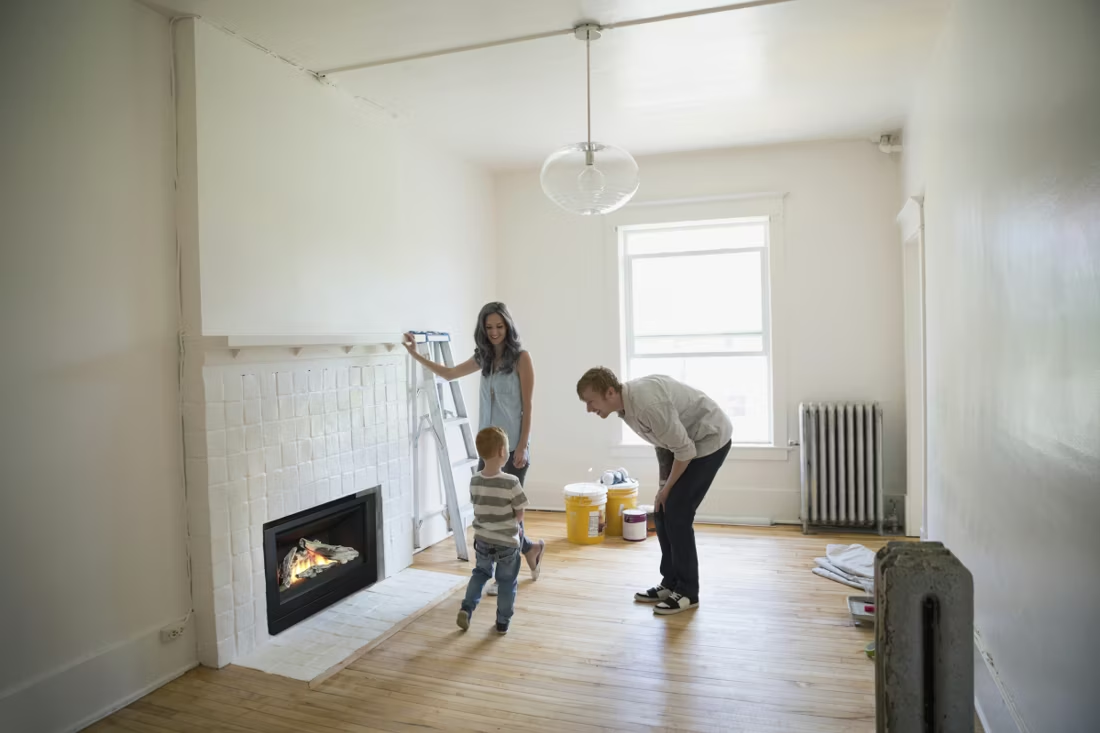
Three steps. No salesperson until you're ready.
Tell us about your project
Your zip code, your situation, and the fuel you're leaning toward—or let the answers point you to one.
See what's actually available
The brands dealers within 100 miles genuinely carry—real options, never a catalog mirage.
Get your dealer & Project Guide
A trusted local dealer, plus the free Project Guide & Parts List that names every component of the job.
Frequently Asked Questions
How much does a gas fireplace installation cost in Valle Vista?
A typical gas fireplace installation in Valle Vista runs $3,500 to $9,000 depending on the unit, whether you're adding a new propane tank or connecting to an existing one, and the length of gas line run needed from tank to hearth. Because Valle Vista sits outside any natural gas utility footprint, nearly every installation here uses propane rather than piped natural gas—that changes the math somewhat since tank placement and buried line routes factor into the estimate. Local installers serving the Kingman and Mohave County area will give you a firm number after walking the site.
Can I convert my existing wood fireplace to gas?
Yes. Converting an existing wood-burning fireplace to gas is a common project in the older homes scattered through the Hualapai Valley. A direct-vent propane insert typically slides into the existing masonry opening, using a stainless liner run up the original chimney, with a propane line run out to a tank set outside. Expect $4,000 to $8,000 for the conversion depending on tank size and line distance. It eliminates the wood-hauling and ash cleanup while keeping the fireplace opening you already have.
Do I need natural gas to install a gas fireplace, or is it propane here?
Propane, not piped natural gas. There is no natural gas utility serving Valle Vista—homes here run on propane, typically delivered and maintained by regional suppliers operating out of Kingman. If you're building new or upgrading a fireplace, you'll either lease a tank from a propane supplier or purchase one outright; sizing (120-gallon, 250-gallon, 500-gallon) depends on whether the fireplace is your only propane appliance or shares the tank with a water heater and range. Almost every 'gas fireplace' installed in Valle Vista is technically a propane fireplace configured with the correct propane orifice.
Will my gas fireplace work during a power outage?
Most modern propane fireplaces are built to run without grid power. Units with intermittent pilot ignition (IPI) include a battery backup that kicks in the moment Mohave Electric Cooperative service drops, which does happen occasionally during summer monsoon storms in this part of the county. Valor fireplaces take a different approach: their pilot assembly generates its own electricity through a thermocouple, so there are no batteries to check or replace. For a rural community where a downed line can mean waiting a while for a repair crew, that self-powered ignition is worth asking about.
What's the difference between a gas fireplace, gas insert, and gas stove?
A gas fireplace is a fully framed-in unit built for new construction or a remodel where no masonry opening exists yet. A gas insert is sized to slide into an existing wood-burning fireplace, converting it to sealed, high-efficiency gas heat while reusing the chimney chase as a vent path. A gas stove is a freestanding cast-iron or steel cabinet that sits on the floor like a wood stove but burns propane. Most of the older Valle Vista homes with an existing brick fireplace opening are good insert candidates; newer or manufactured homes without one usually go with a freestanding stove or built-in unit instead.
Do I need a permit to install a gas fireplace in Valle Vista?
Yes. Mohave County Building Department requires a building permit for new gas fireplace and insert installations, and the propane line and tank work must be handled by a licensed LP-gas installer. Because Valle Vista is unincorporated, county staff rather than city staff review the permit. Most hearth dealers serving Kingman and the surrounding valley coordinate the county permit, the LP-gas hookup, and the final inspection together, so you're not stuck managing separate trades yourself.
What's the difference between vented and vent-free gas fireplaces?
Vented (direct-vent) units draw combustion air from outside and exhaust it back outside through sealed pipe—that's the standard, and it's what goes into the overwhelming majority of Valle Vista homes. Vent-free propane units burn directly into the room and are legal in Arizona within strict room-size and ventilation limits, but they release some moisture and combustion byproducts indoors. In a dry high-desert climate like this one, that added humidity can actually be a minor plus in winter, though most local installers still steer customers toward direct-vent units for the cleaner combustion and lack of any indoor air tradeoff. Ask your dealer which option fits your specific room.
How often should my gas fireplace be serviced?
An annual inspection is recommended for any propane appliance, including gas fireplaces and inserts—a technician checks the burner, pilot assembly, gas connections, and venting, and cleans the glass. Fine desert dust can accumulate in the burner and pilot area faster here than in wetter climates, so it's worth staying on a yearly schedule rather than stretching it out. Gas appliance technicians working out of Kingman typically charge $150 to $250 for this service.
Gas vs. wood—which is right for my Valle Vista home?
Wood is still burned throughout the Hualapai Valley—ponderosa pine, pinyon, and juniper are the common local species—and it offers lower fuel cost plus heat that works without any power or propane delivery. But Valle Vista's winters are mild by national standards (the heating season here is much shorter than in a place like Fargo, ND), so many households don't need wood as a primary heat source, and periodic wildfire smoke in the surrounding forest country makes some homeowners reluctant to add another combustion source during dry, smoky months. Gas offers instant on-off convenience with no ash, no smoke, and no wood storage—for a lot of Valle Vista homes, especially those without an existing masonry fireplace, that convenience wins out.
Why is my open fireplace making my house colder?
Open fireplaces suck—literally. As the fire burns, it consumes air your furnace already paid to heat and pulls it out through the chimney, so the house is actually colder after the fire goes out than before you lit it. An insert fixes this: it seals the chimney, puts fixed glass across the front, and turns that hole in your house into a real heat source.
Is my gas fireplace wasting gas?
If it was installed more than 15 years ago, probably. Older gas fireplaces keep a standing pilot light burning all the time, and that little flame can cost a couple hundred dollars a year. Newer models use pilot-on-demand ignition—the pilot lights only when you use the fireplace and goes out when you turn it off.
Does a fireplace add value to my home?
On average, a fireplace adds back to the home about the same amount you spent installing it. Add the monthly savings from heating the rooms you actually use instead of the whole house—often hundreds of dollars a year—and the value case is strong before you even count what a fire does for how your family uses the room.
How much should I budget for a fireplace?
For an average home—covering the fireplace, the vent pipe, and basic installation—a budget between $3,900 and $5,500 gives you a lot of options across wood, gas, and pellet. By the time you add finish work, gas line, and electrical, the average complete installation lands between $5,000 and $12,000 all-in. In a remodel or new build, a good rule is to put about 2.5% of the total project cost toward the fireplace.
Nearby Dealers
Hearth shops serving Valle Vista and the surrounding area. Every listing shows whether it is a WhyFire partner, a dealer we have verified as authorized for the brands we recommend, or a local business carrying hearth products. No manufacturer pays for placement. How we verify dealers →
Banker Insulation
Banker Insulation
Blue Sky Design And Build
Patio Paradise
Vista Bbq Outfitters
Premier Bbq & Fire
Proficient Patios & Backyard Designs
Find your gas fireplace in Valle Vista.
Tell us a bit about your home and we'll put together a free Project Guide & Parts List for your Valle Vista gas project—the exact parts, including the vent kit, and our recommended local dealer.
Find Your Fireplace →