
Electric heat built for Grand Canyon Village's cold, remote winters.
No chimney, no gas line, no propane delivery truck required—just a fireplace or insert suited to the South Rim's long winter, matched with a local dealer who can get it installed.
Every Project Starts From One of These Five Situations
Clean heat where venting isn't the answer.
Grand Canyon Village sits at 6,756 feet on the South Rim, with winter lows averaging 19°F and a heating season about as demanding as Bozeman, Montana's—a climate closer to Bozeman, Montana, than the desert Arizona most people picture. This isn't a typical residential market, though: the Village is almost entirely National Park Service and concessioner-managed housing and historic lodge buildings, many of which restrict new chimney penetrations or solid-fuel appliances in older structures. Natural gas doesn't reach this remote a location at all, and propane delivery is limited by the distance from Flagstaff, roughly 80 miles south.
That combination makes electric fireplaces and inserts one of the most practical clean-heat options here. They need no venting, no chimney, no cutting permit through the Kaibab or Coconino National Forest offices, and no fuel deliveries to a location that's snowed in more often than most Arizona towns. Arizona Public Service, the local utility, bills residential customers around $0.1645 per kWh—higher than the state average—so electric heat works best here as supplemental or zone heat layered alongside a home's existing furnace or baseboard system, not as the sole source through a South Rim winter.
Three steps. No salesperson until you're ready.
Tell us about your project
Your zip code, your situation, and the fuel you're leaning toward—or let the answers point you to one.
See what's actually available
The brands dealers within 100 miles genuinely carry—real options, never a catalog mirage.
Get your dealer & Project Guide
A trusted local dealer, plus the free Project Guide & Parts List that names every component of the job.
Frequently Asked Questions
How much does an electric fireplace installation cost in Grand Canyon Village?
Electric fireplace inserts and freestanding units typically run $400 to $1,200 installed, well below wood, gas, or pellet options—mostly because there's no venting, chimney, or gas line work involved. Many units are simple plug-in installs a dealer can complete in a few hours. Because there's no hearth retailer inside the Village itself, expect a technician to travel from Flagstaff or Williams, so ask about trip charges when comparing quotes.
What's the difference between an electric fireplace and a space heater?
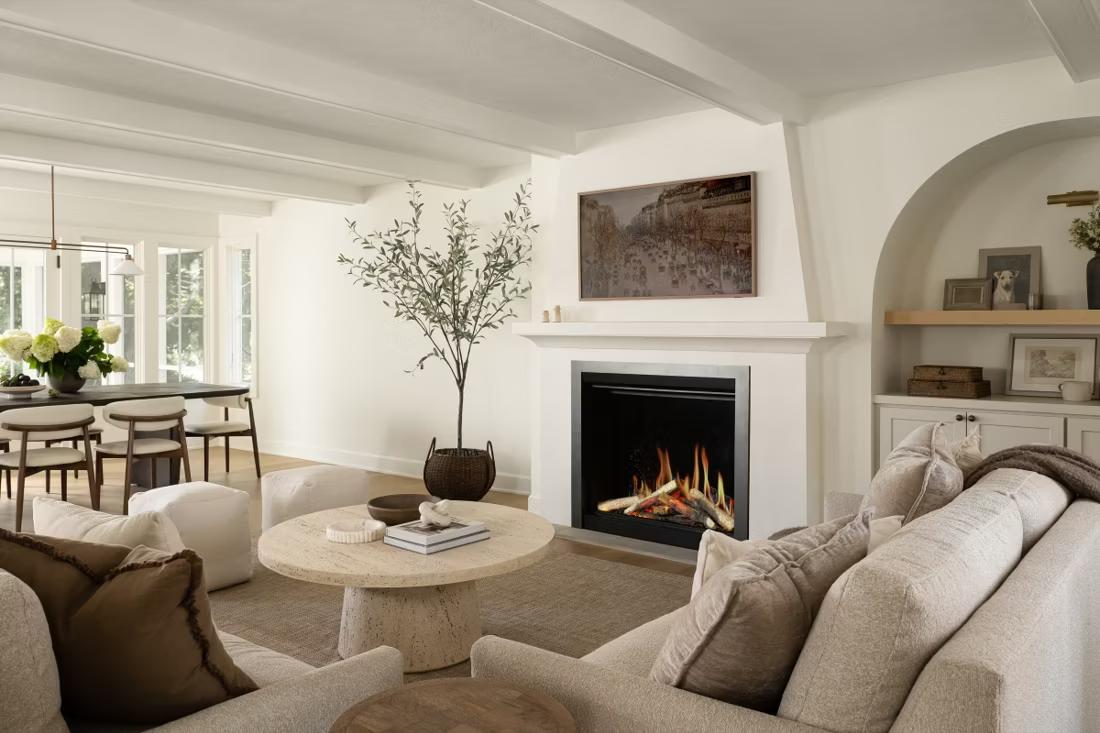
Electric fireplace inserts and stoves are built to look like a real fire, with LED flame effects set into a hearth-style cabinet or wall-mounted frame, and most add supplemental heat to a 400-1,000 sq ft room. A space heater is a portable utility appliance with no permanence or finish. For historic lodge buildings and NPS employee housing where appearance and a built-in fit matter, an electric insert is usually the better long-term choice.
Can an electric fireplace actually heat a home in Grand Canyon Village's climate?
Electric units add real, useful heat to a single room, but with winter lows averaging 19°F and elevation over 6,700 feet, they're best treated as zone heat rather than a whole-home substitute for a furnace or baseboard system. A typical 1,500-watt insert adds roughly 5,000 BTU—enough for a bedroom or living room, not an entire cabin. Most South Rim homeowners pair one with existing electric baseboard heat or a propane furnace.
Do I need a permit to install an electric fireplace in Grand Canyon Village?
In most cases, no. Because there's no venting or gas line involved, a plug-in electric fireplace generally doesn't trigger the building permit a wood stove or gas insert would require elsewhere in Coconino County. That said, structures inside Grand Canyon Village are managed by the National Park Service or its concessioner, and any interior modification—including a built-in electric insert—should be cleared with facilities management first. That step is specific to living in the Village, not something a typical Coconino County homeowner has to think about.
What electric fireplace models work best at this altitude and climate?
Standard 120V plug-in inserts and freestanding stoves from brands like Dimplex and Napoleon perform the same at any altitude, since there's no combustion involved—unlike gas appliances, elevation doesn't touch burner performance. In a cold, dry climate like the South Rim, look for a unit with a genuine 1,500-watt heater-strip rating rather than one marketed mainly for the flame-effect look. With nighttime lows regularly in the high teens, the supplemental heat needs to actually contribute something.
How much does it cost to run an electric fireplace here?
Arizona Public Service bills Grand Canyon Village residents around $0.1645 per kWh, noticeably higher than the Phoenix-area average. A 1,500-watt unit run on high for eight hours a night costs roughly $2 a night, or about $60 a month used as steady evening supplemental heat through a South Rim winter. That's more expensive per BTU than firewood cut under a Kaibab National Forest permit, but it comes without hauling, splitting, ash cleanup, or the smoke concerns that matter on wildfire-smoke-sensitive air quality days.
Will my electric fireplace work during a power outage?
No—unlike battery-backed gas units or wood stoves, an electric fireplace needs grid power and shuts down completely during an outage. Grand Canyon Village sits at the end of a long transmission line, and winter storms occasionally cut power to the South Rim for hours at a stretch. Homes that need heat resilience during outages should treat an electric fireplace as an ambiance-and-supplemental layer and keep a wood or propane backup, not rely on electric as the sole heat plan.
Electric fireplace vs. pellet stove—which is right for my Grand Canyon Village home?
Pellet stoves burning fuel from regional suppliers like Forest Energy or Lignetics produce real heat output—40,000+ BTU on some models—but need a venting penetration and, like electric units, won't run at all without power to drive the auger and blower. That's a real limitation for NPS-managed historic structures where adding a flue isn't an option. Electric fireplaces skip the venting and permitting entirely but produce far less heat. For a historic building where a chimney penetration isn't possible, electric is often the only realistic option; for a standalone home that can accommodate venting, pellet delivers meaningfully more heat per dollar.
Where can I buy and install an electric fireplace near Grand Canyon Village?
There's no hearth retailer inside the Village itself—the nearest dealers with installation service are in Flagstaff, about 80 miles south via Highway 180, or Williams, roughly 60 miles away. Both regularly service South Rim addresses, including NPS and concessioner housing. A dealer match through Find My Fireplace connects you with whichever of these covers Grand Canyon Village most reliably, rather than leaving you to guess.
Do electric fireplaces actually produce heat?
Yes—most put out around 4,800–5,000 BTUs from a standard outlet, which comfortably warms a bedroom, office, or den as a comfort-zone heater. What they won't do is carry a whole house the way wood, gas, or pellet can. Think of electric as ambiance-first with honest supplemental heat: flames on with no heat in July, flames plus warmth in January.
Can I put a TV above my fireplace?
Yes—with an asterisk. Fireplaces are hot and TVs don't like heat. Either put a mantel between them to deflect rising warmth, or choose a fireplace with heat-management technology that creates a cool zone on the wall above—the wall stays around 125 degrees, barely warm, while the room still gets full heat. If you like clean lines and don't want a mantel, heat management is the answer.
How much should I budget for a fireplace?
For an average home—covering the fireplace, the vent pipe, and basic installation—a budget between $3,900 and $5,500 gives you a lot of options across wood, gas, and pellet. By the time you add finish work, gas line, and electrical, the average complete installation lands between $5,000 and $12,000 all-in. In a remodel or new build, a good rule is to put about 2.5% of the total project cost toward the fireplace.
Can a fireplace actually lower my heating bill?
Yes—by creating a comfort zone. A furnace heats every square foot of the house just to warm the one room you're in; a gas fireplace on low burns roughly a sixth of the gas a typical furnace does. Set the furnace around 55–60 degrees as a baseline, then heat the rooms your family actually uses. Families who heat this way commonly save $20–$60 a month.
Nearby Dealers
Hearth shops serving Grand Canyon Village and the surrounding area. Every listing shows whether it is a WhyFire partner, a dealer we have verified as authorized for the brands we recommend, or a local business carrying hearth products. No manufacturer pays for placement. How we verify dealers →
Banker Insulation - Flagstaff
Flagstaff Hearth & Home
HomCo
Wizard's Hearth & Home
Page Fast Glass
Red Rock Fireplace & Bbq
Electric Service in Grand Canyon Village
An electric fireplace's heater draws about 1,500 watts—pennies per hour at local rates.
Arizona Public Service Co
Find your electric fireplace in Grand Canyon Village.
Tell us about your home or unit near the South Rim and we'll match you with a trusted local dealer and a free Project Guide & Parts List—sized, wired, and ready for installation.
Find Your Fireplace →