
Simple, no-vent heat for Swan Hills' long northern winters.
Swan Hills sits at 1,139 metres with winter lows averaging -17.9°C, so most homes lean on a furnace or wood stove for real heat. An electric fireplace adds instant ambiance and zone heat with no venting to plan—we'll help you find a trusted local dealer who knows what actually fits your home.
Every Project Starts From One of These Five Situations
Electric heat earns its place as supplemental warmth, not the whole solution.
Swan Hills sits in climate zone 7B at 1,139 metres of elevation, with winter lows averaging -17.9°C and a heating season that runs closer to what Fort McMurray sees farther north than to milder parts of the province. Chinook-belt freeze-thaw swings are part of the picture too, and households across Northern Alberta who burn aspen poplar, paper birch, lodgepole pine, or white spruce already plan around them when stacking and drying wood. None of that makes electric heat irrelevant here—it just means an electric fireplace plays a supporting role rather than a starring one.
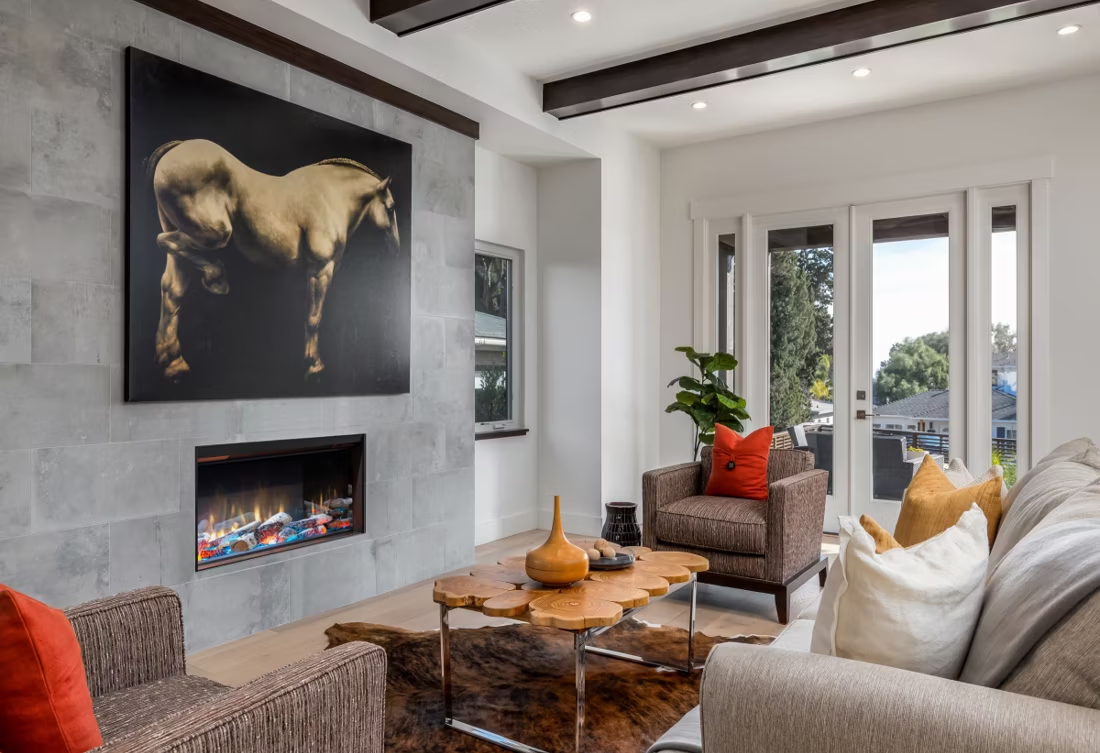
Most Swan Hills homes are built around a gas furnace fed by ATCO Gas or Apex Utilities, with electric service through ENMAX, EPCOR, or ATCO Electric running around $0.13 per kWh. Against that backdrop, an electric fireplace is popular for exactly what it's good at: no chimney, no gas line, and a plug-in or simple hardwire install that adds real warmth and ambiance to a living room, bonus room, or basement without touching the structure of the house. It's the fastest fireplace project in town, and for a lot of households here, that's precisely the point.
Three steps. No salesperson until you're ready.
Tell us about your project
Your postal code, your situation, and the fuel you're leaning toward—or let the answers point you to one.
See what's actually available
The brands dealers within 100 miles genuinely carry—real options, never a catalog mirage.
Get your dealer & Project Guide
A trusted local dealer, plus the free Project Guide & Parts List that names every component of the job.
Frequently Asked Questions
How much does an electric fireplace cost to install in Swan Hills?
Plan on $500 to $1,600 for most electric fireplace installations in Swan Hills, which is a fraction of what wood ($6,000-$12,000), gas ($6,000-$15,000), or pellet ($6,000-$10,000) installs run in town. A plug-in freestanding or wall-mount unit sits at the low end since it just needs a standard outlet nearby. A built-in linear unit set into a wall or existing masonry surround, wired by a licensed electrician, lands toward the top of that range. There's no chimney, no gas line, and no venting to plan for, which is part of why electric is the fastest and least disruptive fireplace project in Swan Hills.
Do I need a permit for an electric fireplace in Swan Hills?
Usually not for a plug-in unit—it's treated like any other appliance you plug into a wall. If you're having a built-in unit hardwired directly into a circuit, that electrical work typically needs to go through the municipal building department for inspection, same as any other hardwired fixture. Because there's no combustion and no flue, the CSA B365 installation code and the WETT inspection insurance companies commonly require for wood appliances in Swan Hills don't apply here—one less inspection to schedule.
Will an electric fireplace actually heat my home through a Swan Hills winter?
Not as the primary heat source. Swan Hills averages winter lows near -17.9°C at 1,139 metres of elevation, a stretch of cold closer to what Fort McMurray sees than what's typical farther south in Alberta. Most electric fireplaces put out 5,000 to 9,000 BTU, enough to noticeably warm a single room but not carry a whole house that cold. In town, electric units are almost always paired with a furnace running on ATCO Gas or Apex Utilities service, or with a wood stove, and used for zone heating a living room, bonus room, or basement rather than carrying the load alone.
What's the difference between an electric fireplace, insert, and wall-mounted unit?
An electric insert is built to slide into an existing masonry firebox, a common retrofit if your Swan Hills home has an old wood-burning fireplace you'd rather not keep supplied with firewood. A freestanding electric stove sits on the floor and mimics a wood stove's look without any hearth pad or clearance requirements. A wall-mounted linear unit is the common choice in newer builds and cabins around town, mounted flush or recessed for a clean look with no housing needed at all. All three plug in or wire in the same basic way—the real question is which one fits the wall or opening you already have.
How does running an electric fireplace compare to gas, wood, or pellet in Swan Hills?
At the local ENMAX, EPCOR, or ATCO Electric residential rate of roughly $0.13 per kWh, a typical electric fireplace on its heat setting runs somewhere around 15 to 25 cents an hour. Natural gas through ATCO Gas or Apex Utilities is generally cheaper per hour of heat output, and plenty of Swan Hills residents cut their own aspen poplar, paper birch, lodgepole pine, or white spruce under a free, year-round permit (valid 30 days) from Government of Alberta Forestry and Parks, which keeps wood heat costs down to labour and a saw. Pellets from regional mills like La Crete Sawmills or Vanderwell run $400-$575 a ton. Electric wins on convenience and low upfront cost, not on the cheapest heat per hour.
What size electric fireplace do I need for a Swan Hills home?
For a single living room or bonus room in the 200 to 400 square foot range, a standard 40 to 50 inch wall unit or insert rated around 5,000 BTU covers it comfortably. Larger open-concept spaces, which show up in some of the newer builds around town, may do better with a wider unit or two smaller units zoned to different rooms, since electric heat output doesn't scale up the way a wood stove or gas unit does. Most local dealers size these against your room's square footage and insulation rather than the fireplace's visual size alone.
Will my electric fireplace still work during a power outage?
No—electric fireplaces run on grid power from ENMAX, EPCOR, or ATCO Electric depending on your service, so an outage takes them offline along with your lights. That's worth planning around in a remote, boreal-forest setting like Swan Hills, where winter storms can knock out power for stretches. A lot of households here keep a wood stove or insert as backup specifically because it works without electricity—cutting your own aspen poplar or white spruce under a free provincial permit makes that backup relatively inexpensive to maintain.
Can an electric fireplace go anywhere in my house?
Pretty much, which is the main appeal. Since there's no venting, gas line, or chimney required, an electric unit can go on an interior wall, in a basement rec room, or in a rental or modular home around Swan Hills where a wood or gas install wouldn't be practical or allowed by a landlord. The only real constraint is a nearby outlet or, for a hardwired built-in, enough capacity on the circuit—a licensed electrician can confirm what your panel can support.
Electric, wood, gas, or pellet—what actually makes sense for a Swan Hills home?
It depends on what you're solving for. Wood, burned as aspen poplar, birch, or spruce cut under a free Forestry and Parks permit, is the cheapest fuel and the only one that keeps working through a power outage, but it needs a $6,000-$12,000 install, seasoned wood storage, and a WETT inspection for insurance. Gas through ATCO Gas or Apex Utilities gives instant, thermostatic heat at $6,000-$15,000 installed. Pellet stoves land in between at $6,000-$10,000 with fuel from La Crete Sawmills or Vanderwell. Electric, at $500-$1,600, is by far the cheapest and simplest install and works well as supplemental or ambiance heat in a specific room, but on its own it won't carry a Swan Hills home through a -17.9°C night.
How much does an electric fireplace cost to run?
With the heater on, a typical unit draws about 1,500 watts—at average electric rates that's roughly 20 cents an hour. Run the flame effect alone and it costs pennies; the flames are LED-driven and use about as much power as a light bulb. There's no pilot light, no fuel delivery, and essentially no maintenance.
What fireplace styles should I know before shopping?
Four cover most of the market: screen-front traditional (mesh front, open feel, fits craftsman homes), traditional door set (the classic look you grew up with), modern linear (wide, low, the statement piece for entertaining), and clean face contemporary (no trim—your tile or stone runs right to the fire's edge). Walk in knowing those four terms and you're ahead of most buyers.
Do electric fireplaces actually produce heat?
Yes—most put out around 4,800–5,000 BTUs from a standard outlet, which comfortably warms a bedroom, office, or den as a comfort-zone heater. What they won't do is carry a whole house the way wood, gas, or pellet can. Think of electric as ambiance-first with honest supplemental heat: flames on with no heat in July, flames plus warmth in January.
Does an electric fireplace need a vent or chimney?
No—that's its superpower. An electric fireplace needs a wall and an outlet, period. No vent pipe, no gas line, no clearances to design around, which is why it works in bedrooms, offices, apartments, and walls where venting a gas or wood unit would be impractical or impossible. Installation is typically the simplest and least expensive of any fireplace type.
Nearby Dealers
Hearth shops serving Swan Hills and the surrounding area. Every listing shows whether it is a WhyFire partner, a dealer we have verified as authorized for the brands we recommend, or a local business carrying hearth products. No manufacturer pays for placement. How we verify dealers →
Country Homes Inspections
Wilson Fans & Lighting
Windsor Plywood
Reynolds Plumbing & Heating
Empire Home Bldg Centre
Electric Service in Swan Hills
An electric fireplace's heater draws about 1,500 watts—pennies per hour at local rates.
Enmax
Epcor
Atco Electric
Get your free Project Guide & Parts List for a Swan Hills electric fireplace.
Tell us about your room and your electrical panel, and we'll help you find a trusted local dealer who can walk you through the electric fireplace options that actually fit your Swan Hills home, plus send a free Project Guide & Parts List with the unit and wiring specifics sized to your space.
Find Your Fireplace →