
Find your fireplace in Craig County's Allegheny Highlands.
Wood, gas, pellet, and electric fireplace resources for New Castle, Paint Bank, and every hollow along Craig Creek and Sinking Creek. Oak, hickory, and maple stands cover the ridges here, and this hub connects you with the local dealers and technicians who actually work this stretch of the Alleghenies.
Every Project Starts From One of These Five Situations
Ridge-and-valley heating across Craig County, Virginia.
Craig County sits in Virginia's climate zone 4A—a mixed-humid zone with real winter cold but nothing like the deep freezes of the northern Rockies or the Great Lakes. Still, in the hollows along Craig Creek and up toward Potts Mountain, nighttime lows drop hard enough during cold snaps that a well-run wood stove earns its keep. Oak, hickory, and maple dominate the hardwood stands here, and a good share of the county sits inside or borders the Jefferson National Forest, where Forest Service firewood-cutting permits keep fuel costs close to nothing for households willing to cut and split their own. With a population around 224 and no incorporated natural gas distribution, this is propane-and-woodstove country more than pipeline country.
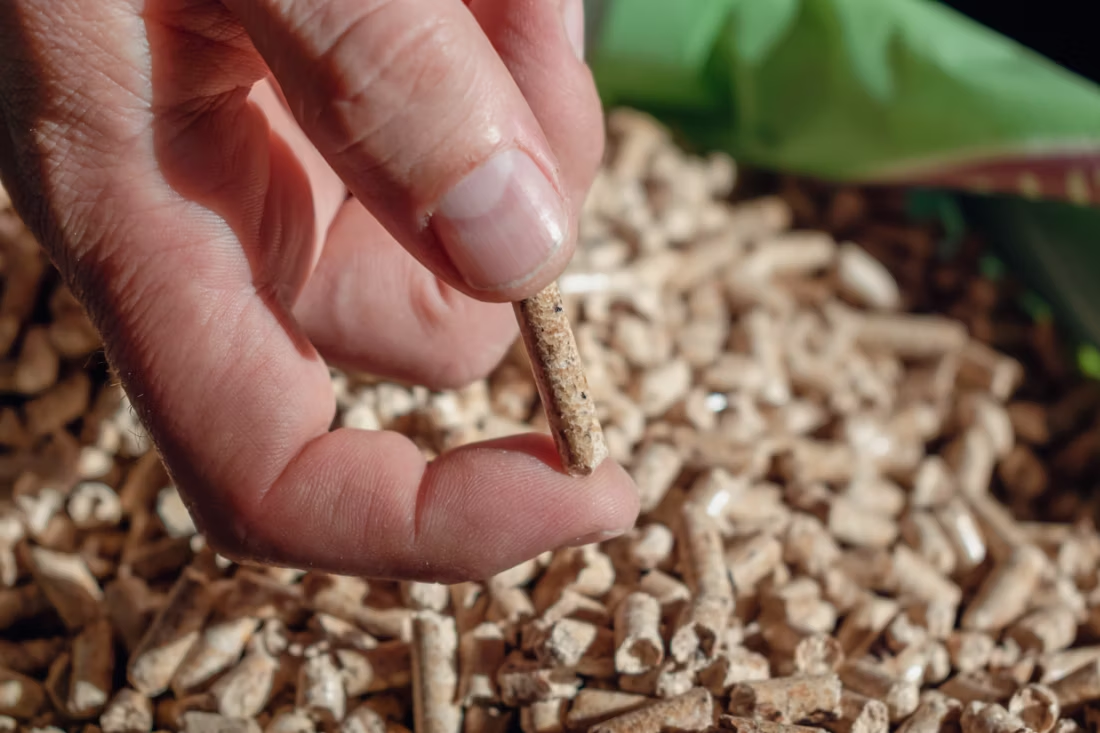
What you'll find on this hub: hearth retailers, chimney sweeps and service techs, and fuel suppliers covering New Castle (the county seat), Paint Bank, and the unincorporated communities strung along Route 42 and Route 311. Given how sparsely populated Craig County is, most of the dealers and technicians listed here are based in nearby Roanoke, Salem, or Blacksburg and travel in for installs and service calls. Pick your fuel below for cost detail, recommended units, and a dealer match—whether you're heating a farmhouse on Craig Creek or a cabin near Paint Bank.
Four fuels. One honest answer for Craig County.
Three steps. No salesperson until you're ready.
Tell us about your project
Your zip code, your situation, and the fuel you're leaning toward—or let the answers point you to one.
See what's actually available
The brands dealers within 100 miles genuinely carry—real options, never a catalog mirage.
Get your dealer & Project Guide
A trusted local dealer, plus the free Project Guide & Parts List that names every component of the job.
Frequently Asked Questions
Which fuel works best for a home in Craig County?
It depends on your access to firewood and how remote your property is. Wood is the natural fit here—oak and hickory burn hot and long, plenty of it grows on Jefferson National Forest land, and a cutting permit keeps fuel cost near zero if you're willing to split your own. Propane is the practical choice for gas fireplaces and inserts, since there's no natural gas distribution network reaching most of the county—you'll need a tank and a delivery contract rather than a utility hookup. Pellet stoves are a solid middle ground for households that want wood-style heat without the chainsaw work; Energex and Greene Team Pellet Fuel are both distributed in this part of Virginia. Electric fireplaces work well as supplemental heat in a bedroom or den, and they're genuinely useful as backup during the ice storms that occasionally knock out power lines along the ridges—though they shouldn't be your only heat source when that happens, since they need grid power to run.
Do I need a permit to install a fireplace in Craig County?
Generally yes. New wood stoves, wood inserts, propane fireplaces, propane inserts, propane stoves, and pellet stoves typically require a building permit through the county building department, and propane gas-line work needs a licensed gas fitter separate from the appliance installation itself. Because Craig County is unincorporated outside New Castle, permitting runs through the county rather than a city office. Electric fireplaces usually skip the permit unless you're doing a built-in installation with new wiring or a dedicated circuit. Most retailers who regularly work in Craig County—even the ones based out of Roanoke or Salem—are familiar with the county's permitting process and handle it as part of the installation quote.
Are there air quality restrictions on wood burning in Craig County?
No. Craig County has no air-quality nonattainment designation, no winter inversion problem, and no mandatory or voluntary wood-burning curtailment days—a real contrast to western basin towns that deal with winter smoke advisories. That means installing a wood stove or insert here is a straightforward permitting and clearance question, not an emissions-compliance question layered on top of it. New units still need to meet current EPA emissions standards, but there's no local burn-ban season to plan around.
Can one local retailer handle wood, gas, pellet, and electric for a Craig County home?
Given the county's population of roughly 224, there isn't a hearth showroom physically located in Craig County—the dealers who serve New Castle and Paint Bank are based in Roanoke, Salem, or Blacksburg and drive in for consultations and installs. Several of those regional dealers do carry all four fuel types and can show you working displays before you commit. If you're set on wood or pellet specifically, some smaller stove and hardware shops closer to the county line focus on those two fuels rather than stocking a full multi-fuel showroom. Find My Fireplace matches you with whichever regional dealer actually covers your specific address and fuel choice.
How does hearth service work in a rural county like this?
Most chimney sweeps and gas techs covering Craig County are based out of Roanoke or Salem and build a route through New Castle, Paint Bank, and the Route 311 corridor a few times a season. Expect a modest travel fee on top of the service call, and expect that scheduling in September or October—before the oak-and-hickory burning season starts in earnest—is far easier than trying to book an emergency sweep in January. If ice storms are a concern in your hollow, it's worth asking your technician about backup heat planning, since propane deliveries and grid power can both be disrupted on the same bad week.
What's the typical cost range for a fireplace installation across fuel types in Craig County?
Costs run close to regional Virginia norms, sometimes with a modest travel surcharge added for the drive out from Roanoke or Salem. Wood stove or insert installation: roughly $4,000–$8,500 for a typical install, more if a full masonry chimney rebuild is needed. Propane fireplace, insert, or stove: roughly $4,000–$10,000, with tank setup and gas-line work adding to the low end of that range if there's no existing propane service. Pellet stove or insert: roughly $4,000–$7,000 for a typical install. Electric fireplace: $200–$3,000 for the unit itself, plus $400–$1,200 in labor for anything beyond a plug-and-play install. For a firm number tied to your specific address, the free Project Guide & Parts List will lay out the parts and the recommended local dealer.
Does a fireplace add value to my home?
On average, a fireplace adds back to the home about the same amount you spent installing it. Add the monthly savings from heating the rooms you actually use instead of the whole house—often hundreds of dollars a year—and the value case is strong before you even count what a fire does for how your family uses the room.
How much should I budget for a fireplace?
For an average home—covering the fireplace, the vent pipe, and basic installation—a budget between $3,900 and $5,500 gives you a lot of options across wood, gas, and pellet. By the time you add finish work, gas line, and electrical, the average complete installation lands between $5,000 and $12,000 all-in. In a remodel or new build, a good rule is to put about 2.5% of the total project cost toward the fireplace.
Wood, gas, pellet, or electric—how do I choose?
Match the fuel to your life, not the other way around. Wood: lowest fuel cost and total power-outage independence, but you're hauling and stacking. Gas: press a button, set a thermostat, no maintenance to speak of. Pellet: wood economics with automatic feeding, in exchange for weekly cleaning and a need for electricity. Electric: plugs in anywhere with honest supplemental heat. Nobody regrets the fuel that fits how they actually live.
Should the dealer who sells my fireplace also install it?
Ideally, yes. A fireplace project involves vent pipe, gas line, electrical, and often tile or stone. Hire three or four separate trades and you own the liability and the game of telephone between them. One company selling and installing means one accountable party, start to finish—ask about factory training, on-time completion records, and what happens if an inspection fails.
Stove and Fireplace Dealers in Craig County
Listings include WhyFire partner dealers, dealers we have verified as authorized for the brands we recommend, and established local businesses that carry hearth products. Every listing shows which one it is. The ones marked Preferred run on WhyFire's software, so they can show you real pricing and book your appointment right here. No manufacturer pays for placement. How we verify dealers →
Skyline Hearth & Fire
Davenport Energy Roanoke
Top Hat Stove & Fireplace
New River Building Supply
Get matched with a hearth dealer for Craig County.
Tell us your fuel and your project, and we'll match you with a trusted dealer who actually covers New Castle, Paint Bank, or your part of the county—plus a free Project Guide & Parts List with the exact parts, including the vent kit, and our recommended local dealer for your install.
Find Your Fireplace →