
Find the right fireplace for your Moore County home.
Fireplace resources for Dumas, Sunray, Cactus, Masterson, and every community across Moore County. Connect with a trusted local hearth dealer who knows what actually works on the Panhandle.
Every Project Starts From One of These Five Situations
Natural gas heat across the high plains of Moore County, Texas.
Moore County sits on the flat, treeless high plains of the Texas Panhandle at around 3,700 feet, a landscape shaped more by cattle feedyards, wheat fields, and gas wells than by forest. This is one of the state's long-running natural gas and helium production areas, and that history shows up in how homes here are heated: gas fireplaces and gas central heat are the standard, with propane filling in for homes outside city gas lines. Winters are milder than the northern plains—a 22°F average winter low and 4,479 heating degree days put Moore County well short of places like Fargo, ND, though the wind across open prairie can make a still-air thermometer reading feel a lot colder than it is.
Because the county has no real timber base—the oak, pecan, and mesquite that grow here are scattered along river breaks, not stocked woodlots—wood stoves are uncommon and mostly show up as decorative gas-log inserts styled to look like a wood fire. Pellet stoves are rarer still; the regional pellet brands you'll see locally, Forest Energy and Lignetics, are typically sold for grilling and smoking rather than home heating appliances. What you'll find on this hub: gas and electric hearth retailers, service technicians, and fuel suppliers covering Dumas and the rest of Moore County so you can find what's genuinely installable near you.
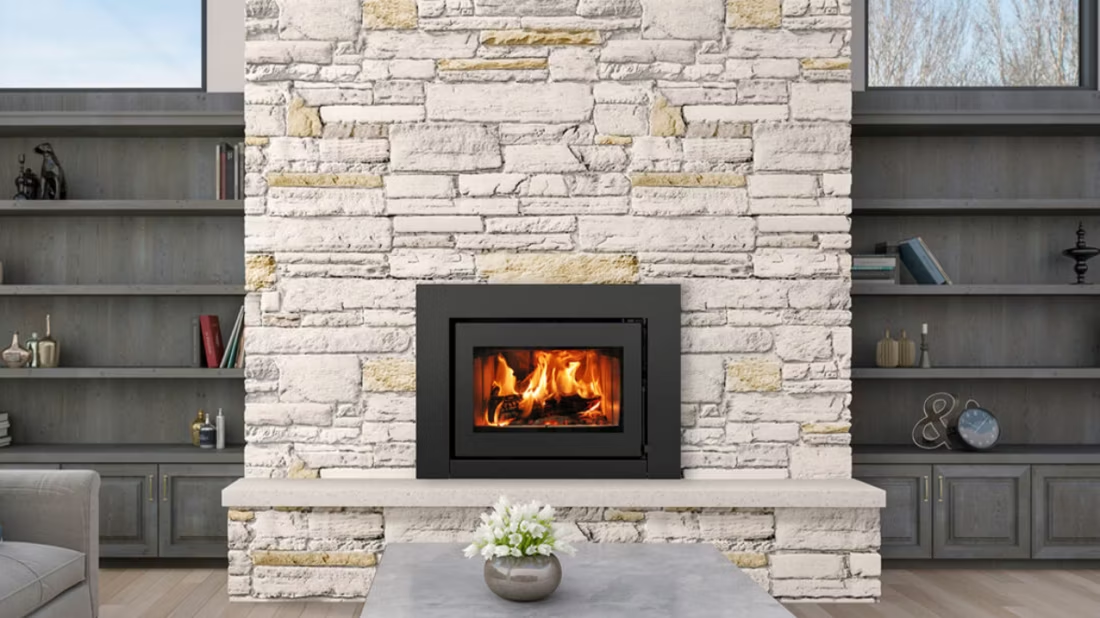
Four fuels. One honest answer for Moore County.
Three steps. No salesperson until you're ready.
Tell us about your project
Your zip code, your situation, and the fuel you're leaning toward—or let the answers point you to one.
See what's actually available
The brands dealers within 100 miles genuinely carry—real options, never a catalog mirage.
Get your dealer & Project Guide
A trusted local dealer, plus the free Project Guide & Parts List that names every component of the job.
Frequently Asked Questions
Which fuel works best in Moore County?
Gas is the dominant choice by a wide margin. Moore County has been a natural gas producing area for decades, and most homes in Dumas, Sunray, and Cactus are already on a gas line, which makes a gas fireplace or gas insert a straightforward add-on with no fuel-storage hassle. Propane fills the gap for rural homes outside city gas service. Electric fireplaces work well as supplemental heat in bedrooms, dens, and additions—with a 22°F average winter low, they're not carrying the whole heating load, but they take the edge off on windy Panhandle nights. Wood and pellet stoves are genuinely uncommon here; this is open plains country with no local timber supply, so most 'wood-look' installs you'll see are gas log sets rather than actual wood-burning appliances.
Do I need a permit to install a gas fireplace in Moore County?
Yes, in most cases. New gas fireplace, insert, or gas stove installations require a building permit through the county or city building department (Dumas issues its own permits inside city limits; unincorporated areas go through Moore County), plus a separate gas line permit handled by a licensed gas fitter for the actual gas connection work. Electric fireplace installs typically skip the permit step unless the project involves hardwiring a built-in unit or adding a new circuit. Most local hearth retailers pull the permits as part of the installation quote, so this usually isn't something the homeowner has to track down separately.
Why isn't wood burning common in Moore County?
It comes down to geography. Moore County is high plains—flat, mostly treeless farmland and rangeland, with oak, pecan, and mesquite growing mainly in scattered stands along river breaks rather than in harvestable woodlots. There's no local firewood industry the way there is in forested regions, so cordwood has to be trucked in and tends to cost more than it's worth compared to the natural gas that's produced right in the county. Some homeowners still like the look of a wood fire, which is why gas log sets—designed to mimic a wood flame using local gas service—are far more common here than actual wood-burning stoves or inserts.
Can I get a pellet stove in Moore County?
You can, but it's a niche request. Pellet stoves need a steady local supply of hardwood pellets, and while brands like Forest Energy and Lignetics show up in the region, they're stocked mainly for grills and smokers rather than bagged heating pellets for a stove hopper. A homeowner set on pellet heat in Moore County should expect to have pellets shipped in or sourced from Amarillo, and to budget for that added cost and effort. Given that natural gas is abundant and already piped to most homes, most local dealers will steer a heating-focused customer toward a gas insert instead—pellet ends up being the exception, not the rule.
Is an electric fireplace worth it for a Moore County home?
For supplemental use, yes. With 4,479 heating degree days and a 22°F average winter low, Moore County's heating season is real but moderate—closer to a mild Panhandle winter than the deep cold of places like Bismarck, ND. An electric fireplace won't replace central gas heat, but it's a low-hassle way to add warmth and ambiance to a bedroom, home office, or den without running new gas line, and it holds up fine against the wind-driven cold snaps that come through in January and February. Plug-in units need no permit at all; built-in electric fireplaces that require a dedicated circuit are the exception.
What's the typical cost range for a fireplace project in Moore County?
Gas fireplace, insert, or stove: roughly $4,000–$10,000 depending on whether existing gas line is in place or new line needs to be run, plus venting. Electric fireplace: $200–$3,000 for the unit itself, with $400–$1,200 in labor for anything beyond a plug-and-play install, which covers most wall-mount and insert setups. Wood and pellet installs are quoted case by case since they're uncommon here and usually involve sourcing appliances and fuel from outside the immediate area, which adds to both cost and lead time. A local dealer can give you an exact number once they know your home's existing gas or electric setup.
How much should I budget for a fireplace?
For an average home—covering the fireplace, the vent pipe, and basic installation—a budget between $3,900 and $5,500 gives you a lot of options across wood, gas, and pellet. By the time you add finish work, gas line, and electrical, the average complete installation lands between $5,000 and $12,000 all-in. In a remodel or new build, a good rule is to put about 2.5% of the total project cost toward the fireplace.
Can I install a fireplace myself?
If you're putting a fire in your house on purpose, it's best to work with an expert. Unless you're genuinely experienced in framing, gas line, vent pipe, and the national code on clearances to combustibles, have a professional do it—and ideally the same company that sells you the fireplace, so warranty, service, and liability all live under one roof.
Can a fireplace actually lower my heating bill?
Yes—by creating a comfort zone. A furnace heats every square foot of the house just to warm the one room you're in; a gas fireplace on low burns roughly a sixth of the gas a typical furnace does. Set the furnace around 55–60 degrees as a baseline, then heat the rooms your family actually uses. Families who heat this way commonly save $20–$60 a month.
Wood, gas, pellet, or electric—how do I choose?
Match the fuel to your life, not the other way around. Wood: lowest fuel cost and total power-outage independence, but you're hauling and stacking. Gas: press a button, set a thermostat, no maintenance to speak of. Pellet: wood economics with automatic feeding, in exchange for weekly cleaning and a need for electricity. Electric: plugs in anywhere with honest supplemental heat. Nobody regrets the fuel that fits how they actually live.
Stove and Fireplace Dealers in Moore County
Listings include WhyFire partner dealers, dealers we have verified as authorized for the brands we recommend, and established local businesses that carry hearth products. Every listing shows which one it is. The ones marked Preferred run on WhyFire's software, so they can show you real pricing and book your appointment right here. No manufacturer pays for placement. How we verify dealers →
Panhandle Outdoor Living & Fireplaces
Reid's Appliance Services
West Texas Brick
Boyd's Equipment
Find your fireplace in Moore County, Texas.
Tell us about your home and we'll match you with a trusted local dealer in Dumas or the surrounding area, plus send you a free Project Guide & Parts List—the right unit, the vent kit, and the dealer who can actually install it near you.
Find Your Fireplace →