
Find the right hearth for mild Fannin County winters.
Wood, gas, pellet, and electric fireplace resources for every city and rural community in Fannin County—from Bonham to Honey Grove. Find the right unit and connect with a trusted local hearth retailer.
Every Project Starts From One of These Five Situations
Moderate heating needs across Fannin County, Texas.
Fannin County sits along the Red River in North Texas, with roughly 2,822 heating degree days a year and average winter lows near 33 degrees—nowhere close to the deep cold of a place like Bismarck ND, but enough for genuine heating season from December through February. Oak, pecan, and mesquite grow throughout the county's farmland and river bottoms, and split hardwood from local land clearing remains a common, low-cost fuel source for homeowners with acreage. There's no formal air quality non-attainment designation here, which means wood burning isn't restricted the way it is in denser metro counties—a real advantage for anyone weighing a wood stove or fireplace.
What you'll find on this hub: hearth retailers, service technicians, and fuel suppliers serving every community in the county—from Bonham as the county seat, east to Honey Grove, south to Leonard and Savoy along Highway 82. Pick your fuel below to drill into specifics—local dealers, installation costs, recommended units, and the resources that match your project. Whether you're heating a farmhouse outside Ector or a townhome in Bonham, this is the starting point.
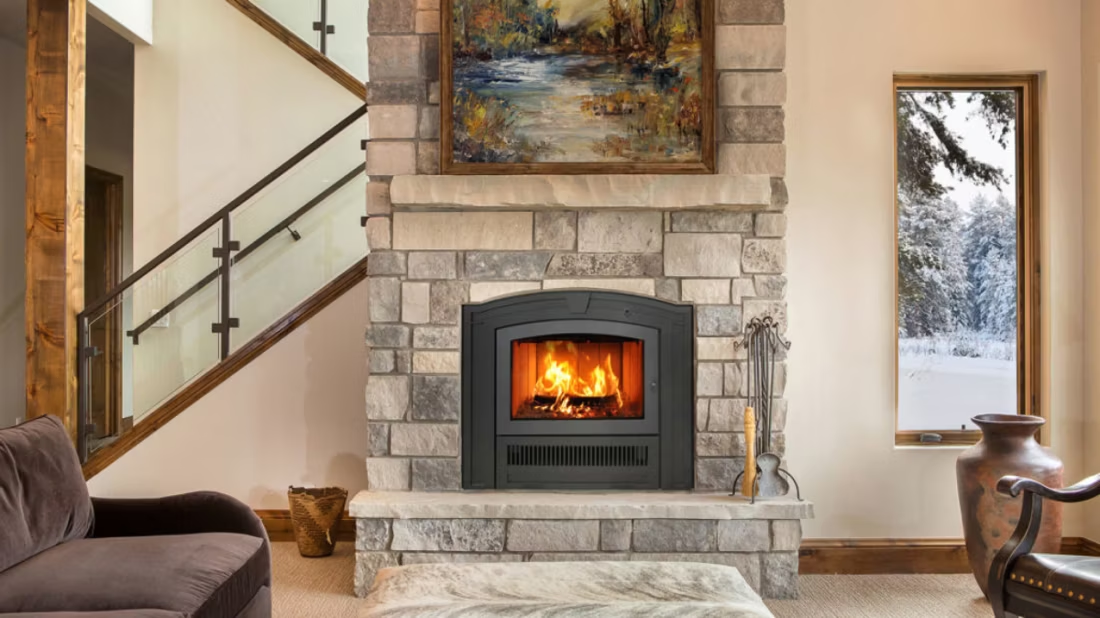
Four fuels. One honest answer for Fannin County.
Three steps. No salesperson until you're ready.
Tell us about your project
Your zip code, your situation, and the fuel you're leaning toward—or let the answers point you to one.
See what's actually available
The brands dealers within 100 miles genuinely carry—real options, never a catalog mirage.
Get your dealer & Project Guide
A trusted local dealer, plus the free Project Guide & Parts List that names every component of the job.
Frequently Asked Questions
Which fuel works best in Fannin County?
With only about 2,822 heating degree days and winter lows averaging around 33 degrees, Fannin County doesn't demand the all-night, single-digit-burn capability you'd need in a place like Duluth MN. That said, all four fuels have real use here. Wood remains popular on rural acreage where oak, pecan, and mesquite are already being cleared or cut—a wood stove or fireplace can meaningfully cut heating costs for anyone with access to a woodlot. Gas is the low-maintenance option for in-town Bonham homes with natural gas service—instant heat, no wood handling, works well for supplemental warmth on cold snaps. Pellet stoves (Forest Energy, Lignetics both distribute regionally) offer wood-like ambiance with easier fuel handling and less daily tending than cordwood. Electric fireplaces are a strong fit for a county with mild winters—many homeowners here use electric as a primary heat source in secondary rooms or as the whole-home solution in newer, well-insulated construction, since the climate rarely demands more.
Do I need a permit to install a fireplace in Fannin County?
Generally yes, though requirements are simpler outside city limits. Within Bonham, Honey Grove, and Leonard, building permits are typically required for new wood stoves, wood-burning inserts, gas fireplaces, gas inserts, gas stoves, and pellet appliances, with gas work also requiring a licensed gas-fitter for the line connection. In unincorporated parts of Fannin County, permitting requirements are lighter and enforcement is less centralized than in Texas's larger metro counties—but any gas line work should still go through a licensed installer for safety, and most insurance carriers want documentation of a code-compliant install regardless of jurisdiction. Electric fireplaces usually don't require a permit unless they involve new wiring or a built-in installation. Most local hearth retailers handle the paperwork as part of the installation, whichever side of the county line you're on.
Are there air quality restrictions on wood burning in Fannin County?
No. Fannin County has no formal air quality non-attainment designation and no winter burn curtailment program, unlike basin or valley counties that deal with temperature inversions trapping smoke. That's a genuine advantage if you're considering a wood stove or fireplace insert—you won't run into voluntary or mandatory burn bans tied to air quality advisories. New wood-burning appliances sold and installed here still need to meet current EPA emissions standards, which is a manufacturing requirement rather than a local restriction, but day-to-day burning isn't subject to the kind of advisory system you'd see in a county with regular winter inversions.
Can one local hearth retailer handle all four fuel types?
Many hearth retailers serving Fannin County carry multiple fuel types, since demand for wood, gas, pellet, and electric is fairly evenly spread across a county with mild but real heating needs. Dealers based in Bonham typically stock both wood and gas units as their core lines, often adding pellet stoves and a selection of electric fireplaces to round out the showroom. Smaller shops or those focused on rural, acreage-heavy customers may lean harder into wood and pellet, since that's what fits the local supply of oak, pecan, and mesquite. If you're not sure which fuel fits your home, a multi-fuel dealer can show you working displays side by side and talk through what actually makes sense given your gas access, wood supply, and whether the room is a primary or supplemental heat source.
How does service work in rural areas of Fannin County?
Most chimney sweeps, gas techs, and pellet service technicians serving Fannin County are based in or near Bonham and drive out to surrounding communities—Honey Grove to the east, Leonard and Savoy to the south, and the farm-and-ranch areas along the Red River. Expect a modest travel fee for calls outside the immediate Bonham area, and expect scheduling to tighten up heading into the December cold snaps, since a lot of rural homeowners wait until the first freeze to think about their chimney or gas unit. Booking annual service in the fall—before the heating season actually starts—is the easiest way to avoid a wait, especially if you're relying on wood or pellet as a real heat source rather than just ambiance.
What's the typical cost range for fireplace installation across all fuel types in Fannin County?
Costs vary by fuel and by how much existing infrastructure (chimney, gas line, electrical) is already in place. Wood stove or insert installation: roughly $3,500–$7,500 for typical installs, more if new chimney construction is involved. Gas fireplace, insert, or stove: roughly $3,500–$8,500, with cost driven mainly by how much new gas line work is needed. Pellet stove or insert: roughly $3,500–$6,000 for typical installs. Electric fireplace: $200–$2,500 for the unit itself, plus $300–$1,000 in labor for anything beyond a plug-and-play install. For local specifics tied to Fannin County retailer pricing, see the county + fuel pages above.
Can I install a fireplace myself?
If you're putting a fire in your house on purpose, it's best to work with an expert. Unless you're genuinely experienced in framing, gas line, vent pipe, and the national code on clearances to combustibles, have a professional do it—and ideally the same company that sells you the fireplace, so warranty, service, and liability all live under one roof.
What is an in-home preview and do I need one?
It's a visit where a hearth professional measures your space, confirms the model you picked actually works in your home, and walks the specs—framing, gas line, venting, finish work—before anything is ordered. Some details you just can't know until you see the house. Never make a down payment without one; it's the single most-skipped step that burns buyers.
Can a fireplace actually lower my heating bill?
Yes—by creating a comfort zone. A furnace heats every square foot of the house just to warm the one room you're in; a gas fireplace on low burns roughly a sixth of the gas a typical furnace does. Set the furnace around 55–60 degrees as a baseline, then heat the rooms your family actually uses. Families who heat this way commonly save $20–$60 a month.
What are the biggest mistakes people make buying a fireplace?
Five come up constantly: budgeting for the unit but not the full job (vent, gas line, electrical, finish work); drowning in options instead of starting from style and fuel; buying without an in-home preview; handing installation to a handyman instead of a pro; and giving up out of sheer indecision. Every one is avoidable with a clear plan—step one, step two, step three.
Stove and Fireplace Dealers in Fannin County
Listings include WhyFire partner dealers, dealers we have verified as authorized for the brands we recommend, and established local businesses that carry hearth products. Every listing shows which one it is. The ones marked Preferred run on WhyFire's software, so they can show you real pricing and book your appointment right here. No manufacturer pays for placement. How we verify dealers →
Nolen's Home Market
Fan & Flame
Ntx Bbq Supply
Cooper Propane
Brinker's Service
Youngs Brothers Buck Stove
Find your fireplace in Fannin County.
Pick your fuel below and I'll match you with a trusted local dealer and a free Project Guide & Parts List—the exact parts, including the vent kit, for your project.
Find Your Fireplace →