
Heat your home through Todd County's long, cold winters.
Wood, gas, pellet, and electric fireplace resources for every community across Todd County—from Mission and Rosebud to St. Francis, Parmelee, and Okreek. Find the right unit for your home and get matched with a trusted local dealer.
Every Project Starts From One of These Five Situations
Cold, wind-driven winters across Todd County, South Dakota.
Todd County is coterminous with the Rosebud Indian Reservation in south-central South Dakota—about 1,400 square miles and roughly 6,300 residents, one of the more sparsely populated counties in the state. With winters as cold as Madison, Wisconsin sees each year and an average winter low of 12°F, the heating load here is close to what a home in Madison, Wisconsin deals with each winter—long stretches of subzero nights made worse by open prairie wind with nothing to break it. The heating season typically runs from October into April. Wood heat is practical and common: ponderosa pine grows in the western part of the county, and oak and cottonwood are cut along the White River and Little White River bottoms. Unlike basin communities that deal with winter inversions, Todd County's open plains disperse smoke readily, and there are no wood-burning curtailment days or non-attainment restrictions to plan around here.
What you'll find on this hub: hearth retailers, service technicians, and fuel suppliers covering every town in the county—Mission, the county seat, along with Rosebud, St. Francis, Parmelee, Okreek, and Antelope. Since Todd County reorganized as a self-governing county in 2016, most day-to-day building and permitting questions now run through the courthouse in Mission rather than a neighboring county. Pick your fuel below for local dealer info, installation costs, and recommended units—whether you're heating a home in Mission or a place out along the White River.
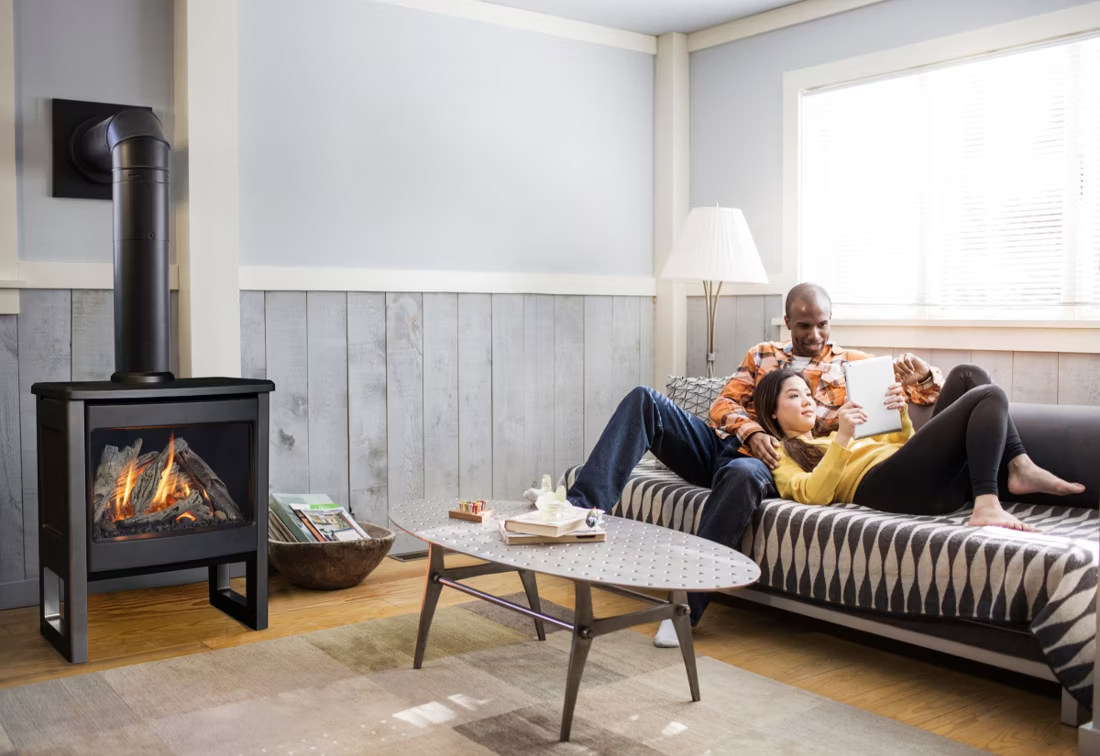
Four fuels. One honest answer for Todd County.
Three steps. No salesperson until you're ready.
Tell us about your project
Your zip code, your situation, and the fuel you're leaning toward—or let the answers point you to one.
See what's actually available
The brands dealers within 100 miles genuinely carry—real options, never a catalog mirage.
Get your dealer & Project Guide
A trusted local dealer, plus the free Project Guide & Parts List that names every component of the job.
Frequently Asked Questions
Which fuel works best in Todd County?
It depends on the home and how remote it is. Wood remains a strong, practical choice across rural Todd County—ponderosa pine from the western part of the county and oak or cottonwood cut along the White River bottoms both burn well, and a wood stove keeps working when winter storms take down power lines. Gas is really propane here, since there's no piped natural gas network—propane fireplaces and inserts offer instant heat with no wood-hauling, but fuel has to be delivered and stored on-site. Pellet stoves are a solid middle ground, and Lignetics and Indeck Energy Services both supply the region, though you'll want to plan ahead for delivery given how spread out the county is. Electric fireplaces work well as a supplemental heat source in a bedroom or living room, but at 12°F average winter lows they shouldn't be your only heat source. Most homes here end up pairing wood or propane as primary heat with pellet or electric in secondary rooms.
Do I need a permit to install a fireplace in Todd County?
In most cases, yes, though how that works depends on where the home sits. Todd County reorganized as a self-governing county in 2016, and building permit questions for private land now generally run through the Todd County courthouse in Mission rather than a neighboring county. For homes on tribal trust land, you may also need to coordinate with the Rosebud Sioux Tribe's building programs or the Bureau of Indian Affairs in addition to county requirements. Wood stoves, inserts, propane fireplaces, and pellet stoves typically require a permit; propane installations also need a licensed gas-fitter for the line and tank connection. Electric fireplaces usually skip the permit process unless you're doing a hardwired built-in. A local hearth retailer who's installed in the county before is worth asking—most have already worked out which office to call for your specific parcel.
Are there air quality restrictions on wood burning in Todd County?
No—Todd County doesn't have the geographic setup that causes wood-smoke problems elsewhere. There's no winter inversion issue and no non-attainment designation here; the open prairie means smoke disperses rather than pooling the way it does in basin communities ringed by mountains. That said, installing an EPA 2020 NSPS-certified stove still makes practical sense on its own merits—you'll burn less wood for the same heat output, which matters when you're cutting or hauling ponderosa pine, oak, or cottonwood yourself. There are no curtailment days or burn bans to plan around in Todd County.
Can one local hearth retailer handle all four fuel types?
Because Todd County's population is small and spread thin, most of the retailers who cover this area are generalists based in surrounding towns like Winner or Pierre, and they typically carry three or four fuel types rather than specializing in just one—it isn't practical to run a single-fuel showroom for a county this size. That's actually useful if you're not sure yet whether wood, propane, pellet, or electric fits your home best, since one visit can cover the comparison. Confirm ahead of time which fuels a given dealer stocks and installs before you drive out to see them, since inventory can shift with propane and pellet fuel availability.
How does service work in the more remote parts of Todd County?
Plan for some drive time either way. Technicians serving Todd County are usually based outside the county and travel in to reach Mission, then out to St. Francis, Parmelee, Okreek, and Antelope—distances that can run 15 to 25 miles or more between communities. Expect a modest travel fee for service calls outside Mission itself, and know that winter storms can delay scheduled visits on gravel and unpaved roads. Booking your annual chimney sweep or propane system check in September or early October, before the first hard cold snap, gives you a much better shot at a convenient appointment than trying to get someone out during a January cold spell.
What's the typical cost range for fireplace installation across all fuel types in Todd County?
Costs run a bit higher here than in denser markets, mostly due to travel distance for installers. Wood stove or insert installation: roughly $4,500–$9,500 for a typical setup, more if new chimney work is involved. Propane fireplace, insert, or stove: roughly $4,000–$10,000 depending on tank setup, line run, and venting—often on the higher end if there's no existing propane infrastructure at the home. Pellet stove or insert: roughly $4,500–$8,000 installed. Electric fireplace: $200–$3,000 for the unit itself, plus $400–$1,200 in labor for anything beyond a simple plug-in install. For details tied to specific dealers, see the county + fuel pages above.
What is an in-home preview and do I need one?
It's a visit where a hearth professional measures your space, confirms the model you picked actually works in your home, and walks the specs—framing, gas line, venting, finish work—before anything is ordered. Some details you just can't know until you see the house. Never make a down payment without one; it's the single most-skipped step that burns buyers.
Can I install a fireplace myself?
If you're putting a fire in your house on purpose, it's best to work with an expert. Unless you're genuinely experienced in framing, gas line, vent pipe, and the national code on clearances to combustibles, have a professional do it—and ideally the same company that sells you the fireplace, so warranty, service, and liability all live under one roof.
How much should I budget for a fireplace?
For an average home—covering the fireplace, the vent pipe, and basic installation—a budget between $3,900 and $5,500 gives you a lot of options across wood, gas, and pellet. By the time you add finish work, gas line, and electrical, the average complete installation lands between $5,000 and $12,000 all-in. In a remodel or new build, a good rule is to put about 2.5% of the total project cost toward the fireplace.
Does a fireplace add value to my home?
On average, a fireplace adds back to the home about the same amount you spent installing it. Add the monthly savings from heating the rooms you actually use instead of the whole house—often hundreds of dollars a year—and the value case is strong before you even count what a fire does for how your family uses the room.
Find your fireplace dealer in Todd County.
Pick your fuel below and I'll match you with a trusted local dealer serving Todd County, plus a free Project Guide & Parts List—the exact parts, including the vent kit, for your project and where to get it installed.
Find Your Fireplace →