
Fireplace Options Built for Day County's Deep-Freeze Winters.
Wood, gas, pellet, and electric fireplace resources for Webster, Waubay, Bristol, Andover, and every farm and lake community in Day County. Find the fuel that fits your home and connect with a trusted local hearth dealer.
Every Project Starts From One of These Five Situations
Prairie heating in the Glacial Lakes region of South Dakota.
Day County sits in northeastern South Dakota's Glacial Lakes country, a landscape of pothole lakes, shelterbelts, and open farmland around Waubay, Blue Dog, and Pickerel lakes. Winters here are severe even by Dakota standards—an average winter low near 2°F and roughly 8,600 heating degree days a year, on par with Fargo just across the state line. The heating season commonly runs from October through April, and homes here are built to handle sustained cold, not just cold snaps. Firewood culture leans on what actually grows in this county: cottonwood along the lakeshores, oak from farmstead shelterbelts, and ponderosa pine planted as windbreaks decades ago. There are no air-quality nonattainment designations or winter burn restrictions here—this is open, rural country where wood heat has never had to compete with smog concerns.
What you'll find on this hub: hearth retailers, service technicians, and fuel suppliers serving every community in Day County—from the county seat in Webster to Waubay, Bristol, Andover, Butler, Pierpont, Roslyn, South Shore, and Grenville. Because Day County's population is under 3,200, some services draw from a regional network based in nearby Watertown or Aberdeen, and we've noted that where it applies. Pick your fuel below for local dealers, installation costs, recommended units, and the details that matter for a farmhouse, lake cabin, or in-town home in this part of the state.
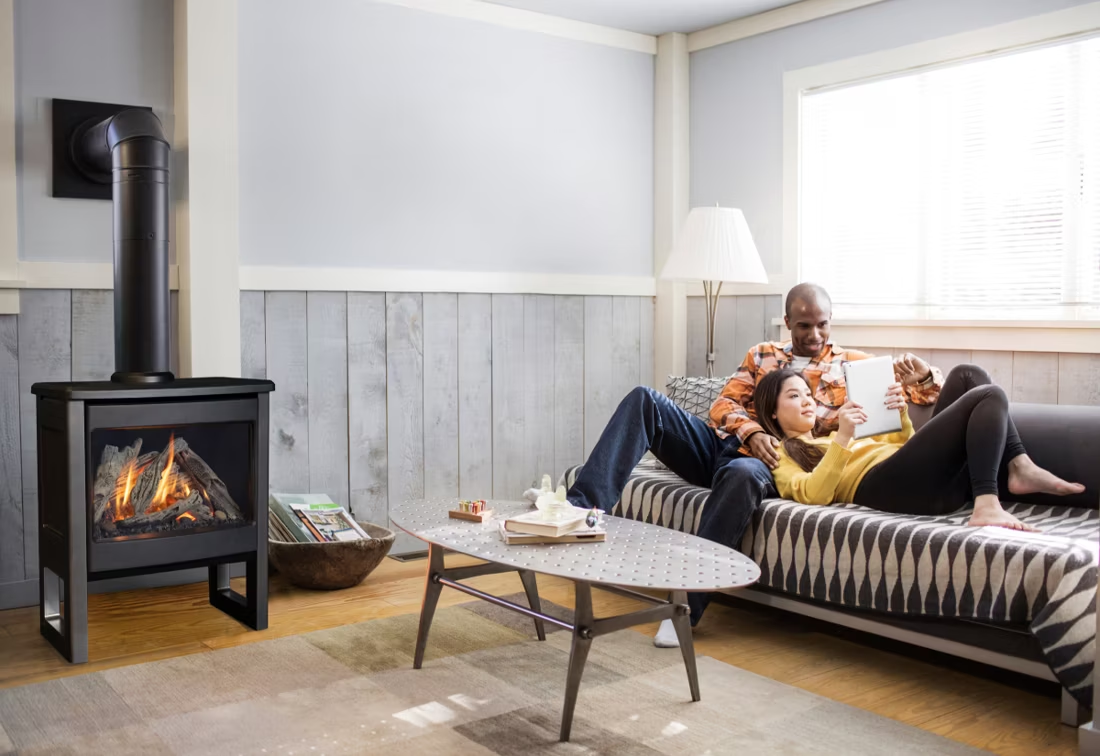
Four fuels. One honest answer for Day County.
Three steps. No salesperson until you're ready.
Tell us about your project
Your zip code, your situation, and the fuel you're leaning toward—or let the answers point you to one.
See what's actually available
The brands dealers within 100 miles genuinely carry—real options, never a catalog mirage.
Get your dealer & Project Guide
A trusted local dealer, plus the free Project Guide & Parts List that names every component of the job.
Frequently Asked Questions
Which fuel works best in Day County?
Given roughly 8,600 heating degree days and winter lows that regularly sit near or below zero, Day County homes generally need a fuel that can run hard, all season, without fail. Wood remains a strong primary choice on farmsteads with access to cottonwood, oak, or shelterbelt pine—a catalytic stove can hold overnight coals through a January cold snap far better than a non-cat unit. Propane is the practical default for most in-town and rural homes, since natural gas mains are limited to parts of Webster and propane delivery is reliable countywide. Pellet stoves work well for homeowners who want wood-style heat without splitting and stacking, and Lignetics and Indeck Energy Services pellets are both available through regional suppliers. Electric fireplaces are supplemental here—good for a bedroom or a lake cabin used part of the year, but not enough on their own against a Dakota winter.
Do I need a permit to install a fireplace in Day County?
Requirements are lighter here than in a larger metro county, but they still apply. New wood stoves, inserts, propane appliances, and pellet stoves generally require a building permit, and any gas-line work should go through a licensed propane installer. Within Webster city limits, permits are handled through the city; in unincorporated Day County, check with the county zoning office before you start. Because this is a small, sparsely populated county, permitting timelines tend to be faster than in a city—most local dealers who serve the area can walk you through what's actually required for your address.
Are there air quality restrictions on wood burning in Day County?
No. Day County has no air-quality nonattainment designation and no winter burn advisories—this is open prairie country without the temperature-inversion issues that trigger burn restrictions in mountain basins or valley towns. That means wood and pellet stoves here are regulated the same way any home heating appliance is: through building code and manufacturer installation clearances, not through seasonal curtailment. New wood stove installations still need to meet current EPA emissions standards, but you won't run into a
Can one local hearth retailer handle all four fuel types in a county this small?
Not always, and that's normal for a county of about 3,190 people. A Webster-based retailer may focus on wood and propane, while pellet stoves and electric units are more often stocked by dealers based in Watertown (about 40 miles south) or Aberdeen (about 45 miles west) who also service Day County. If you want to compare across all four fuels in person, expect that comparison shopping may mean visiting a dealer just outside the county line—Find My Fireplace matches you with whichever trusted dealer actually covers your address and carries what you need, regardless of exactly where their storefront sits.
How does service work for rural properties in Day County?
Most technicians who service Day County are based in Webster, Watertown, or Aberdeen and drive out to farmsteads and lake properties around Waubay, Bristol, Andover, and the smaller unincorporated communities. Expect to schedule a bit further ahead than you would in a city—pre-season appointments in September and October are far easier to get than an emergency call in the middle of a January cold spell. For remote farm properties, it's worth asking about a travel fee up front and keeping basic parts on hand (igniter batteries for propane units, a spare stovepipe gasket for wood stoves) so a minor issue doesn't turn into a multi-day wait for a service truck.
What's the typical cost range for fireplace installation across all fuel types in Day County?
Costs run close to regional South Dakota norms, sometimes with a modest travel premium for farmstead installs outside Webster. Wood stove or insert: roughly $4,000–$8,500 installed, more if a full masonry chimney is involved. Propane fireplace, insert, or stove: roughly $4,000–$10,000 depending on tank setup and venting, since most of the county runs on delivered propane rather than piped natural gas. Pellet stove or insert: roughly $4,000–$7,000 for a typical install. Electric fireplace: $200–$3,000 for the unit itself, plus $400–$1,200 in labor for anything beyond a plug-and-play placement. For details tied to your specific fuel, see the county + fuel pages above.
Can I install a fireplace myself?
If you're putting a fire in your house on purpose, it's best to work with an expert. Unless you're genuinely experienced in framing, gas line, vent pipe, and the national code on clearances to combustibles, have a professional do it—and ideally the same company that sells you the fireplace, so warranty, service, and liability all live under one roof.
Wood, gas, pellet, or electric—how do I choose?
Match the fuel to your life, not the other way around. Wood: lowest fuel cost and total power-outage independence, but you're hauling and stacking. Gas: press a button, set a thermostat, no maintenance to speak of. Pellet: wood economics with automatic feeding, in exchange for weekly cleaning and a need for electricity. Electric: plugs in anywhere with honest supplemental heat. Nobody regrets the fuel that fits how they actually live.
Should the dealer who sells my fireplace also install it?
Ideally, yes. A fireplace project involves vent pipe, gas line, electrical, and often tile or stone. Hire three or four separate trades and you own the liability and the game of telephone between them. One company selling and installing means one accountable party, start to finish—ask about factory training, on-time completion records, and what happens if an inspection fails.
How much should I budget for a fireplace?
For an average home—covering the fireplace, the vent pipe, and basic installation—a budget between $3,900 and $5,500 gives you a lot of options across wood, gas, and pellet. By the time you add finish work, gas line, and electrical, the average complete installation lands between $5,000 and $12,000 all-in. In a remodel or new build, a good rule is to put about 2.5% of the total project cost toward the fireplace.
Stove and Fireplace Dealers in Day County
Listings include WhyFire partner dealers, dealers we have verified as authorized for the brands we recommend, and established local businesses that carry hearth products. Every listing shows which one it is. The ones marked Preferred run on WhyFire's software, so they can show you real pricing and book your appointment right here. No manufacturer pays for placement. How we verify dealers →
Larry's Lumber
Hometown Building Center
Andor Inc.
Get matched with a Day County hearth dealer.
Tell us your fuel and address, and we'll send a free Project Guide & Parts List—the exact parts, including the vent kit, and the trusted local dealer we recommend for your Day County project.
Find Your Fireplace →