
Pellet heat sourced from Québec mills, not overseas.
Saint-Philippe sees winter lows averaging -15.1°C, and the pellets that feed a stove here-Granules LG, Energex, Trebio-come from mills inside the province, not a container ship. I'll match you with a trusted local dealer and a free plan for what a pellet project actually costs to install here: typically $6,000-$10,000 CAD.
Every Project Starts From One of These Five Situations
A steady burn without the woodpile or the bylaw maze.
Saint-Philippe sits in Montérégie on Montreal's south shore, low-lying at 23 metres, in climate zone 6A. Winters here average -15.1°C on the cold nights and regularly dip further during a January cold snap-not far off what Québec City sees most winters. That's a long, genuine heating season, and a lot of homeowners in this part of Montérégie want the steady, thermostatically controlled heat of a solid-fuel appliance without splitting and stacking cordwood every fall.
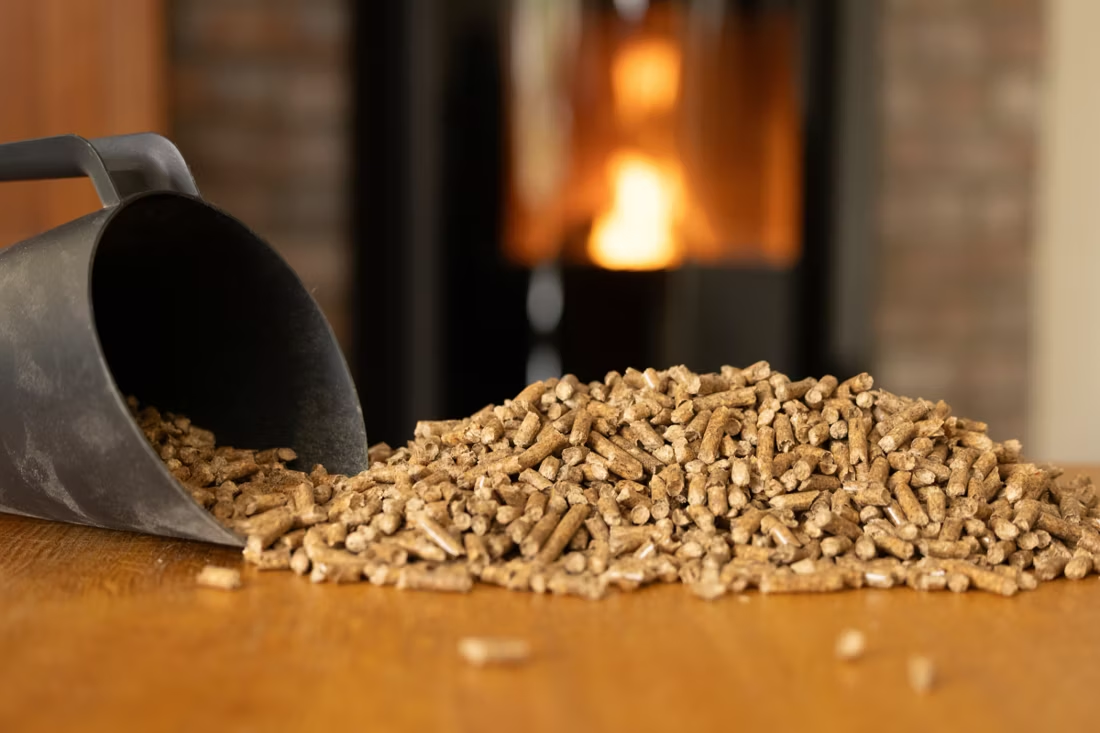
Pellet fits that gap well. Regional brands-Granules LG, Energex, and Trebio-mill pellets from Québec forestry residue and sell locally at roughly $400-$575 a tonne, so the fuel supply isn't tied to import shipping the way it can be elsewhere. It also sidesteps a permitting headache that trips up wood-stove buyers closer to Montreal: the island's rule requiring registered, certified appliances under 2.5 g/h of fine particles applies specifically to the island of Montreal, not to Saint-Philippe, but pellet appliances already burn well under that threshold regardless. You'll still go through the municipal building department here, and CSA B365 governs the installation itself-your dealer handles both as a routine part of the job.
Three steps. No salesperson until you're ready.
Tell us about your project
Your postal code, your situation, and the fuel you're leaning toward—or let the answers point you to one.
See what's actually available
The brands dealers within 100 miles genuinely carry—real options, never a catalog mirage.
Get your dealer & Project Guide
A trusted local dealer, plus the free Project Guide & Parts List that names every component of the job.
Frequently Asked Questions
How much does a pellet stove installation cost in Saint-Philippe?
Most pellet installations in Saint-Philippe run $6,000 to $10,000 CAD. An insert dropping into an existing masonry firebox, common in older homes closer to the village core, tends to land at the lower end since the chimney chase is already there. A freestanding pellet stove in a home without an existing fireplace needs new venting through a wall, which pushes the project toward the top of that range. The municipal building department requires a permit either way, and most local dealers include that paperwork in the quote.
Where do the pellets actually come from, and what will they cost me?
Granules LG, Energex, and Trebio are the three brands most Saint-Philippe dealers stock, all milled from Québec forestry and sawmill residue rather than shipped in from outside the province. Expect to pay roughly $400 to $575 per tonne depending on brand and whether you buy bagged pallets or bulk. Because the supply chain is regional rather than import-dependent, availability tends to stay steadier through a cold winter than it does in areas relying on trucked-in pellets from farther afield.
Do I need a permit to install a pellet stove in Saint-Philippe?
Yes. The municipal building department issues the permit, and the installation itself has to meet the CSA B365 code, same as any solid-fuel appliance in Quebec. Many home insurers in Montérégie also ask for an inspection modeled on WETT standards before they'll cover a pellet appliance, even though pellet stoves burn far cleaner than an open wood stove-it's worth confirming with your insurer before the install rather than after.
Does Montreal's wood-burning bylaw apply to my home in Saint-Philippe?
No, not directly. The rule requiring wood appliances to be registered and certified under 2.5 grams per hour of fine particles is specific to the island of Montreal. Saint-Philippe, on the south shore in Montérégie, sets its own requirements through the municipal building department. That said, a pellet stove already burns well under that Montreal threshold, so if the bylaw ever gets referenced by a lender or insurer during a sale, a pellet appliance is rarely the sticking point that an old uncertified wood stove would be.
What happens to my pellet stove during a power outage?
A pellet stove's auger and blower both run on household electricity, so a Hydro-Québec outage-something this region has seen during major ice storms-will stop the stove cold unless you've got backup power. A lot of Saint-Philippe homeowners pair their pellet stove with a small battery backup or a generator sized for the appliance's draw, which is modest. Hydro-Québec's residential rate of about $0.078 per kilowatt-hour also makes it cheap to run a backup electric heater as a stopgap if you'd rather not invest in generator backup for the stove itself.
What size pellet stove do I need for a Saint-Philippe home?
With winter lows averaging -15.1°C and a heating season that runs from November into March, most main living areas here do well with a mid-size pellet stove rather than a compact unit meant for occasional supplemental heat. A dealer sizing your home will factor in square footage, ceiling height, and insulation level rather than square footage alone-older homes in the village with less insulation often need a step up from what a newer build on the same street would require.
Pellet vs. wood stove-which makes more sense in Saint-Philippe?
Wood is the cheaper fuel if you're willing to do the work: the Ministère des Ressources naturelles et des Forêts issues cutting permits for about $1.85 per cubic metre plus tax, up to 22.5 cubic metres, valid April 1 to March 31, and sugar maple, yellow birch, American beech, and red oak are all common species harvested regionally. But wood means splitting, stacking, and seasoning, plus a WETT inspection for insurance. Pellet trades some of that fuel-cost savings for thermostatic control, easier loading, and simpler compliance-worth considering if convenience matters more to your household than minimizing fuel spend.
What about a gas fireplace instead of pellet?
Natural gas is a genuinely rare choice for home heating in this part of Quebec, and Saint-Philippe is no exception. Énergir's distribution network reaches only parts of Montérégie, and plenty of streets here simply aren't served. If gas access matters to you, it's worth checking your specific address before planning around it-otherwise a propane conversion is possible but typically runs $6,000 to $15,000 CAD installed, well above a pellet setup. For most Saint-Philippe homes, pellet stays the more reliably available solid-fuel option regardless of what's running down the street.
How much pellet storage do I need to get through a Saint-Philippe winter?
A typical home burning a pellet stove as a primary or heavy supplemental heat source through the local November-to-March season goes through roughly 2 to 3 tonnes of pellets, depending on house size and how cold a given winter runs. Most households buy in bulk pallets from a Granules LG, Energex, or Trebio dealer in the fall and store them in a garage or basement, dry and off a concrete floor. Plan on emptying the ash pan every few days of steady use and a professional hopper and venting cleaning once a season, usually before the first real cold snap in November.
Why do fireplace quotes vary so much?
Because a fireplace is an iceberg—there's more behind the wall than in front of it. A low quote often covers only the unit; the full scope includes vent pipe, gas line or electrical, framing, and the tile or stone that has to come off and go back on. Make every bidder price the whole job. If a dealer can't speak to the full scope with confidence, that's your signal to keep looking.
Is it worth replacing an old fireplace that still sort of works?
Ask three questions: Is it ugly? Is it drafty? Does it actually work? Most old fireplaces fail at least two. Beyond looks, an old unit leaks air around the damper year-round and—if it's gas with a standing pilot—quietly burns a couple hundred dollars a year. A modern replacement seals the wall, heats the room, and changes how the whole space gets used.
Why is my open fireplace making my house colder?
Open fireplaces suck—literally. As the fire burns, it consumes air your furnace already paid to heat and pulls it out through the chimney, so the house is actually colder after the fire goes out than before you lit it. An insert fixes this: it seals the chimney, puts fixed glass across the front, and turns that hole in your house into a real heat source.
What's the difference between an insert and a zero-clearance fireplace?
An insert is a fireplace that slides into a pre-existing wood-burning fireplace—if you don't have one, there's nothing to insert it into. A zero-clearance fireplace is built into a framed wall, which makes it the answer for remodels and new construction. Simple test: existing masonry fireplace means insert; blank or framed wall means zero-clearance.
Nearby Dealers
Hearth shops serving Saint-Philippe and the surrounding area. Every listing shows whether it is a WhyFire partner, a dealer we have verified as authorized for the brands we recommend, or a local business carrying hearth products. No manufacturer pays for placement. How we verify dealers →
Piscines Jacques-Cartier
Confort Elite
Napert Signature
Thermopompes N & R Sol
Décor Chaleur Châteauguay
Chauffage Gadbois
Foyer Universel Montreal Inc. (A.m.f.)
Nergiflex
Noréa Foyers Montréal
Propane Plus Inc
Arta Boutik
Alternatives
Pro Du Foyer
Suroît Boutique (Sainte-Martine)
Pellet Brands Stocked Around Saint-Philippe
Typical price runs $400-$575 per ton—buy early-season for the best rates. Manufacturers will point you to the nearest stocking dealer.
Granules Lg
Trebio
Get your free Project Guide & Parts List for a Saint-Philippe pellet project.
Tell me about your home and I'll match you with a trusted local dealer who knows Granules LG, Energex, and Trebio supply, the municipal permit process, and what's actually installable on your street-then send a free Project Guide & Parts List with the vent kit and parts your project needs.
Find Your Fireplace →