
In Maniwaki, gas usually means propane, not a mains line.
Maniwaki sits in climate zone 6A at 162 metres elevation, with winter lows averaging -18.4°C. Énergir's gas network doesn't reach this far up the Gatineau valley, so a gas fireplace here almost always means propane. I'll help you confirm what's actually available on your street and match you with a trusted local dealer.
Every Project Starts From One of These Five Situations
Why gas is the exception here, not the rule.
Maniwaki sits in the Vallée-de-la-Gatineau, at 162 metres elevation along the Gatineau and Désert rivers, in climate zone 6A where winter lows average -18.4°C and hard freezes stretch from November into April—closer to a Saguenay or Val-d'Or winter than anything near Montréal. With a population of roughly 4,236, most homes and camps in the region are heated with wood or electricity, not gas: sugar maple, yellow birch, American beech, and red oak are the species split and stacked in woodsheds across the area, and Hydro-Québec's residential rate of about 7.8 cents per kWh keeps electric heat competitive too.
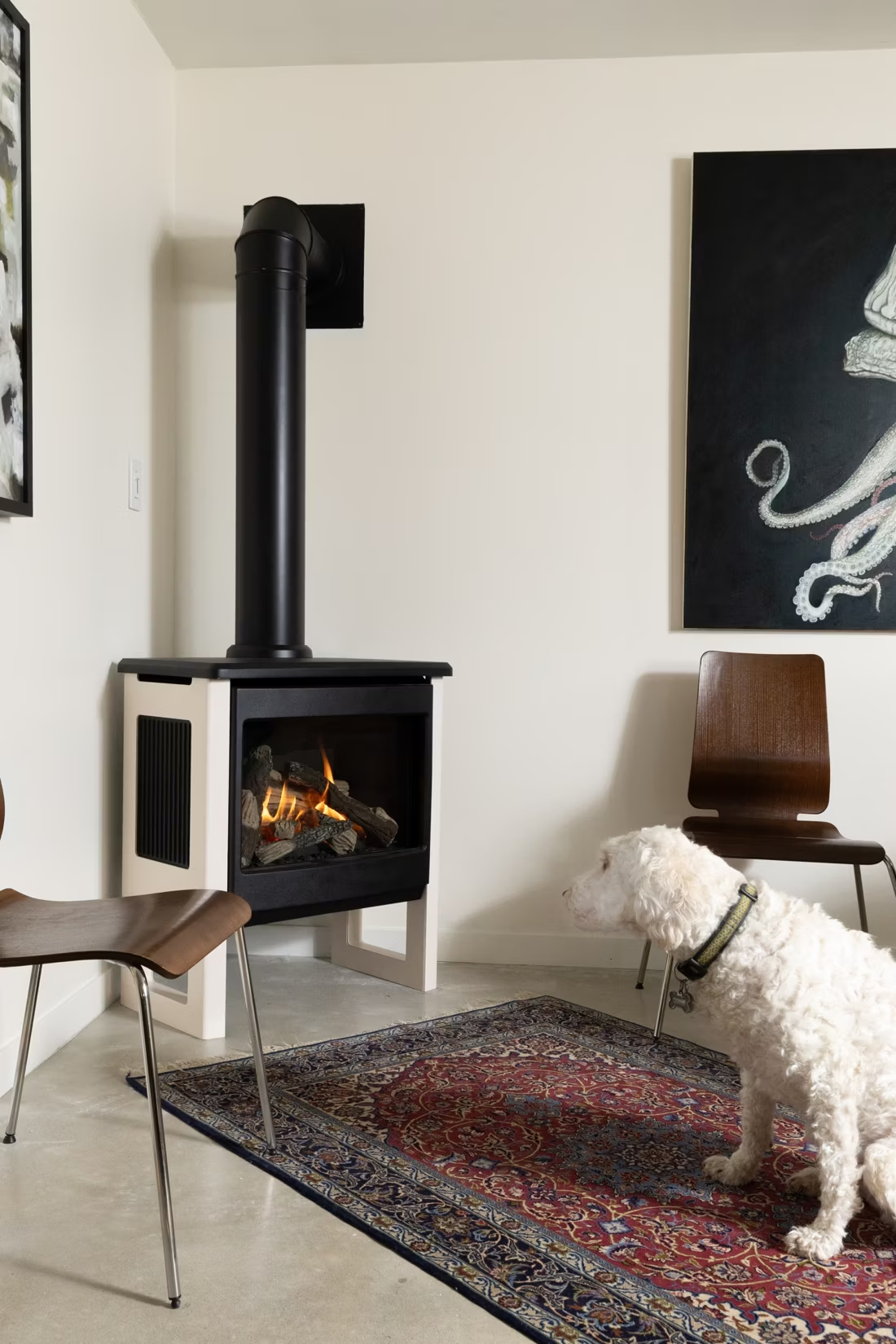
Énergir's natural gas distribution reaches limited corridors of Quebec—pockets of greater Montréal, the south shore, and a handful of urban spines—and Maniwaki sits well outside that served network. That doesn't rule out a gas fireplace here, but it usually means propane: a tank set on the property feeding a direct-vent unit, often installed as a conversion of an existing wood-burning fireplace. I'll be straightforward about this up front—check what's actually available on your street before falling in love with a specific unit, and a local dealer can confirm in a phone call what your real options are.
Three steps. No salesperson until you're ready.
Tell us about your project
Your postal code, your situation, and the fuel you're leaning toward—or let the answers point you to one.
See what's actually available
The brands dealers within 100 miles genuinely carry—real options, never a catalog mirage.
Get your dealer & Project Guide
A trusted local dealer, plus the free Project Guide & Parts List that names every component of the job.
Frequently Asked Questions
Is natural gas actually available in Maniwaki?
Rarely. Énergir's pipeline network is concentrated in and around greater Montréal and a few other urban corridors, and it does not reach Maniwaki or most of the Vallée-de-la-Gatineau. A handful of properties elsewhere in Quebec sit on served streets, but that's not the reality here. If you want a gas fireplace, budget for a propane tank setup instead of a natural gas line, and confirm with your municipality and a licensed gas fitter before you commit to a model.
How much does a gas (propane) fireplace installation cost in Maniwaki?
Typical installs run $6,000 to $15,000 CAD. Because most Maniwaki homes run on propane rather than a mains line, that range often includes a new propane tank and the line run to it, which pushes costs toward the upper end compared to a hookup in a serviced neighbourhood. A propane insert going into an existing masonry firebox that already has a chimney chase, common in older homes near downtown Maniwaki, lands closer to the low end since there's less new venting and gas work involved.
Can I convert my existing wood fireplace to gas?
Yes, and it's a common project here given how many homes were originally built around a wood-burning fireplace using local sugar maple or yellow birch. A propane insert typically slides into the existing masonry firebox with a liner run up the current chimney. If your current wood appliance needed a WETT inspection for insurance, converting to a propane insert removes that requirement going forward, though the installation still needs to meet CSA B365 and pass a municipal building department permit.
What's the difference between propane and natural gas fireplace units?
The fireplace body is usually similar, but the burner orifice and regulator are sized differently for propane's higher pressure versus natural gas, so a unit has to be ordered or converted for the fuel you're actually running. In Maniwaki that almost always means propane, so tell your dealer that up front. Buying a natural-gas-only floor model and trying to run it on a propane tank isn't a simple swap; it needs a proper conversion kit installed by a qualified gas fitter.
Do I need a permit to install a gas fireplace in Maniwaki?
Yes. Installations go through the municipal building department, and the appliance and venting must meet the CSA B365 installation code. Propane tank placement also has its own setback rules from the building and property lines, so it's worth having your dealer walk the site before finalizing a tank size or location. Most local installers who handle propane fireplace work are familiar with these requirements and pull the permit as part of the job.
Wood, pellet, or gas—which makes the most sense for a Maniwaki home?
Wood is the default here for good reason: sugar maple, yellow birch, American beech, and red oak are all locally available, cutting permits through the Ministère des Ressources naturelles et des Forêts run about $1.85 per cubic metre up to 22.5 m3, and a wood stove keeps working straight through a Hydro-Québec outage during an ice storm. Pellet stoves burning Granules LG, Energex, or Trebio at roughly $400 to $575 a ton are a cleaner-burning, lower-maintenance alternative, though they need electricity to run the auger. Gas, given the propane-only reality in Maniwaki, tends to make the most sense as a convenience unit in one room rather than a whole-home heating strategy.
Will a propane fireplace still work if the power goes out?
Many will, which matters given how winter storms in the Vallée-de-la-Gatineau can knock out Hydro-Québec service for hours at a stretch. Units with intermittent pilot ignition run on a small battery backup that kicks in automatically. Some models, including certain Valor fireplaces, use a standing pilot whose thermocouple generates its own current, so they don't need a battery at all. Ask your dealer which ignition system is on any unit you're considering; for a rural property that loses power in a storm, it's worth the extra question.
How often does a gas fireplace need servicing in Maniwaki?
An annual check, ideally in late summer or early fall before the cold really sets in, is the standard recommendation. A technician inspects the burner, pilot assembly, propane line connections, and venting, and cleans the glass. Given how long the heating season runs here, with hard freezes from November into April being typical, skipping the annual check is how a minor issue turns into a no-heat day in January. Expect roughly $150 to $250 CAD for a standard visit.
Should I choose a vented or vent-free gas unit for a Maniwaki home?
Direct-vent units, which draw combustion air from outside and exhaust sealed venting back outside, are the standard recommendation for a climate zone 6A winter like this one, where a fireplace may run for hours at a stretch on the coldest days. Vent-free units are legal in Quebec under certain room-sizing rules, but most local dealers steer homeowners toward direct-vent for a primary or near-daily-use fireplace, since it doesn't add combustion byproducts to indoor air during the long stretches when doors and windows stay sealed against the cold.
Can a gas fireplace run on a thermostat?
Most modern gas fireplaces can—turn it on and off from the couch with a remote, or set a room temperature and let the fireplace hold the comfort zone for you. If low maintenance matters to your family, this is the feature set that makes gas the convenience pick over wood and pellet.
Why do fireplace quotes vary so much?
Because a fireplace is an iceberg—there's more behind the wall than in front of it. A low quote often covers only the unit; the full scope includes vent pipe, gas line or electrical, framing, and the tile or stone that has to come off and go back on. Make every bidder price the whole job. If a dealer can't speak to the full scope with confidence, that's your signal to keep looking.
What's the difference between radiant and convective fireplace heat?
Most fireplaces are a thin metal box—they heat fine, but you rely on the fan to move the warmth into the room. Radiant models use a thick cast-ceramic firebox, about an inch and a quarter thick, that soaks up the fire's heat and radiates roughly 25–30% more warmth into the room with no fan running. If you watch TV in the same room or want heat in a power outage, radiant is worth asking about.
What does it take to replace an existing fireplace?
Fireplaces are like icebergs—bigger behind the wall than in front of it. Replacement means removing the surrounding tile or stone (the finish material laps onto the fireplace face), pulling the old unit, setting the new one in the same enclosure, and re-finishing the wall. A hearth professional can determine what's behind your wall without demolition during an in-home preview.
Nearby Dealers
Hearth shops serving Maniwaki and the surrounding area. Every listing shows whether it is a WhyFire partner, a dealer we have verified as authorized for the brands we recommend, or a local business carrying hearth products. No manufacturer pays for placement. How we verify dealers →
Propane Hilliker
Clement Riopel Gaz Propane
Touchette Chauffage & Climatisation
Budget Propane Inc.
Coop Agrodor
Entreprise Proulx
Natural Gas Service in Maniwaki
Confirm service at your address before planning a gas fireplace—a quick call settles it.
énergir
Get your free Project Guide & Parts List for a Maniwaki gas project.
Tell me about your home and whether propane is already on the property, and I'll match you with a trusted local dealer and send a free Project Guide & Parts List, sized for a Vallée-de-la-Gatineau winter, with the exact vent kit and parts specified.
Find Your Fireplace →