
Pellet heat built for an island wrapped by two rivers.
Winter lows here average -14.2°C and the island catches wind off both the Ottawa River and Lac Saint-Louis. I'll match you with a trusted local dealer who knows what actually installs well on L'Île-Perrot and hand you a free planning packet for the project.
Every Project Starts From One of These Five Situations
Convenience heat for hardwood country without cutting a single log.
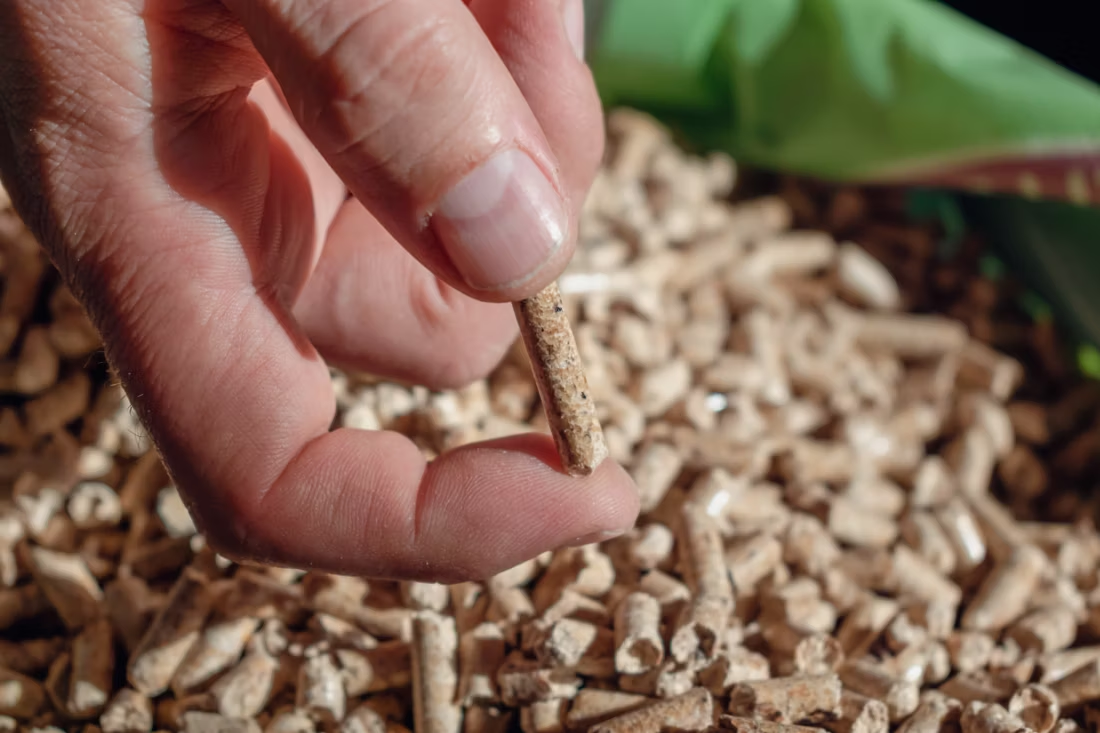
L'Île-Perrot sits at 49 metres elevation in climate zone 6A, and while its winters aren't quite as severe as Ottawa's just up the Outaouais, they're still long—a five-month stretch of sub-zero nights with lows regularly reaching -14.2°C. The forests along the island and across the wider Montérégie corridor are thick with sugar maple, yellow birch, American beech, and red oak, the same hardwoods that have kept woodstoves in local homes for generations. Pellet appliances tap into that same hardwood-heavy fuel supply but skip the splitting, stacking, and seasoning that cordwood demands.
With Hydro-Québec's residential rate sitting around 7.8 cents per kWh, plenty of L'Île-Perrot homes already run on electric baseboard heat, and Énergir's gas network only reaches part of the region, so pellet stoves fill a real gap as both a supplemental heat source and a hedge against outages. Quebec-based brands like Granules LG, Energex, and Trebio supply the local market at roughly $400-$575 CAD a ton, and because pellet appliances burn well under the fine-particle limits Montreal imposes on wood-burning devices, certification and municipal sign-off tend to be far less of a headache than with an open wood stove.
Three steps. No salesperson until you're ready.
Tell us about your project
Your postal code, your situation, and the fuel you're leaning toward—or let the answers point you to one.
See what's actually available
The brands dealers within 100 miles genuinely carry—real options, never a catalog mirage.
Get your dealer & Project Guide
A trusted local dealer, plus the free Project Guide & Parts List that names every component of the job.
Frequently Asked Questions
How much does a pellet stove installation cost in L'Île-Perrot?
Typical pellet stove installs here run $6,000-$10,000 CAD. An insert going into an existing masonry firebox with a straightforward exterior vent run sits toward the low end. A freestanding unit needing a new hearth pad, wall penetration, and full pellet-rated venting in a home without a chimney already in place lands closer to the top. Your municipal building department will require a permit either way, and most local dealers include that paperwork as part of the quote.
Do I need a permit to install a pellet stove in L'Île-Perrot?
Yes. Installations go through the municipal building department, and the work has to meet the CSA B365 installation code. Insurers in Quebec commonly ask for a WETT inspection on solid-fuel appliances before they'll write or renew a policy, and that holds for pellet stoves even though they burn cleaner than an open wood fire. A dealer who installs regularly on the island will already know which inspector to call and won't leave that step for you to chase down after the fact.
Is natural gas an option here, or is pellet really the better fit?
Énergir's distribution network reaches only part of the Montérégie region, and L'Île-Perrot is not solidly inside that footprint the way parts of Greater Montréal are. Gas fireplaces remain a rare choice on the island for that reason—some streets can tie in, most can't without a propane conversion. Pellet stoves don't depend on a gas main at all, which is part of why they've become the more consistently available choice for homeowners here who want something beyond electric baseboards.
What size pellet stove do I need for a home on L'Île-Perrot?
With winter lows averaging -14.2°C and occasional stretches that rival what Ottawa sees just up the river, most single-family homes on the island do well with a mid-size unit rated for 1,200 to 2,000 square feet, sized against actual insulation and ceiling height rather than floor area alone. Homes using the stove as a true primary heat source through the full five-month season should size toward the upper end so the hopper doesn't need refilling multiple times a day during a cold snap.
Which pellet brands are actually available near L'Île-Perrot?
Granules LG, Energex, and Trebio are the three brands most commonly stocked by dealers serving the Montérégie region, generally priced around $400 to $575 CAD a ton depending on the season and how far in advance you order. All three are produced from the same hardwood base—maple, birch, beech—that fuels traditional woodstoves on the island, so the smoke character and heat output are familiar even if the fuel form is different.
Will a pellet stove still work if the power goes out?
Not without help. Pellet stoves rely on an electric auger and blower, so a straight power failure shuts them down, unlike a plain wood stove. Montérégie has a long memory of the 1998 ice storm, which knocked out power across the region for weeks, and that history is still why a lot of local homeowners pair a pellet stove with a small battery backup or generator hookup. It's worth raising with your dealer at the planning stage rather than after the first outage.
Does the Montreal wood-burning bylaw affect a pellet stove on L'Île-Perrot?
The rule limiting wood-burning appliances to 2.5 grams per hour of fine particles and requiring registration is a Montréal municipal bylaw, and L'Île-Perrot sits outside that jurisdiction. That said, most Montérégie municipalities follow similar CSA B365 and WETT expectations for solid-fuel appliances, and pellet stoves generally emit well under that Montréal threshold anyway, so certification is rarely the sticking point it can be for an older uncertified wood stove.
How much maintenance does a pellet stove need through a Quebec winter?
Plan on emptying the ash pan every few days during heavy use, wiping the glass weekly, and cleaning the burn pot and hopper monthly through a season that typically runs five months or more. An annual professional service, ideally booked in September before the first cold snap, should check the exhaust blower, gaskets, and venting—the same venting that a WETT inspector will want to see documented if your insurer asks.
Pellet stove or wood stove—which makes more sense on L'Île-Perrot?
A wood stove burning local sugar maple or yellow birch costs less to fuel if you're willing to cut your own—the Ministère des Ressources naturelles et des Forêts issues cutting permits at about $1.85 per cubic metre up to 22.5 cubic metres a season—but it means splitting, stacking, and seasoning wood a year ahead, plus meeting the certified-appliance standards that apply across the wider Montréal-adjacent region. A pellet stove trades that labour for bagged fuel from Quebec producers like Granules LG or Energex, cleaner-burning performance, and simpler compliance, at the cost of needing electricity to run the auger. Most homeowners here choose pellet for daily convenience and keep an electric or wood backup for extended outages.
Why do fireplace quotes vary so much?
Because a fireplace is an iceberg—there's more behind the wall than in front of it. A low quote often covers only the unit; the full scope includes vent pipe, gas line or electrical, framing, and the tile or stone that has to come off and go back on. Make every bidder price the whole job. If a dealer can't speak to the full scope with confidence, that's your signal to keep looking.
Is it worth replacing an old fireplace that still sort of works?
Ask three questions: Is it ugly? Is it drafty? Does it actually work? Most old fireplaces fail at least two. Beyond looks, an old unit leaks air around the damper year-round and—if it's gas with a standing pilot—quietly burns a couple hundred dollars a year. A modern replacement seals the wall, heats the room, and changes how the whole space gets used.
Why is a fireplace insert so efficient?
An insert does two things: it seals the chimney completely, so you stop losing air you already paid to heat, and it radiates warmth into the room through the firebox and glass. Most add a heat-exchange fan that pulls cool room air underneath, wraps it around the hot firebox, and pushes it back out warm. Your home is more efficient before you've even lit the first fire.
What should I look for in pellet stove design?
Three things separate the field: how easy the burn pot is to clean (trapdoor designs let the ash drop straight into the pan), how the auger moves pellets (top-mounted augers that pull instead of push jam less and wear slower), and diagnostics (self-diagnosing control boards tell you exactly which part needs attention instead of leaving you guessing). Heat output is table stakes—livability is in these details.
Nearby Dealers
Hearth shops serving L'Île-Perrot and the surrounding area. Every listing shows whether it is a WhyFire partner, a dealer we have verified as authorized for the brands we recommend, or a local business carrying hearth products. No manufacturer pays for placement. How we verify dealers →
Foyer-Gaz
Alternatives
Décor Chaleur Châteauguay
Thermopompes N & R Sol
Suroît Boutique (Sainte-Martine)
Les Foyer Mirabel A.m.f.
Nergiflex
Noréa Foyers Montréal
Finition Belle-Flammes
Foyer Universel Montreal Inc. (A.m.f.)
Confort Elite
Boutique Poêles & Foyers Rive-Nord
Pro Du Foyer
Max Oxygene Pur
Napert Signature
Pellet Brands Stocked Around L'Île-Perrot
Typical price runs $400-$575 per ton—buy early-season for the best rates. Manufacturers will point you to the nearest stocking dealer.
Granules Lg
Trebio
Get your free Project Guide & Parts List for a L'Île-Perrot pellet stove.
Tell me about your home and I'll match you with a trusted local dealer serving the Montérégie region, plus send a free Project Guide & Parts List sized for the island's winters, with the vent kit and hopper specified.
Find Your Fireplace →