
Steady heat for Wellington's long farm-country winters.
With winter lows averaging -10.3°C and a heating season that runs from November into April, Wellington homes from Fergus and Elora to Mount Forest and Erin lean on gas for daily heat. We'll help you find a trusted local dealer who knows which towns sit on the Enbridge Gas main and which need a propane setup, then sends a free plan for your project.
Every Project Starts From One of These Five Situations
Instant heat without splitting a cord of sugar maple.
Wellington covers a broad stretch of rolling farmland between Guelph and the edge of Grey-Bruce, taking in Fergus, Elora, Arthur, Mount Forest, Erin, Palmerston, and dozens of smaller crossroads communities. Sitting in climate zone 6A with an average winter low of -10.3°C, the region gets a real winter—milder than Sudbury or Thunder Bay to the north, but still cold enough that a working fireplace stops being optional from late November through March. Many of the older farmhouses scattered across Centre Wellington and Mapleton still have a wood-burning setup, often fed with sugar maple, red oak, white ash, or yellow birch cut from a neighbouring woodlot. Gas, though, has become the default for the appliance families actually use every day, because it lights with a switch and doesn't ask anyone to stack a cord before the first snow.
Enbridge Gas mains reach the town cores of Fergus, Elora, Mount Forest, Arthur, Palmerston, and Rockwood, so a direct-vent gas fireplace or insert in one of those villages usually taps an existing line. Head out along the concession roads—plenty of Wellington's population lives on rural properties in Puslinch, Erin, and Minto that sit outside the gas footprint—and propane becomes the standard fuel instead, delivered and stored on-site. Either way, any new installation goes through a municipal building department (Centre Wellington, Wellington North, Minto, Mapleton, Puslinch, Erin, or Guelph/Eramosa, depending on where you are) and needs the gas piping run or connected by a TSSA-licensed gas fitter. Typical installed cost across the region runs $6,000 to $15,000 CAD, depending on whether you're converting an existing masonry fireplace or building venting into new construction.
Three steps. No salesperson until you're ready.
Tell us about your project
Your postal code, your situation, and the fuel you're leaning toward—or let the answers point you to one.
See what's actually available
The brands dealers within 100 miles genuinely carry—real options, never a catalog mirage.
Get your dealer & Project Guide
A trusted local dealer, plus the free Project Guide & Parts List that names every component of the job.
Frequently Asked Questions
How much does a gas fireplace installation cost in Wellington?
Installed gas fireplace projects across Wellington typically run $6,000 to $15,000. A direct-vent insert going into an existing masonry firebox in a Fergus or Elora home that's already on the Enbridge Gas main sits toward the lower end. A new build-in unit for a renovation or new construction—with framing, a fresh gas line, and roof or wall venting—lands in the middle to upper range. Rural properties in Puslinch, Erin, or Minto that need a propane tank set and a longer line run before the fireplace even gets connected tend to push toward the top of that range.
Can I convert an existing wood fireplace to gas?
Yes, and it's a common project in the older farmhouses and village homes around Centre Wellington and Wellington North. A gas insert drops into the existing masonry opening and vents through a stainless liner run up the original chimney, so the fireplace keeps its look while gaining a thermostatically controlled flame. Expect the job to land on the lower half of the $6,000-$15,000 range if the home is already on a natural gas line, and somewhat higher if a new propane tank needs to be set for a rural property off the Enbridge Gas footprint.
Do I need natural gas, or does propane work too?
Both are used across Wellington, and the choice usually comes down to your address. Enbridge Gas mains run through the built-up areas of Fergus, Elora, Mount Forest, Arthur, Palmerston, and Rockwood, so homes there typically connect a fireplace to the existing gas service. Once you're out on the concession roads—which describes a large share of properties in Puslinch, Erin, Mapleton, and Minto—there's no gas main nearby, and propane from a local bulk supplier, stored in a tank on the property, becomes the standard setup. Most gas fireplace models can be configured for either fuel with the right orifice and regulator.
Will a gas fireplace still work if the power goes out?
Most will, with the right ignition system. Units with intermittent pilot ignition run on a small battery backup that kicks in automatically, so the fireplace still lights on demand when the power drops. Valor fireplaces go further, generating their own current through the pilot's thermocouple so there's no battery to maintain. That matters in the rural stretches of Wellington—Mapleton, Minto, Wellington North—where winter storms and ice can knock out hydro service for hours at a time. Ask your local dealer about the ignition system on any model you're weighing.
What's the difference between a gas fireplace, insert, and stove?
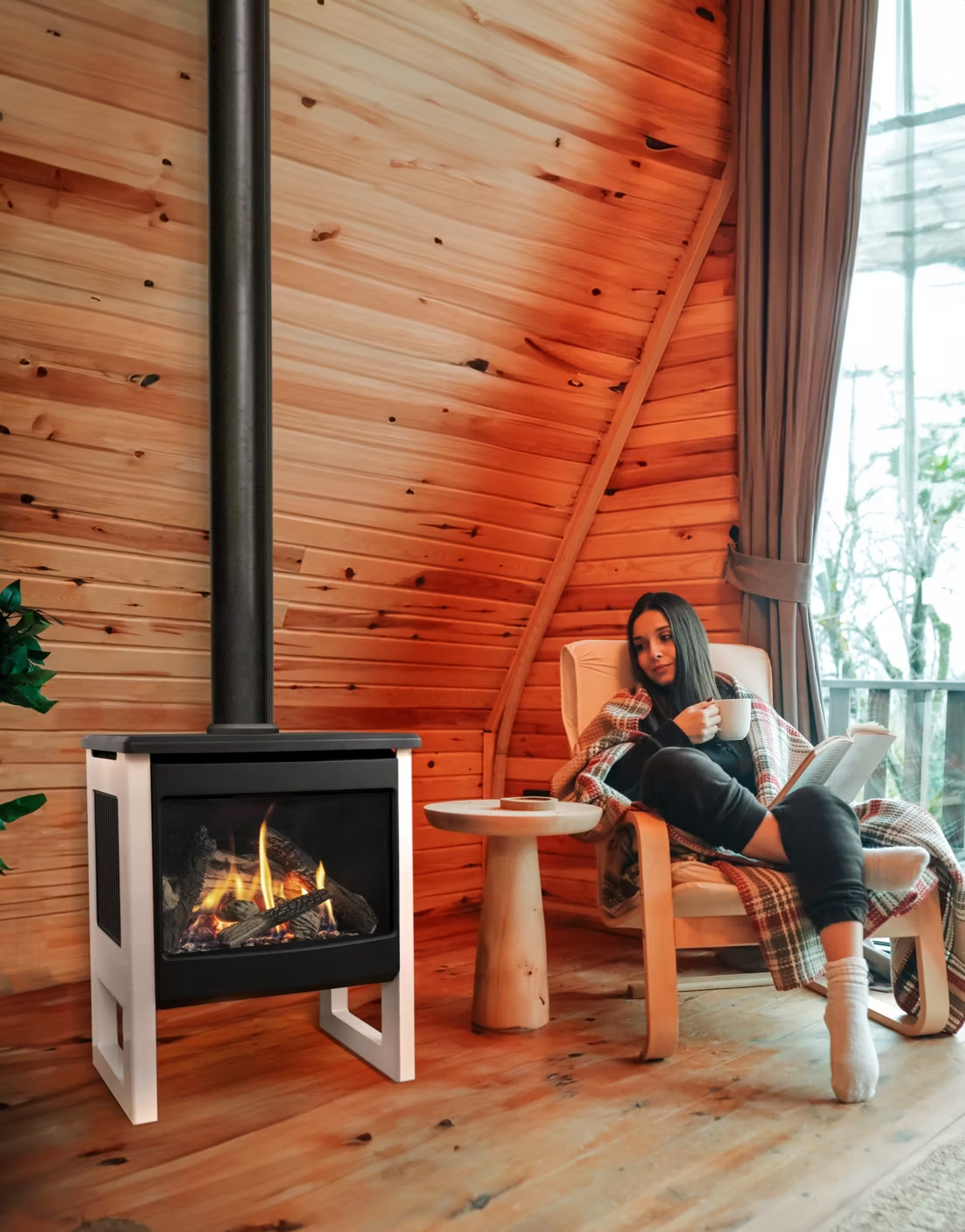
A gas fireplace is a fully built-in unit framed into a wall, the usual choice for new construction or a full renovation. A gas insert is sized to slide into an existing masonry firebox and uses the existing chimney chase for venting—the common route for the century farmhouses around Elora and Fergus that already have a wood fireplace opening. A gas stove is a freestanding, cabinet-style unit that sits on the floor like a wood stove but burns gas, a good fit for a room with no chimney at all, including additions and finished basements. A local dealer can tell you which configuration your space actually supports.
What permits does a gas fireplace need in Wellington?
You'll need a building permit through the municipal building department covering your property—Centre Wellington, Wellington North, Minto, Mapleton, Puslinch, Erin, or Guelph/Eramosa—and the gas piping itself has to be run or connected by a TSSA-licensed gas fitter to meet the CSA B149.1 gas code. Going through a full-service hearth dealer usually means the gas work, the venting, and the inspection sign-off get coordinated as one job instead of you booking separate trades.
Should I get a vented or vent-free gas fireplace?
In Wellington, and across Canada generally, this isn't really a choice—vent-free gas fireplaces aren't approved for installation here, unlike some U.S. markets. Every gas fireplace installed locally is a direct-vent or natural-vent unit that draws combustion air from outside and exhausts it back outside through sealed piping, which keeps the appliance out of the room's air entirely. That's a good thing for a Wellington winter: you get real heat output without adding humidity or combustion byproducts to a house that's already closed up tight against the cold.
How often does a gas fireplace need servicing?
Plan on an annual inspection, ideally in September or October before the heating season starts in earnest. A technician checks the burner, pilot assembly, gas connections, and venting, and cleans the glass—a much shorter visit than a wood chimney sweep, but worth doing every year for a fireplace that runs daily through a Wellington winter. A standard service call from a local gas technician typically runs somewhere in the $150-$250 range.
Gas or wood—which makes more sense for a Wellington home?
Plenty of Wellington households run both. Wood—sugar maple, red oak, white ash, or yellow birch, usually sourced from a private woodlot rather than a Crown land permit, since this is farmland rather than the Northern Boreal zones the province's free cutting allowance is aimed at—still heats a lot of rural living rooms and offers a fallback that doesn't need electricity or a gas line. Gas gives you instant, thermostat-controlled heat with no ash to manage and no wood to stack, which is why it's become the default choice for daily-use fireplaces in newer builds and village homes on the Enbridge Gas main. If your household wants low-maintenance heat that just works every evening from November through March, gas is usually the simpler starting point.
Can a gas fireplace run on a thermostat?
Most modern gas fireplaces can—turn it on and off from the couch with a remote, or set a room temperature and let the fireplace hold the comfort zone for you. If low maintenance matters to your family, this is the feature set that makes gas the convenience pick over wood and pellet.
Why do fireplace quotes vary so much?
Because a fireplace is an iceberg—there's more behind the wall than in front of it. A low quote often covers only the unit; the full scope includes vent pipe, gas line or electrical, framing, and the tile or stone that has to come off and go back on. Make every bidder price the whole job. If a dealer can't speak to the full scope with confidence, that's your signal to keep looking.
Are new gas fireplaces really better than old ones?
Two ways, and they're both big. Looks: modern gas fireplaces are realistic enough that it's hard to believe they aren't burning wood. Cost: old units burn a standing pilot year-round (roughly $200 a year), while new ones use pilot-on-demand ignition and modern burners. Add remote controls and thermostat operation, and the day-to-day experience isn't close.
Does a gas fireplace work when the power is out?
Yes—modern gas fireplaces have a battery backup for the ignition system that lasts for weeks, so no power equals no problem. Your furnace can't say that: no electricity, no blower, no heat. It's one of the most common reasons families add a fireplace, and worth confirming on any model you're considering.
Stove and Fireplace Dealers in Wellington
Listings include WhyFire partner dealers, dealers we have verified as authorized for the brands we recommend, and established local businesses that carry hearth products. Every listing shows which one it is. The ones marked Preferred run on WhyFire's software, so they can show you real pricing and book your appointment right here. No manufacturer pays for placement. How we verify dealers →
Doug Beatty & Sons Chimney Services
Mantels Plus
Fine Line Fireplaces
Arthurs Fuels Inc.
Brampton Plumbing, Heating & Ind. Supplies
Hyde-Whipp Heating And Air Cond.
Don Crole Chimney Services
Hearth & Leisure
Natural Gas Service in Wellington
Confirm service at your address before planning a gas fireplace—a quick call settles it.
Enbridge Gas
Get your free Project Guide & Parts List for a gas fireplace in Wellington.
Tell us about your home and where it sits in Wellington, and we'll help you find a trusted local dealer and send a free Project Guide & Parts List—the exact parts, including the vent kit, and the dealer best positioned to help with your gas fireplace project.
Find Your Fireplace →