
Keep Your Family Warm and Safe—No Matter What
Orillia sits at 232 metres on the shore of Lake Simcoe, where winters settle into a solid five-month heating season and sugar maple, red oak, and yellow birch are stacked in yards across town. We'll help you find a trusted local dealer for your wood heat project and send a free planning packet built around your home.
Every Project Starts From One of These Five Situations
A hardwood region built to burn.
Orillia sits at 232 metres on the shore of Lake Simcoe, in climate zone 6A, where winter lows average around -12°C and settle in for a solid five-month stretch—colder than most of southern Ontario, though nowhere near what Sudbury or Thunder Bay see most winters. It's a climate that rewards a stove built to run daily rather than one that only comes out for a few cold snaps a year.
Sugar maple, red oak, white ash, and yellow birch are the species most local burners are splitting, and Simcoe Region's dense hardwood supply keeps firewood affordable and easy to source, mostly through private woodlots and local dealers rather than crown land permits. That supply, combined with a real chance of ice-storm power outages along the Lake Simcoe shoreline, keeps wood heat in steady demand even in homes where gas or electric is the primary system. The tradeoff to plan for is code: installations have to meet the CSA B365 standard, insurers commonly ask for a WETT inspection before covering a wood appliance, and some municipalities in the region require certified low-emission stoves outright in new construction.
Firewood Cutting Permits Near Orillia
Ontario Ministry Of Natural Resources
Three steps. No salesperson until you're ready.
Tell us about your project
Your postal code, your situation, and the fuel you're leaning toward—or let the answers point you to one.
See what's actually available
The brands dealers within 100 miles genuinely carry—real options, never a catalog mirage.
Get your dealer & Project Guide
A trusted local dealer, plus the free Project Guide & Parts List that names every component of the job.
Frequently Asked Questions
How much does a wood stove installation cost in Orillia?
Most wood stove installations in Orillia run $6,000-$12,000 CAD, with the swing driven by whether you're dropping an insert into a chimney that's already there or building new venting from scratch. A straightforward insert into a working masonry flue in one of the older homes near downtown or the West Ward tends to land toward the low end. Newer construction around the Lake Simcoe waterfront or west-end subdivisions, where there's often no existing chimney, needs a full Class A chimney run through the roof, which pushes the project toward the top of that range. Either way, the municipal building department requires a permit, and most installers fold that into the quote.
What size wood stove do I need for an Orillia home?
Orillia sits in climate zone 6A with winter lows averaging around -12°C and stretches that dip colder during a hard January cold snap. For a typical two-storey home in one of the established neighbourhoods, a medium stove rated for 1,200 to 2,000 square feet is usually enough, but larger open-concept homes near Couchiching or the newer subdivisions on the edge of town often do better with a stove rated up to 2,500 square feet so it can hold an overnight burn without constant reloading. A local dealer will size it against your actual insulation and ceiling height, not just the floor plan.
Do I need a permit to install a wood stove in Orillia?
Yes. New installations go through the municipal building department, and the work has to meet the CSA B365 installation code. Most insurance providers will also want a WETT inspection once the stove is in, since an uncertified or improperly installed unit is a common reason claims get denied on wood-burning appliances in Ontario. Reputable local dealers working across the Simcoe Region handle both the permit paperwork and the WETT documentation as a normal part of the job.
What's the difference between a wood stove and a wood insert for my house?
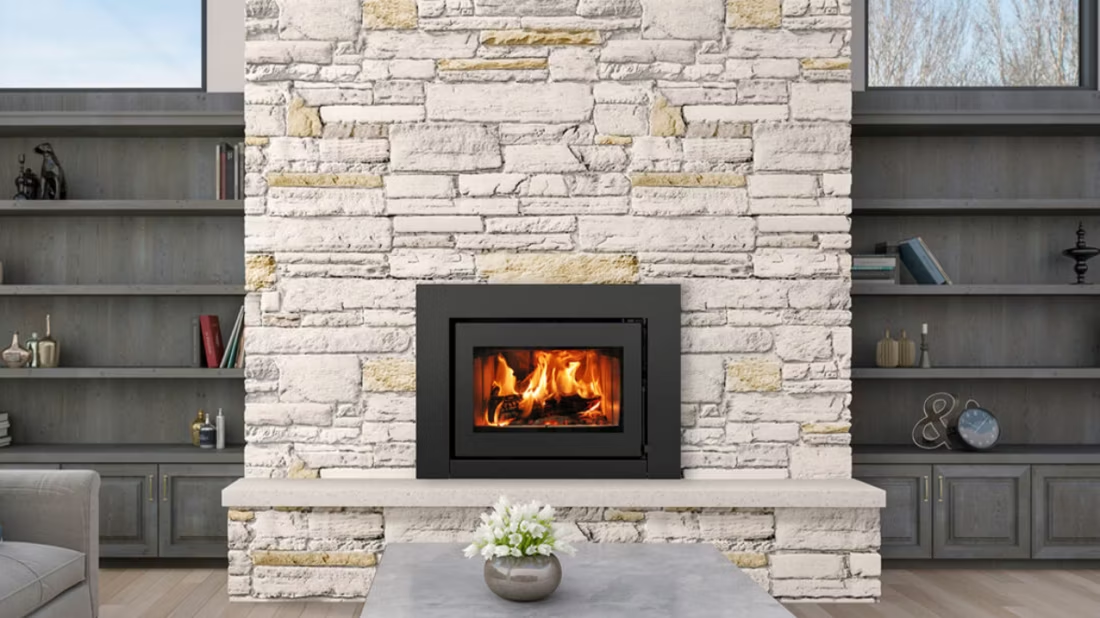
A freestanding wood stove sits on its own hearth pad and vents up through new Class A pipe, which suits newer homes in Orillia's outlying subdivisions that were never built with a masonry fireplace. A wood insert slides into an existing masonry firebox and reuses the chimney you already have, which is the more common upgrade in the older homes around downtown Orillia and the streets near Tudhope Park where open fireplaces were standard decades ago. Inserts generally land toward the lower end of the $6,000-$12,000 range since the chimney structure is already in place.
Where does firewood come from around Orillia?
Simcoe Region sits in a dense hardwood belt, so sugar maple, red oak, white ash, and yellow birch are the species most local burners are splitting and stacking, much of it sourced from private woodlots rather than crown land. If you're willing to travel farther north into the Managed Forest or Northern Boreal zones, the Ontario Ministry of Natural Resources issues cutting permits that are free for up to 10 cubic metres, roughly 4 cords, per household per year, year-round. Closer to home, most Orillia households buy seasoned hardwood from local firewood dealers rather than cutting their own, given how much private supply is already in the area.
What's the best wood stove for Orillia winters?
With winter lows averaging -12°C and colder snaps that push toward -20°C some winters, a lot of local homeowners lean toward catalytic stoves from Blaze King or Kuma that can hold a fire 12 to 20 hours overnight without a reload. Non-catalytic stoves from Pacific Energy or Regency are a solid, lower-maintenance option for households running wood as supplemental heat alongside a furnace. Whatever you choose, it needs to be EPA/CSA-certified, and some municipalities across the Simcoe Region require certified low-emission appliances outright in new construction, so it's worth confirming before you buy.
How often should my chimney be swept in Orillia?
An annual inspection before burning season, ideally in September or early October ahead of the first cold nights, is the standard WETT-trained sweeps recommend, and it holds here given how many Orillia households burn dense hardwood like sugar maple and red oak through a solid five-month heating season. If you're burning oak that hasn't had a full year or two to season, expect faster creosote buildup and consider a mid-season check, since oak in particular holds moisture longer than maple or birch and can look deceptively dry on the outside.
Are there rules about wood stoves in new Orillia builds?
Some municipalities across the Simcoe Region require certified, low-emission wood appliances in new construction rather than leaving it optional, a response to how much wood heat is already in use across the region's dense hardwood belt. In practice this means any stove or insert going into a new build needs to be EPA/CSA-certified, which almost every model sold by a reputable local dealer already is. It's worth confirming the specific requirement with the municipal building department before you finalize a model, especially if you're building new rather than retrofitting an older home.
Wood vs. gas—which makes more sense for an Orillia home?
Enbridge Gas serves Orillia, so a direct-vent gas fireplace or insert is a realistic option if you want instant heat without splitting and stacking cordwood. Wood keeps working through a power outage, which matters here given the ice storms that periodically move through the Lake Simcoe area and knock out Hydro One service for days at a time, and it pairs with a hardwood supply that's cheap and abundant across the region. Plenty of Orillia households run gas in the main living space for daily convenience and keep a certified wood stove or insert elsewhere in the house as backup heat.
Why do fireplace quotes vary so much?
Because a fireplace is an iceberg—there's more behind the wall than in front of it. A low quote often covers only the unit; the full scope includes vent pipe, gas line or electrical, framing, and the tile or stone that has to come off and go back on. Make every bidder price the whole job. If a dealer can't speak to the full scope with confidence, that's your signal to keep looking.
Louvered or clean face—which fireplace front is better?
Louvered fronts have grill work above and below the glass for airflow, move heat a little better with a fan, and suit traditional mantels. Clean face designs drop the louvers entirely so finish work runs to the fire's edge—they fit both modern and traditional rooms. When we did our own home we chose clean face: a big viewing area beat a little extra airflow. It depends on your room, not on a rulebook.
Do I have to leave the stove door cracked open to start a fire?
On many stoves, yes—a new fire needs extra air, and cracking the door a couple inches is how most stoves get it. But some modern stoves offer an automatic startup air system: engage it when you light, and timed air jets feed the fire for the first 20 minutes with the door fully shut, then close automatically. It's mechanical—like an egg timer, no electricity—and it means you can load it, light it, and walk away.
Why is my open fireplace making my house colder?
Open fireplaces suck—literally. As the fire burns, it consumes air your furnace already paid to heat and pulls it out through the chimney, so the house is actually colder after the fire goes out than before you lit it. An insert fixes this: it seals the chimney, puts fixed glass across the front, and turns that hole in your house into a real heat source.
Nearby Dealers
Hearth shops serving Orillia and the surrounding area. Every listing shows whether it is a WhyFire partner, a dealer we have verified as authorized for the brands we recommend, or a local business carrying hearth products. No manufacturer pays for placement. How we verify dealers →
Orillia Building Supplies
Central Heating
Chase N' Chimneys
Aaf Heating & Cooling
WellSwept Chimneys
B & R Heating & Cooling
Home Bldg Centre Gravenhurst – G.r. Henwood Lumber Co. Ltd.
Perfect Home Heating And Air
Complete Chimney Service
Heatcool Pro
Hearth & Leisure
Get your free Project Guide & Parts List for your Orillia wood heat project.
Tell us about your home and we'll help you find a trusted local dealer in the Simcoe Region and send a free Project Guide & Parts List—sized for Orillia's winters, with the vent kit and parts specified before you call anyone.
Find Your Fireplace →