
Warmth and ambiance for Haliburton Highlands cottages, without a chimney.
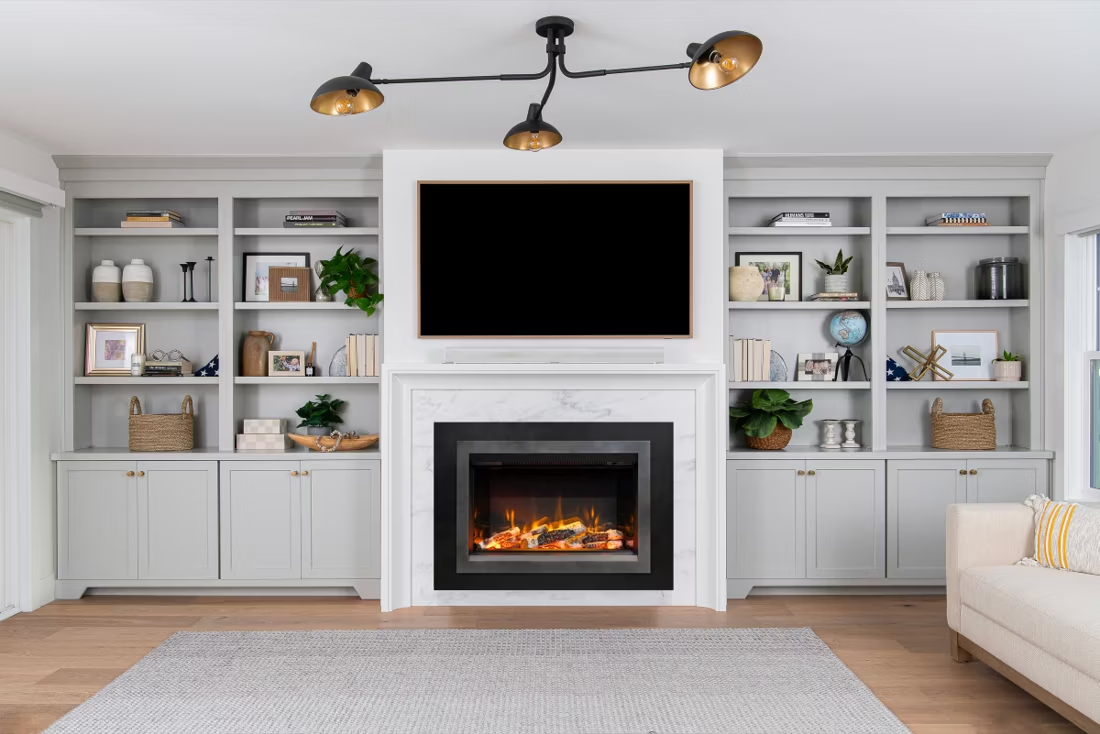
Haliburton's winter lows average -17.6°C, and this is cottage country where most heat still comes from a wood stove or a propane tank. An electric fireplace adds instant ambiance and supplemental warmth to a cabin, basement, or bedroom without a flue, a permit fight, or a WETT inspection. We'll help you find a trusted local dealer who can spec the right circuit and unit for your place.
Every Project Starts From One of These Five Situations
A lake town built on wood and propane, with room for a simpler option.
At 325 metres elevation with a population under 1,200, Haliburton is more cottage than commuter town, and its winters run long even if they don't hit the extremes of Sudbury or Thunder Bay. An average winter low of -17.6°C and a climate zone of 6A mean the heating season here stretches from October well into April, and it shows in how homes are actually heated. Sugar maple, red oak, white ash, and yellow birch get split and stacked in nearly every dooryard, and while Enbridge Gas technically lists service in the area, mains coverage is thin across the Haliburton Highlands, so a lot of camps and year-round houses run on propane instead.
That's where electric fits in. It doesn't need a chimney, a wood permit from the municipal building department, or a WETT inspection for insurance purposes the way a wood stove or insert does—which matters for the seasonal cottages and rental properties that make up a good share of housing stock here. Most of the region is served by Hydro One rather than Toronto Hydro or Alectra Utilities, and at roughly 12.8 cents per kWh, running an electric insert or built-in unit as supplemental heat in a bedroom, basement, or bunkie is inexpensive compared to a propane top-up. Installed cost typically runs $500 to $1,600 CAD, a fraction of what a wood or gas project costs to permit and vent.
Three steps. No salesperson until you're ready.
Tell us about your project
Your postal code, your situation, and the fuel you're leaning toward—or let the answers point you to one.
See what's actually available
The brands dealers within 100 miles genuinely carry—real options, never a catalog mirage.
Get your dealer & Project Guide
A trusted local dealer, plus the free Project Guide & Parts List that names every component of the job.
Frequently Asked Questions
How much does an electric fireplace installation cost in Haliburton?
Most electric fireplace installs in Haliburton run $500 to $1,600 CAD. A plug-in insert or wall-mount unit on an existing 15-amp outlet sits at the low end—common in cottages where someone just wants ambiance in the main room. A larger built-in unit that needs a dedicated 20-amp circuit run from the panel, which is typical in year-round houses or a finished basement, lands toward the top of that range once an electrician is involved.
Do I need a permit for an electric fireplace in Haliburton?
Usually not through the municipal building department, since there's no combustion, chimney, or venting involved—that's the main appeal compared to a wood or gas project. Where a permit-adjacent step does come up is the wiring: if your dealer is adding a new dedicated circuit for a larger built-in unit, that electrical work needs to meet Ontario's Electrical Safety Authority requirements. Most local dealers handle that as a routine part of the install rather than a separate headache.
Will an electric fireplace actually heat my Haliburton cottage through the winter?
Not as a primary heat source, no. With winter lows averaging -17.6°C and long stretches below freezing from December through March, an electric unit is best treated as supplemental heat for a single room—a bedroom, a bunkie, or a basement rec room—while a wood stove burning local sugar maple or red oak, or a propane furnace, carries the main load. Where electric shines is convenience: flip it on for evening ambiance without hauling wood or firing up a pilot.
Will my electric fireplace still work during a power outage?
No, and that's worth planning around in the Haliburton Highlands, where Hydro One lines through wooded, hilly terrain go down during ice storms and heavy snow more often than in denser parts of Ontario. A wood stove or insert keeps burning with zero electrical input, which is why many year-round households here keep one as backup heat even after adding an electric unit for daily convenience. If backup heat during outages is a priority, that's a conversation worth having with your dealer before you choose electric as your only upgrade.
What's the difference between an electric insert and a built-in electric fireplace?
An electric insert slides into an existing masonry firebox—a common retrofit in older Haliburton cottages that originally burned wood and still have the original chimney chase, even if it's no longer venting anything. A built-in unit is framed into a wall from scratch, which suits new construction or a basement remodel with no existing firebox. Both skip the WETT inspection wood appliances typically need for insurance, which simplifies things for cottage owners renting out their property in summer.
How much does it cost to run an electric fireplace in Haliburton?
At Hydro One's residential rate of roughly 12.8 cents per kWh, a typical 1,500-watt electric fireplace costs about 19 cents an hour to run on heat mode, or closer to 2-3 cents an hour on flame-only ambiance mode. For a cottage using it as evening supplemental heat rather than round-the-clock warmth, that's a modest add to a hydro bill—a fraction of what topping up a propane tank costs after a cold month.
Is electric a good fit for a seasonal cottage in Haliburton?
Often, yes. Seasonal camps around Haliburton's lakes don't need to worry about freeze-ups or fuel deliveries with an electric unit the way they would with a boiler or a propane furnace, and there's no cutting permit, no wood to stack, and no WETT inspection to arrange before closing up for winter. It won't carry the place through a February cold spell on its own, but for a camp used mainly spring through fall with occasional winter weekends, it's a low-maintenance way to add heat and ambiance without a bigger mechanical project.
Should I look at natural gas instead of electric in Haliburton?
It depends on your street. Enbridge Gas does list service in the area, but mains coverage across the Haliburton Highlands is patchy—plenty of properties, especially around the lakes and back roads, have no gas line anywhere near them and rely on propane or wood instead. Electric sidesteps that question entirely since it only needs a working outlet or circuit, which is part of why it's a common choice for cottages where running a new gas or propane line isn't practical.
Electric vs. wood vs. pellet—what actually makes sense for a Haliburton property?
Wood is still the backbone of heating here, and it's cheap to source: the Ontario Ministry of Natural Resources allows free cutting up to 10 cubic metres, about 4 cords, per household per year in managed forest zones, and sugar maple, red oak, white ash, and yellow birch are all abundant locally. Pellet stoves using regional brands like Lacwood or Energex run $400-$575 CAD a tonne and burn cleaner with less daily tending. Electric can't compete with either as a primary heat source, but it wins on simplicity—no permit, no WETT inspection, no fuel storage—which makes it the right call for a secondary room, a rental unit, or a cottage where low-maintenance ambiance matters more than heat output.
How much does an electric fireplace cost to run?
With the heater on, a typical unit draws about 1,500 watts—at average electric rates that's roughly 20 cents an hour. Run the flame effect alone and it costs pennies; the flames are LED-driven and use about as much power as a light bulb. There's no pilot light, no fuel delivery, and essentially no maintenance.
What fireplace styles should I know before shopping?
Four cover most of the market: screen-front traditional (mesh front, open feel, fits craftsman homes), traditional door set (the classic look you grew up with), modern linear (wide, low, the statement piece for entertaining), and clean face contemporary (no trim—your tile or stone runs right to the fire's edge). Walk in knowing those four terms and you're ahead of most buyers.
Do electric fireplaces actually produce heat?
Yes—most put out around 4,800–5,000 BTUs from a standard outlet, which comfortably warms a bedroom, office, or den as a comfort-zone heater. What they won't do is carry a whole house the way wood, gas, or pellet can. Think of electric as ambiance-first with honest supplemental heat: flames on with no heat in July, flames plus warmth in January.
Does an electric fireplace need a vent or chimney?
No—that's its superpower. An electric fireplace needs a wall and an outlet, period. No vent pipe, no gas line, no clearances to design around, which is why it works in bedrooms, offices, apartments, and walls where venting a gas or wood unit would be impractical or impossible. Installation is typically the simplest and least expensive of any fireplace type.
Nearby Dealers
Hearth shops serving Haliburton and the surrounding area. Every listing shows whether it is a WhyFire partner, a dealer we have verified as authorized for the brands we recommend, or a local business carrying hearth products. No manufacturer pays for placement. How we verify dealers →
We’ve paused dealer listings for this connection today. Enter your zip or postal code above to find dealers near you, or come back tomorrow.
Electric Service in Haliburton
An electric fireplace's heater draws about 1,500 watts—pennies per hour at local rates.
Hydro One
Toronto Hydro
Alectra Utilities
Get your free Project Guide & Parts List for a Haliburton electric fireplace.
Tell us about your cottage or house and whether you're adding a plug-in insert or a built-in unit that needs a new circuit, and we'll help you find a trusted local dealer and send a free Project Guide & Parts List with the exact unit and electrical specs your project needs.
Find Your Fireplace →