
Real warmth that doesn't strain Nova Scotia's highest electricity rates.
Brookside sits just outside Halifax at 69 metres elevation, where winter lows average -8.2°C and Nova Scotia Power charges among the highest residential electricity rates in the country. An electric fireplace or insert adds real, controllable heat to the room you use most, without a chimney, a gas line, or a big install bill. We'll help you find a trusted local dealer who knows what's actually installable in your home.
Every Project Starts From One of These Five Situations
The lowest-friction heat source for a high-cost grid.
Brookside is a small community within the Halifax Regional Municipality, sitting in climate zone 5A where winters bring roughly five months of nights below freezing and an average low around -8.2°C—colder than Halifax's harbour-moderated core but nowhere near what Winnipeg or Thunder Bay see most winters. At 18.3 cents per kWh, Nova Scotia Power's residential rate is among the highest in the country, which shapes how local households actually heat: whole-home electric resistance heat is expensive to run day after day, but a single electric fireplace or insert used to warm one room is a different equation entirely.
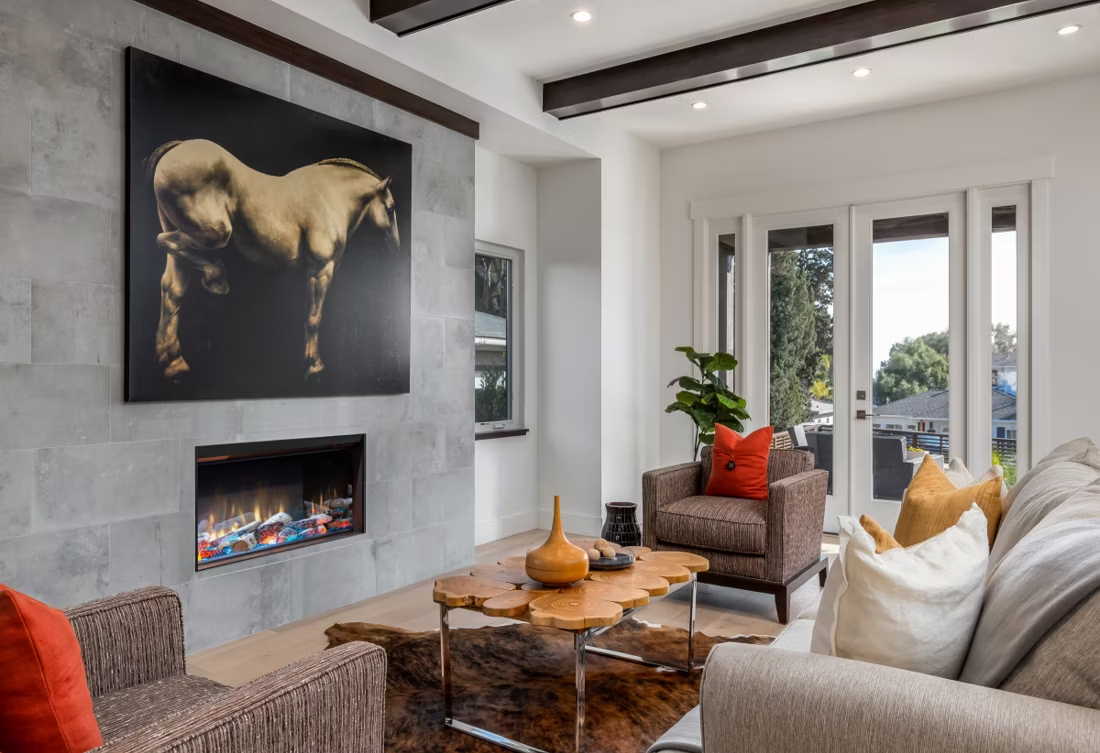
That's the role electric fireplaces mostly play in Brookside—supplemental, targeted heat in a living room or basement rec room, often installed alongside a heat pump that carries the bulk of the load. Compare that to a wood installation running $6,000 to $12,000 for a stove burning local sugar maple, yellow birch, red oak, or red spruce, or a gas fireplace at $6,000 to $15,000 where Eastward Energy's lines actually reach—natural gas service in this part of the Halifax Regional Municipality is real but limited to certain corridors, so plenty of Brookside addresses simply aren't on the main. Electric skips all of that: a typical install runs $500 to $1,600, there's no venting, no wood to season, and no WETT inspection to schedule.
Three steps. No salesperson until you're ready.
Tell us about your project
Your postal code, your situation, and the fuel you're leaning toward—or let the answers point you to one.
See what's actually available
The brands dealers within 100 miles genuinely carry—real options, never a catalog mirage.
Get your dealer & Project Guide
A trusted local dealer, plus the free Project Guide & Parts List that names every component of the job.
Frequently Asked Questions
How much does an electric fireplace installation cost in Brookside?
Most electric fireplace and insert installs here run $500 to $1,600 CAD. A plug-in unit dropping into an existing masonry firebox or a simple wall-mount sits at the low end—it just needs a standard outlet. A built-in linear unit that requires a dedicated circuit run by a licensed electrician, or one framed into new cabinetry, lands toward the top of that range. Either way it's a fraction of the $6,000-plus a wood or gas project typically runs in Brookside.
Do I need a permit for an electric fireplace in Brookside?
Usually not for a plug-in model—it's treated like any other appliance. If your dealer is running a new dedicated circuit or hardwiring a built-in unit, that electrical work typically needs a permit through the municipal building department covering Brookside and the wider Halifax Regional Municipality, pulled by the licensed electrician doing the work. There's no equivalent to the CSA B365 wood-appliance code or a WETT inspection to worry about with electric.
Will an electric fireplace actually lower my heating bill given Nova Scotia Power's rates?
It can, if you're using it the way most Brookside households do—as zone heat in the room you actually occupy, with the thermostat turned down elsewhere, rather than trying to heat the whole house on baseboards. At 18.3 cents per kWh, running an electric fireplace all day in every room would add up fast, but confining it to a living room while a heat pump handles the rest of the house is a common and genuinely cost-effective pairing here.
Electric vs. wood heat—which makes more sense for my Brookside home?
Wood, burning sugar maple, yellow birch, red oak, or red spruce from a private supplier or your own woodlot, still beats electric on raw fuel cost and keeps working if Nova Scotia Power's lines go down in a winter storm. But it comes with real overhead: a $6,000 to $12,000 install, CSA B365 code compliance, and typically a WETT inspection for your insurer. Electric has none of that friction and none of the wood-splitting, but it's dependent entirely on the grid staying up. A lot of households here run both—wood as backup, electric for everyday convenience.
Is natural gas an option instead of electric in Brookside?
Sometimes. Eastward Energy serves parts of the Halifax Regional Municipality, but coverage runs along specific corridors rather than blanketing every street, and Brookside is small enough that plenty of addresses aren't reachable without a costly line extension. If gas isn't available at your address, electric or propane are the practical fallbacks, and a local dealer can tell you quickly which side of the gas line your home falls on.
What size electric fireplace do I need?
Most electric inserts and built-ins are rated for supplemental heat in the 400 to 1,000 square foot range, which covers a typical Brookside living room or finished basement comfortably. Because electric units don't scale up the way a wood stove or gas fireplace can for whole-home heat, sizing is more about matching the unit's heater output and BTU rating to the specific room than to your total square footage—a mismatch here just means underwhelming warmth, not a safety issue.
What features actually matter when choosing an electric fireplace?
Look past the flame effect and check the heater's actual wattage and BTU output—some units are essentially ambiance-only with a token heater, which won't do much on a -8.2°C evening. A built-in thermostat with a remote, rather than a fixed high or low switch, lets you dial in real room heat without running it wide open all evening at Nova Scotia Power's rates. Your dealer can walk you through which models in your price range genuinely heat versus ones that mostly just glow.
Can I convert an existing wood fireplace to electric in Brookside?
Yes, and it's a common project in Brookside's older homes with an existing masonry firebox that's fallen out of use. An electric insert slides into the opening and just needs power run to it, without touching the chimney structure, though many owners cap or seal the flue afterward to stop drafts. It's a far simpler conversion than swapping to gas, since there's no line to bring in and no CSA B365 clearance work to satisfy.
What happens to my electric fireplace during a power outage?
It stops working immediately, since there's no pilot light or battery backup involved. That's the real tradeoff against wood here: a certified wood stove keeps a Brookside home warm through a multi-day Nova Scotia Power outage after an ice storm, while an electric fireplace or insert goes cold with everything else. It's part of why several households in this area keep a wood stove or insert as backup heat even while running electric day-to-day for convenience.
How much does an electric fireplace cost to run?
With the heater on, a typical unit draws about 1,500 watts—at average electric rates that's roughly 20 cents an hour. Run the flame effect alone and it costs pennies; the flames are LED-driven and use about as much power as a light bulb. There's no pilot light, no fuel delivery, and essentially no maintenance.
What fireplace styles should I know before shopping?
Four cover most of the market: screen-front traditional (mesh front, open feel, fits craftsman homes), traditional door set (the classic look you grew up with), modern linear (wide, low, the statement piece for entertaining), and clean face contemporary (no trim—your tile or stone runs right to the fire's edge). Walk in knowing those four terms and you're ahead of most buyers.
Can I put a TV above my fireplace?
Yes—with an asterisk. Fireplaces are hot and TVs don't like heat. Either put a mantel between them to deflect rising warmth, or choose a fireplace with heat-management technology that creates a cool zone on the wall above—the wall stays around 125 degrees, barely warm, while the room still gets full heat. If you like clean lines and don't want a mantel, heat management is the answer.
Do electric fireplaces actually produce heat?
Yes—most put out around 4,800–5,000 BTUs from a standard outlet, which comfortably warms a bedroom, office, or den as a comfort-zone heater. What they won't do is carry a whole house the way wood, gas, or pellet can. Think of electric as ambiance-first with honest supplemental heat: flames on with no heat in July, flames plus warmth in January.
Nearby Dealers
Hearth shops serving Brookside and the surrounding area. Every listing shows whether it is a WhyFire partner, a dealer we have verified as authorized for the brands we recommend, or a local business carrying hearth products. No manufacturer pays for placement. How we verify dealers →
Ultimate Home Comfort
Electric Service in Brookside
An electric fireplace's heater draws about 1,500 watts—pennies per hour at local rates.
Nova Scotia Power
Get your free Project Guide & Parts List for a Brookside electric fireplace.
Tell us about your room and your electrical panel, and we'll help you find a trusted local dealer serving the Halifax Regional Municipality and send a free Project Guide & Parts List—sized for the space, with the exact unit and any electrical work spelled out.
Find Your Fireplace →