
Find your fireplace in Queens County, NY.
Fireplace resources for every neighborhood in Queens—from Astoria to the Rockaways. Stoves are rare here given the borough's attached housing stock, but gas and electric cover nearly every project. Find a trusted local dealer for yours.
Every Project Starts From One of These Five Situations
Mild coastal winters, dense housing, and gas-first heating across Queens.
Queens sits in ASHRAE climate zone 4A, with an average winter low around 28°F and roughly 4,553 heating degree days a year—a real winter, but nowhere close to the cold of Duluth, Minnesota or Burlington, Vermont, where HDD totals run two to three times higher. That milder profile, combined with Queens' role as one of the most densely built counties in the country—a borough within NYC's metro area of over 21 million residents—shapes what actually gets installed here. Most housing stock is attached: apartment buildings, co-ops, condos, and rowhouses share walls, chimneys are often shared or nonexistent, and the FDNY and NYC Department of Buildings (DOB) tightly regulate any appliance that burns solid fuel indoors.
That's why this hub leans hard into gas and electric. Wood and pellet stoves are technically possible in a small number of Queens' detached single-family homes—mostly in neighborhoods like Douglaston, Bayside, and parts of Howard Beach—but they're the exception, not the rule; most co-op and condo boards won't approve a solid-fuel appliance, and DOB permitting for a new chimney in an attached building is a heavy lift. Gas fireplaces and inserts, tied into Con Edison or National Grid service, and electric fireplaces, which need no venting or chimney at all, cover the overwhelming majority of installs across Queens' neighborhoods—from Astoria and Long Island City to Flushing, Forest Hills, and Jamaica. Pick your fuel below for local dealers, cost ranges, and the permit path that applies to your building type.
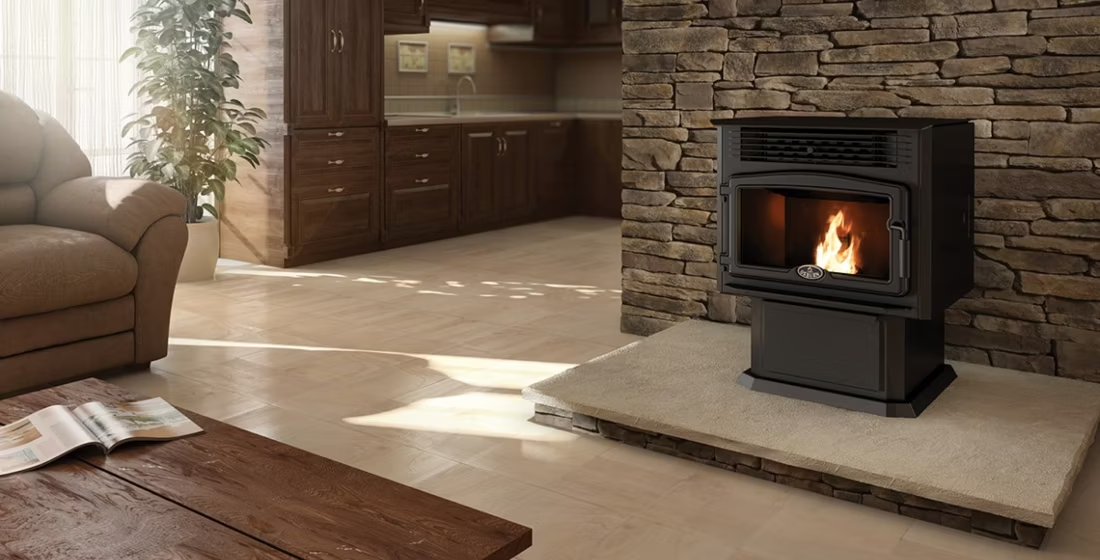
Four fuels. One honest answer for Queens County.
Three steps. No salesperson until you're ready.
Tell us about your project
Your zip code, your situation, and the fuel you're leaning toward—or let the answers point you to one.
See what's actually available
The brands dealers within 100 miles genuinely carry—real options, never a catalog mirage.
Get your dealer & Project Guide
A trusted local dealer, plus the free Project Guide & Parts List that names every component of the job.
Frequently Asked Questions
Which fuel works best in Queens County?
For most Queens households, it's gas or electric—not wood or pellet. Queens' housing stock is dominated by attached multi-family buildings, co-ops, and condos, where FDNY and DOB rules make solid-fuel appliance installation impractical or outright prohibited by the building's board. Gas fireplaces and inserts, run off Con Edison or National Grid service, are the standard choice for homeowners who want real heat output and a live flame. Electric fireplaces are the go-to for apartments, co-ops, and rentals—no venting, no gas line, no permit hurdles in most cases—and they still deliver useful supplemental warmth on Queens' colder days, when lows average around 28°F. Wood and pellet stoves show up occasionally in the handful of detached homes in neighborhoods like Douglaston or Bayside, but they're a small minority of installs countywide.
Do I need a permit to install a fireplace in Queens County?
Almost always, yes—and the process runs through NYC agencies rather than a county building department. Gas fireplace and insert installations need a permit from the NYC Department of Buildings plus a licensed plumber for the gas connection, and Con Edison or National Grid typically has to sign off on the gas line. Electric fireplace installs are usually permit-free if you're plugging into an existing outlet, but built-in units that require new wiring or a dedicated circuit need an electrical permit and a licensed electrician. If you live in a co-op or condo, add your building's alteration approval process on top of city permitting—boards often want engineering drawings before approving any hearth installation, gas or electric. Local hearth retailers who work regularly in Queens generally know this process and handle the paperwork as part of installation.
Are there air quality or fire-code restrictions on hearth appliances in Queens County?
Queens doesn't have the wood-smoke air quality advisories you'd see in wood-burning regions out west, but it has something arguably stricter: FDNY and DOB fire-safety codes governing solid-fuel appliances in multi-family construction. New wood-burning fireplace or stove installations in attached buildings face real restrictions tied to fire separation, chimney clearances, and shared-wall construction—a big part of why gas and electric dominate here. For gas appliances, the main regulatory concern is proper venting and carbon monoxide safety, inspected as part of the DOB permit process. There's no seasonal burn-ban system like you'd find in western wood-burning counties, mostly because there's very little wood burning happening across the borough to begin with.
Can one local hearth retailer handle both gas and electric installs?
Yes—most Queens-area hearth retailers that install fireplaces carry both gas and electric lines, since those two fuels cover nearly all the demand in the borough. A dealer showing you a gas insert will typically also stock electric wall-mount and built-in units, which makes sense given how many Queens installs happen in apartments and co-ops where electric is the only realistic option. If you're comparing a gas fireplace against an electric alternative for the same room—a common question for co-op owners unsure their board will approve a gas line—a multi-fuel retailer can walk you through both options side by side.
How does hearth service work in a dense borough like Queens?
Differently than in suburban or rural counties. Service techs working Queens deal with building access as much as the appliance itself—scheduling around co-op board hours, coordinating elevator use for equipment, and navigating tight street parking near neighborhoods like Long Island City or Astoria. Gas fireplace service—igniter checks, pilot assembly cleaning, venting inspection—is generally a shorter job than in detached homes, since there's no chimney system to sweep. Electric fireplace service is minimal by comparison, mostly bulb or heating-element replacement on older units. If you're in a co-op, loop in your building super or management office when scheduling; many require advance notice before a contractor can access common areas or risers.
What's the typical cost range for fireplace installation across fuel types in Queens County?
Costs run higher here than in most of the country, largely due to NYC labor rates and co-op or condo approval requirements layered on top of the installation itself. Gas fireplace or insert: roughly $5,500–$13,000, with the top end driven by new gas line runs in older buildings that need them. Electric fireplace: $300–$3,500 for the unit itself, plus $500–$1,500 in labor for built-in or wall-mount installs that need new wiring—plug-and-play electric units on the low end skip most of that labor cost entirely. Wood or pellet stove installs are rare enough in Queens that pricing isn't standardized; where they do happen, in the borough's detached homes, expect costs closer to what you'd see in nearby Nassau County, generally $6,000 and up given the added chimney and structural work in an area not built for solid-fuel venting.
What is an in-home preview and do I need one?
It's a visit where a hearth professional measures your space, confirms the model you picked actually works in your home, and walks the specs—framing, gas line, venting, finish work—before anything is ordered. Some details you just can't know until you see the house. Never make a down payment without one; it's the single most-skipped step that burns buyers.
Can a fireplace actually lower my heating bill?
Yes—by creating a comfort zone. A furnace heats every square foot of the house just to warm the one room you're in; a gas fireplace on low burns roughly a sixth of the gas a typical furnace does. Set the furnace around 55–60 degrees as a baseline, then heat the rooms your family actually uses. Families who heat this way commonly save $20–$60 a month.
Can I install a fireplace myself?
If you're putting a fire in your house on purpose, it's best to work with an expert. Unless you're genuinely experienced in framing, gas line, vent pipe, and the national code on clearances to combustibles, have a professional do it—and ideally the same company that sells you the fireplace, so warranty, service, and liability all live under one roof.
Wood, gas, pellet, or electric—how do I choose?
Match the fuel to your life, not the other way around. Wood: lowest fuel cost and total power-outage independence, but you're hauling and stacking. Gas: press a button, set a thermostat, no maintenance to speak of. Pellet: wood economics with automatic feeding, in exchange for weekly cleaning and a need for electricity. Electric: plugs in anywhere with honest supplemental heat. Nobody regrets the fuel that fits how they actually live.
Hearth Dealers in Queens County
Get matched with a local dealer in Queens County.
Tell us about your building and your fuel preference, and we'll match you with a trusted local dealer and send a free Project Guide & Parts List—the exact parts, venting or wiring plan, and permit path for your gas or electric fireplace project in Queens.
Find Your Fireplace →