
Heat that holds through a Franklin County winter.
Wood, gas, pellet, and electric fireplace resources for every Adirondack community in Franklin County—from Malone and Saranac Lake to Tupper Lake and Chateaugay. Find the right unit and connect with a trusted local hearth retailer.
Every Project Starts From One of These Five Situations
Adirondack cold, four fuels, one directory.
Franklin County sits largely within the Adirondack Park, and the numbers show it: 9,225 heating degree days, roughly in the same range as Fargo, North Dakota, with average winter lows around 5°F. The heating season here runs long, often October through April, and wood heat is deeply embedded in local life—oak, maple, birch, and ash are the hardwoods most homeowners split, stack, and burn, and they're what most local dealers size stoves and inserts around. With just under 11,000 people spread across a county roughly the size of Rhode Island, this isn't a place with a fireplace showroom on every corner—it's a place where the right dealer might be forty minutes away in Malone or Saranac Lake.
What you'll find on this hub: hearth retailers, service technicians, and fuel suppliers serving communities across the county—Malone, Saranac Lake, Tupper Lake, Chateaugay, Brighton, and the smaller hamlets tucked along the Park's lakes and rivers. Pick your fuel below to see local dealers, installation costs, and recommended units for your specific project. Whether you're heating a farmhouse near Malone or a camp on Lake Kushaqua, this is the starting point.
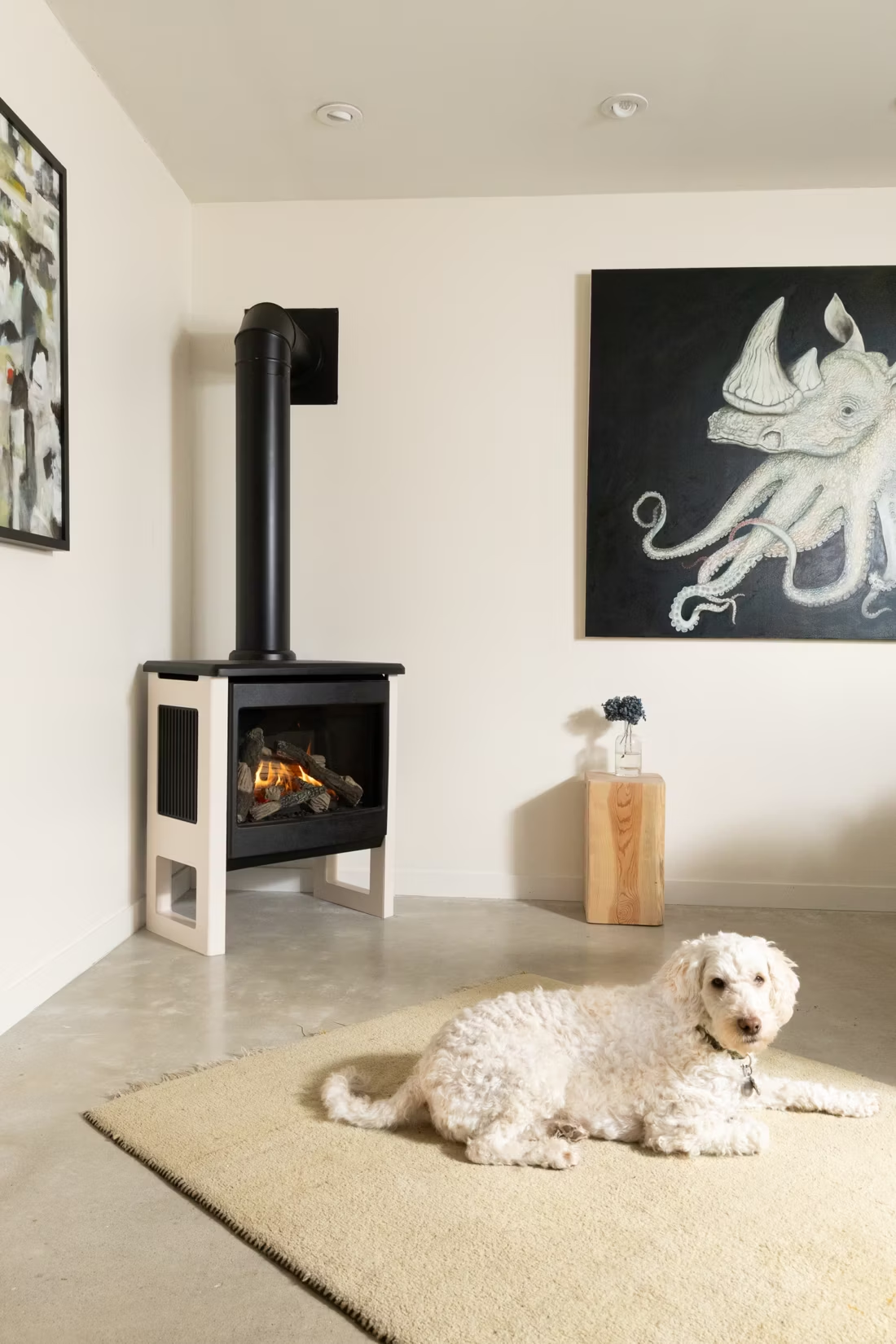
Four fuels. One honest answer for Franklin County.
Three steps. No salesperson until you're ready.
Tell us about your project
Your zip code, your situation, and the fuel you're leaning toward—or let the answers point you to one.
See what's actually available
The brands dealers within 100 miles genuinely carry—real options, never a catalog mirage.
Get your dealer & Project Guide
A trusted local dealer, plus the free Project Guide & Parts List that names every component of the job.
Frequently Asked Questions
Which fuel works best in Franklin County?
It depends on the home and how remote it is. Wood is the deep local default—oak, maple, birch, and ash are all abundant, split and stacked wood is how a lot of Franklin County households have heated for generations, and a well-loaded catalytic stove can hold a burn through a single-digit overnight without much trouble. Gas is the low-maintenance option where propane service reaches a home, since piped natural gas is limited across most of the county—a gas insert or stove gives instant heat with none of the wood-handling labor. Pellet is a strong middle path here, with Energex, Hamer Pellet Fuel, and Greene Team Pellet Fuel all distributed regionally, giving pellet-stove owners a reliable local supply chain. Electric works well as a supplemental heater for a bedroom, camp, or seasonal cabin, but on its own it's not built for a Franklin County winter. Many households here run two fuels—wood or pellet as the workhorse, gas or electric for convenience rooms.
Do I need a permit to install a fireplace in Franklin County?
In most cases, yes. New wood stoves, wood inserts, gas appliances, and pellet stoves typically require a building permit through the code enforcement office of the town where the home sits—Malone, Tupper Lake, Saranac Lake, Brighton, and the other towns each handle this locally rather than through one county office. Because much of Franklin County lies inside the Adirondack Park boundary, some construction and site work can also fall under Adirondack Park Agency (APA) jurisdiction, particularly for new structures or additions near shorelines—worth confirming with your town office before work starts. Wood-burning appliances should meet current EPA emissions standards, and gas work generally requires a licensed installer for the gas connection. Most local hearth retailers handle the permit paperwork as part of the installation, so it's rarely something a homeowner has to navigate alone.
Are there air quality restrictions on wood burning in Franklin County?
No—Franklin County isn't designated a non-attainment area, and there's no local wood-smoke advisory program like you'd see in a valley or basin community that traps inversions. That said, good burning practice still matters here: seasoned hardwood (oak, maple, birch, and ash all need six months to a year of drying time to burn clean) and an EPA-certified stove will produce far less smoke and creosote than an old uncertified unit burning green wood. It's less a regulatory issue in Franklin County and more a matter of getting more heat per cord and keeping your chimney safer over a long, cold season.
Can one local hearth retailer handle all four fuel types?
Most of the hearth retailers serving Franklin County are based in or near Malone or Saranac Lake and carry at least wood, gas, and pellet, since those are the three fuels most in demand across the Park. Electric fireplace selection tends to be thinner and more focused on smaller wall-mount and insert units for camps and secondary rooms. Given the driving distances in this county—Tupper Lake to Malone is close to an hour—most homeowners work with whichever retailer is realistically in range rather than cross-shopping several. If you want to compare fuels side by side, ask a retailer directly which lines they stock; most will be upfront about what they carry versus what they'd need to special-order.
How does service work in the more remote parts of the county?
Technicians serving Franklin County are typically based in Malone or Saranac Lake and travel out to Tupper Lake, Chateaugay, Brighton, and the smaller hamlets along the lakes. Expect a modest travel charge for the more remote camps and homes, and expect scheduling to tighten up fast once cold weather hits—pre-season service calls in September and October are far easier to book than a January emergency. Given how long and cold the heating season runs here (average winter lows near 5°F), it's worth getting your chimney swept or your gas unit inspected before the first hard freeze rather than after.
What's the typical cost range for fireplace installation across all fuel types in Franklin County?
Wood stove or insert installation: roughly $4,000–$8,500 for a typical install, more if new chimney work is needed for a camp or older farmhouse. Gas fireplace, insert, or stove: about $4,000–$10,000, with propane tank setup or line work pushing costs toward the higher end for homes without existing service. Pellet stove or insert: generally $4,000–$7,000, with Energex, Hamer, and Greene Team pellets all available regionally once the stove is in. Electric fireplace: $200–$2,500 for the unit itself, plus $300–$1,000 in labor for anything beyond a simple plug-in wall unit. Exact numbers depend heavily on how far a dealer has to travel and what condition the existing chimney or gas line is in—see the county + fuel pages above for more detail.
Can a fireplace actually lower my heating bill?
Yes—by creating a comfort zone. A furnace heats every square foot of the house just to warm the one room you're in; a gas fireplace on low burns roughly a sixth of the gas a typical furnace does. Set the furnace around 55–60 degrees as a baseline, then heat the rooms your family actually uses. Families who heat this way commonly save $20–$60 a month.
What is an in-home preview and do I need one?
It's a visit where a hearth professional measures your space, confirms the model you picked actually works in your home, and walks the specs—framing, gas line, venting, finish work—before anything is ordered. Some details you just can't know until you see the house. Never make a down payment without one; it's the single most-skipped step that burns buyers.
How much should I budget for a fireplace?
For an average home—covering the fireplace, the vent pipe, and basic installation—a budget between $3,900 and $5,500 gives you a lot of options across wood, gas, and pellet. By the time you add finish work, gas line, and electrical, the average complete installation lands between $5,000 and $12,000 all-in. In a remodel or new build, a good rule is to put about 2.5% of the total project cost toward the fireplace.
What are the biggest mistakes people make buying a fireplace?
Five come up constantly: budgeting for the unit but not the full job (vent, gas line, electrical, finish work); drowning in options instead of starting from style and fuel; buying without an in-home preview; handing installation to a handyman instead of a pro; and giving up out of sheer indecision. Every one is avoidable with a clear plan—step one, step two, step three.
Stove and Fireplace Dealers in Franklin County
Listings include WhyFire partner dealers, dealers we have verified as authorized for the brands we recommend, and established local businesses that carry hearth products. Every listing shows which one it is. The ones marked Preferred run on WhyFire's software, so they can show you real pricing and book your appointment right here. No manufacturer pays for placement. How we verify dealers →
The Home Zone
Mullarney’s Garden Center
Summerhaven Pool, Spa & Hearth
North Country Fireplaces
Summer Haven Dba The Bicknell Corp.
Cornwall Concrete Products Ltd
Emard Lumber
McKay Mechanical Inc
Walker Climate Care
Find your fireplace fuel in Franklin County.
Pick your fuel below and we'll match you with a trusted local dealer and send a free Project Guide & Parts List—the exact parts, vent kit included, for your specific home and heating season.
Find Your Fireplace →