
Find your fireplace match in Strafford County, New Hampshire.
Wood, gas, pellet, and electric fireplace resources for every city and town in Strafford County—from Dover and Rochester to Barrington and New Durham. Get matched with a trusted local hearth retailer who knows what actually works in a Seacoast New Hampshire winter.
Every Project Starts From One of These Five Situations
Seacoast heat needs for Strafford County homes.
Strafford County sits in New Hampshire's Seacoast region, mostly low-lying land between 50 and 400 feet, anchored by Dover, Rochester, and Somersworth along the Cocheco and Salmon Falls rivers, with UNH in Durham to the south. With an average winter low near 15°F, the county runs a heating season similar to Burlington, Vermont—long, steady cold from October through April rather than the deep-freeze extremes of far-northern New England. Hardwood is abundant and cheap to source locally: maple, birch, beech, and oak dominate area woodlots, and most homeowners buy or cut firewood well within the county rather than traveling. The nearest public cutting permits through White Mountain National Forest are issued a good two hours north, so they matter more for hobbyists and camp owners than for everyday household firewood in Strafford County itself.
What you'll find on this hub: hearth retailers, service technicians, and fuel suppliers serving every community in the county—Dover, Rochester, Somersworth, and Farmington along the Spaulding Turnpike corridor, Durham and Lee to the south, and the smaller towns of Barrington, Madbury, Middleton, Milton, New Durham, Rollinsford, and Strafford. Pick your fuel below to see local dealers, realistic installation costs, and the units that fit a Seacoast New Hampshire home—whether that's a Dover triple-decker, a farmhouse in Barrington, or a lake camp near Milton.
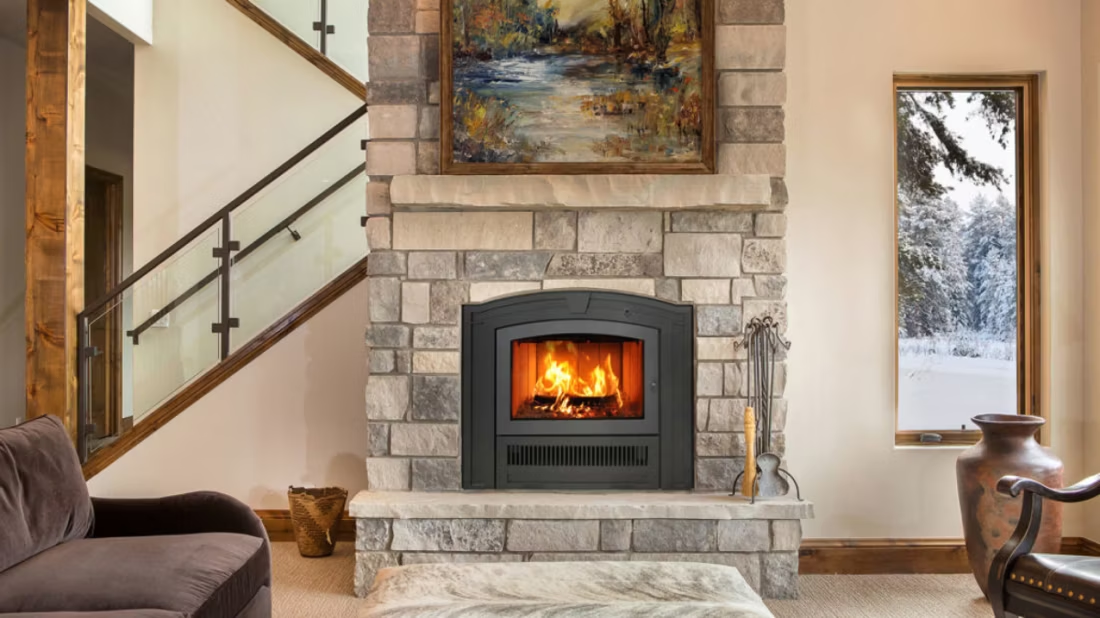
Four fuels. One honest answer for Strafford County.
Three steps. No salesperson until you're ready.
Tell us about your project
Your zip code, your situation, and the fuel you're leaning toward—or let the answers point you to one.
See what's actually available
The brands dealers within 100 miles genuinely carry—real options, never a catalog mirage.
Get your dealer & Project Guide
A trusted local dealer, plus the free Project Guide & Parts List that names every component of the job.
Frequently Asked Questions
Which fuel works best in Strafford County?
It depends on the house and how you use it. Wood is a strong fit here—local hardwoods like oak, maple, birch, and beech burn long and hot, and a lot of Dover- and Rochester-area homes still split their own firewood or buy it from a neighbor by the cord. Gas is the convenience pick, especially where Unitil natural gas service reaches along the Dover-Somersworth corridor; propane fills the gap for homes further out in Barrington, Lee, or New Durham. Pellet stoves do well in this climate too, and with New England Wood Pellet milling just over the border in Jaffrey, fuel supply stays local and reliable rather than shipped in from out of region. Electric is best treated as a supplemental heat source—good for a bedroom, sunroom, or apartment, but not enough on its own once temperatures sit in the teens for weeks at a stretch. Most Strafford County homes end up pairing a primary wood, gas, or pellet unit with an electric unit somewhere secondary.
Do I need a permit to install a fireplace in Strafford County?
In nearly every case, yes. Each town in Strafford County—Dover, Rochester, Somersworth, Durham, and the rest—issues its own building permits through its local building department, and New Hampshire's adopted state building and mechanical codes apply on top of that. New wood stoves and inserts must meet current EPA 2020 NSPS emissions standards to be permitted. Gas fireplaces, inserts, and stoves need both a building permit and a separate gas-line permit pulled by a licensed gas fitter. Electric fireplaces are usually exempt from permitting unless you're doing a built-in installation with new wiring or a dedicated circuit, which then needs an electrical permit. Most local hearth retailers handle the permit paperwork as part of the installation quote, so you're rarely filing it yourself.
Are there any wood-burning restrictions in Strafford County?
Strafford County isn't a nonattainment area, so you won't run into the kind of mandatory burn curtailments that show up in basin or valley air-quality zones out west. That said, New Hampshire still regulates outdoor burning through the Department of Environmental Services, and any new wood stove or insert installed in the county has to meet EPA 2020 NSPS emissions certification regardless of local air quality—that requirement is federal, not tied to a local advisory. Practically speaking, this means Strafford County homeowners have more day-to-day flexibility with wood heat than places dealing with winter inversions, but a new stove still has to be a certified, efficient unit to get permitted.
Can one local hearth retailer in Strafford County handle all four fuel types?
Some can, some specialize. Dealers based in the Dover-Rochester corridor tend to carry the broadest lineup—wood, gas, pellet, and electric—since they're serving a mix of city rowhouses, suburban colonials, and rural farmhouses within a 20-mile radius. Smaller shops closer to the Lakes Region edge of the county, around Milton and New Durham, often lean more heavily into wood and pellet, since propane and cordwood are the practical fuels for homes without natural gas access. If you're not sure which fuel fits your house, a multi-fuel dealer with working showroom displays is worth the drive—they can walk you through venting requirements and real installed cost side by side rather than guessing from a spec sheet.
How does installation and service work in the smaller towns outside Dover and Rochester?
Most retailers and service technicians covering Strafford County are based in Dover, Rochester, or Somersworth and drive out to Barrington, Lee, Madbury, Middleton, Milton, New Durham, Rollinsford, and Strafford for both installs and annual service. Expect a modest trip fee on service calls to the county's edges, and book your fall chimney sweep or gas inspection early—September and October fill up fast once the first cold snap hits and everyone remembers their unit at once. For homes further from the main corridor, it's worth scheduling wood stove or pellet stove service before heating season starts rather than waiting for a mid-January breakdown when technicians are booked solid.
What's the typical cost range for fireplace installation across fuel types in Strafford County?
Costs track fairly close to regional New England averages. Wood stove or insert installation: roughly $4,000–$8,500 for a typical retrofit, more if new chimney liner or hearth pad work is needed. Gas fireplace, insert, or stove: $4,500–$10,500, with cost driven mainly by whether a new gas line has to be run or an existing line can be tapped. Pellet stove or insert: $4,000–$7,000 installed, including venting. Electric fireplace: $200–$3,000 for the unit itself, plus $400–$1,200 in labor for anything beyond a simple plug-in, which covers most wall-mount and insert jobs. The county + fuel pages above break these numbers down further by dealer and by town.
Does a fireplace add value to my home?
On average, a fireplace adds back to the home about the same amount you spent installing it. Add the monthly savings from heating the rooms you actually use instead of the whole house—often hundreds of dollars a year—and the value case is strong before you even count what a fire does for how your family uses the room.
Can a fireplace actually lower my heating bill?
Yes—by creating a comfort zone. A furnace heats every square foot of the house just to warm the one room you're in; a gas fireplace on low burns roughly a sixth of the gas a typical furnace does. Set the furnace around 55–60 degrees as a baseline, then heat the rooms your family actually uses. Families who heat this way commonly save $20–$60 a month.
How much should I budget for a fireplace?
For an average home—covering the fireplace, the vent pipe, and basic installation—a budget between $3,900 and $5,500 gives you a lot of options across wood, gas, and pellet. By the time you add finish work, gas line, and electrical, the average complete installation lands between $5,000 and $12,000 all-in. In a remodel or new build, a good rule is to put about 2.5% of the total project cost toward the fireplace.
Can I install a fireplace myself?
If you're putting a fire in your house on purpose, it's best to work with an expert. Unless you're genuinely experienced in framing, gas line, vent pipe, and the national code on clearances to combustibles, have a professional do it—and ideally the same company that sells you the fireplace, so warranty, service, and liability all live under one roof.
Stove and Fireplace Dealers in Strafford County
Listings include WhyFire partner dealers, dealers we have verified as authorized for the brands we recommend, and established local businesses that carry hearth products. Every listing shows which one it is. The ones marked Preferred run on WhyFire's software, so they can show you real pricing and book your appointment right here. No manufacturer pays for placement. How we verify dealers →
Somersworth Stove Shop
Drogold Dba A Merrie Sweepe Chimney Service
D & J Home & Hearth
The Stove Shoppe & Fences
Northeast Distribution
Jackson Fireplace
Home & Hearth
Abundant Life
Find your fireplace in Strafford County.
Pick your fuel below, get matched with a trusted local dealer, and receive a free Project Guide & Parts List—a plan for your project in Strafford County with the exact parts, including the vent kit, and the local dealer we'd recommend.
Find Your Fireplace →