
Instant warmth with zero venting for Dieppe's cold snaps to -13.9°C.
Dieppe's winters push well below freezing for months at a time, and a growing number of townhouses and newer subdivisions here don't have a chimney to work with. We'll help you find a trusted local dealer who can size an electric unit correctly and send a free plan for your project.
Every Project Starts From One of These Five Situations
The lowest-friction hearth upgrade in a region built on wood and gas.
Dieppe sits alongside Moncton in the Westmorland region, and its winter low averages -13.9°C in a climate zone (6A) that keeps homes heated from late October well into April. That's milder than what Fredericton or Edmundston see further up the province, but it's still cold enough that heating decisions here matter, and the city's rapid growth over the past two decades means a lot of Dieppe housing stock is townhouses, duplexes, and newer single-family builds without an existing masonry chimney to retrofit.
New Brunswick has a deep firewood culture—DNRED district offices issue cutting permits for up to 14 cubic metres per household at $6.10 per cubic metre, and sugar maple and yellow birch split from local woodlots heat plenty of homes in this region—but that whole process is unnecessary if what you want is supplemental warmth in a living room or bedroom. An electric fireplace plugs into a standard circuit or ties into one with simple electrical work, runs on NB Power at $0.146 per kWh, and skips the chimney, the WETT inspection, and the annual sweep entirely. It's also the fastest fit for condos and rental units in Dieppe's newer developments where venting a gas or wood appliance through Liberty Utilities (Gas NB) service or a Class A chimney isn't practical.
Three steps. No salesperson until you're ready.
Tell us about your project
Your postal code, your situation, and the fuel you're leaning toward—or let the answers point you to one.
See what's actually available
The brands dealers within 100 miles genuinely carry—real options, never a catalog mirage.
Get your dealer & Project Guide
A trusted local dealer, plus the free Project Guide & Parts List that names every component of the job.
Frequently Asked Questions
How much does an electric fireplace installation cost in Dieppe?
Most electric fireplace projects in Dieppe run $500 to $1,600. A plug-in unit or a wall-mounted model on an existing 15-amp circuit sits at the low end, often installable in an afternoon. A built-in electric insert or a linear unit framed into a wall during a renovation, which needs a dedicated circuit run by a licensed electrician, lands toward the top of that range. Compare that to $6,000-$12,000 for a wood setup or $6,000-$15,000 for gas in this area, and the appeal for a lot of Dieppe homeowners is straightforward: real warmth for a fraction of the cost and none of the venting work.
Do I need a permit to install an electric fireplace in Dieppe?
A simple plug-in electric fireplace generally doesn't trigger a permit since there's no venting or gas line involved. A built-in unit wired to its own circuit is treated as an electrical alteration, so your electrician typically pulls that permit, and any structural framing changes go through the municipal building department. There's no WETT inspection requirement either, since WETT covers wood-burning appliances specifically—one more reason electric tends to be the fastest path from decision to installed fireplace in this city.
What does it actually cost to run an electric fireplace on NB Power rates?
At NB Power's residential rate of $0.146 per kWh, a typical 1,500-watt electric fireplace costs roughly $0.22 an hour to run on full heat, or about $1.75 for a five-hour evening. That's cheap enough that most Dieppe households run theirs for ambiance and zone heat in the room they're actually sitting in, rather than trying to heat the whole house with it—which brings down the load on your furnace or heat pump without a noticeable jump on the power bill.
Electric vs. wood—which makes more sense for a Dieppe home?
Wood still has real economics here: a DNRED district office permit runs about $85 for a full 14 cubic metre household allotment, and sugar maple, yellow birch, and red maple are all common, well-seasoned local species. But wood means chimney maintenance, a WETT inspection for insurance, and physical work every winter. Electric skips all of that and installs for $500-$1,600 instead of $6,000-$12,000, though it won't function as your primary heat source through a New Brunswick winter the way a wood stove can. Most homeowners choosing electric here already have a furnace or heat pump doing the heavy lifting and want supplemental warmth and ambiance in a specific room.
Electric vs. gas—how do they compare in Dieppe?
Liberty Utilities (Gas NB) serves a real part of Dieppe, and a gas fireplace puts out serious heat—enough to function as genuine supplemental heat on a -13.9°C night—for $6,000-$15,000 installed with venting. Electric can't match that heat output, but it installs for a fraction of the price, needs no gas line or venting, and works in any room with an outlet or a simple circuit. If you're weighing the two, it usually comes down to whether you want a real secondary heat source (gas) or a low-cost, low-maintenance ambiance feature (electric).
Can an electric fireplace serve as a primary heat source in Dieppe?
Not really, and a good local dealer will tell you that upfront. With winter lows averaging -13.9°C and a heating season that runs a good six months, a 1,500-watt electric fireplace is built for zone heating a single room, not for carrying a whole house through a New Brunswick winter. Most Dieppe homes pair an electric fireplace with a furnace, boiler, or increasingly a ductless heat pump as the actual primary system, and use the fireplace to take the edge off a specific room without running the whole-house system harder than it needs to.
What size electric fireplace do I need for my Dieppe living room?
Nearly every electric fireplace on the market tops out around 1,500 watts, since that's the practical limit for a standard household circuit—so sizing here is less about wattage and more about matching the unit to your room's insulation and layout. A 1,500-watt insert or linear unit comfortably takes the chill off a typical 200-300 square foot living room in an older Dieppe home, while open-concept great rooms common in newer builds around town may need two zones or a supplemental heat pump to feel the difference. A local dealer can walk your actual space before you buy.
Are there rebates for electric heating upgrades in New Brunswick?
NB Power runs efficiency rebate programs from time to time, including its Total Home Energy Savings offerings, but those are aimed mainly at heat pumps and insulation upgrades rather than electric fireplaces specifically, since a fireplace is a supplemental appliance rather than a primary heating system swap. If you're doing an electric fireplace install alongside a heat pump upgrade, it's worth asking your contractor whether the combined project qualifies for anything currently on offer—the programs shift year to year.
What's the difference between an electric fireplace, insert, and stove?
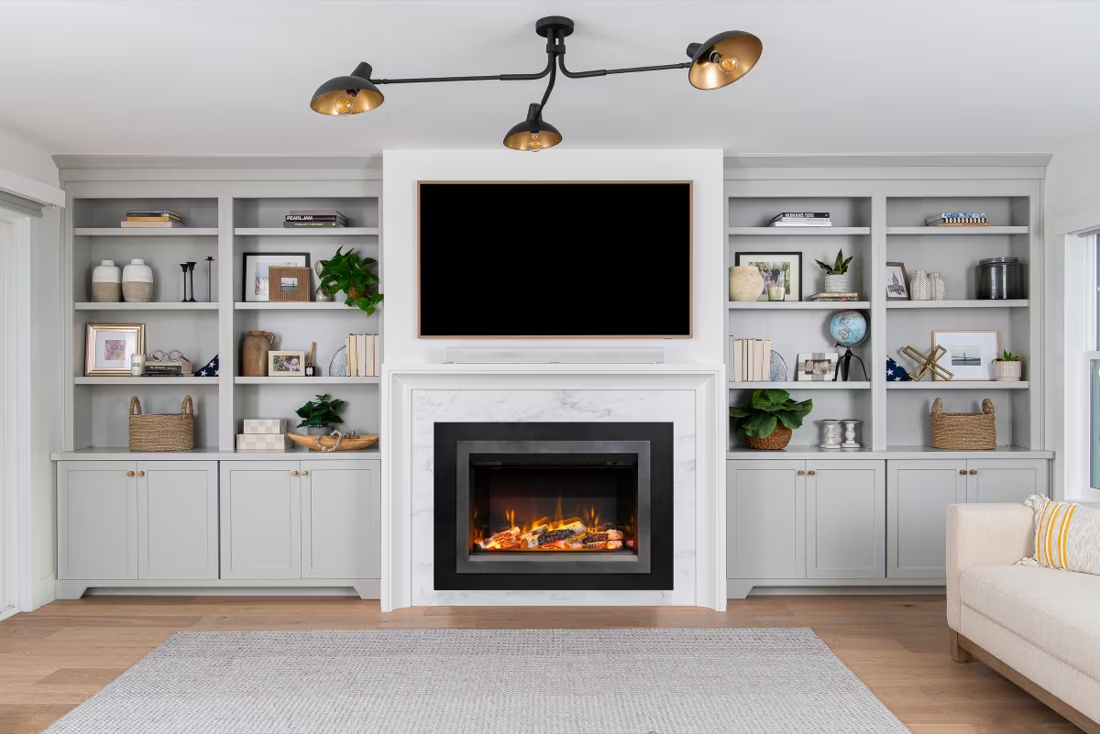
An electric fireplace is usually a wall-mounted or built-in unit framed into a wall, popular in Dieppe's newer townhouse construction where there's no existing firebox. An electric insert drops into an existing masonry or factory-built firebox, which suits older homes in the area that have a fireplace opening but no interest in burning wood or running a gas line. An electric stove is a freestanding cabinet-style unit that sits on the floor like a wood stove would, which works well as a focal point in a room with no fireplace opening at all. All three run on the same basic electrical principles and land in the same $500-$1,600 cost range.
How much does an electric fireplace cost to run?
With the heater on, a typical unit draws about 1,500 watts—at average electric rates that's roughly 20 cents an hour. Run the flame effect alone and it costs pennies; the flames are LED-driven and use about as much power as a light bulb. There's no pilot light, no fuel delivery, and essentially no maintenance.
What fireplace styles should I know before shopping?
Four cover most of the market: screen-front traditional (mesh front, open feel, fits craftsman homes), traditional door set (the classic look you grew up with), modern linear (wide, low, the statement piece for entertaining), and clean face contemporary (no trim—your tile or stone runs right to the fire's edge). Walk in knowing those four terms and you're ahead of most buyers.
Does an electric fireplace need a vent or chimney?
No—that's its superpower. An electric fireplace needs a wall and an outlet, period. No vent pipe, no gas line, no clearances to design around, which is why it works in bedrooms, offices, apartments, and walls where venting a gas or wood unit would be impractical or impossible. Installation is typically the simplest and least expensive of any fireplace type.
Can I put a TV above my fireplace?
Yes—with an asterisk. Fireplaces are hot and TVs don't like heat. Either put a mantel between them to deflect rising warmth, or choose a fireplace with heat-management technology that creates a cool zone on the wall above—the wall stays around 125 degrees, barely warm, while the room still gets full heat. If you like clean lines and don't want a mantel, heat management is the answer.
Nearby Dealers
Hearth shops serving Dieppe and the surrounding area. Every listing shows whether it is a WhyFire partner, a dealer we have verified as authorized for the brands we recommend, or a local business carrying hearth products. No manufacturer pays for placement. How we verify dealers →
Electric Service in Dieppe
An electric fireplace's heater draws about 1,500 watts—pennies per hour at local rates.
Nb Power
Get your free Project Guide & Parts List for a Dieppe electric fireplace.
Tell us about your room and your circuit setup, and we'll help you find a trusted local dealer and send a free Project Guide & Parts List with the right unit, mounting details, and electrical notes for your Dieppe project.
Find Your Fireplace →