
Find your fireplace in Pemiscot County, Missouri.
Wood, gas, pellet, and electric fireplace resources for the whole Bootheel—from Caruthersville down along the Mississippi to Steele and Cooter. Pick a fuel and get matched with a local dealer who actually installs it here.
Every Project Starts From One of These Five Situations
Mild Bootheel winters, 3,594 heating degree days, and a county built on oak and hickory.
Pemiscot County sits at the southern tip of the Missouri Bootheel, a flat expanse of Mississippi River bottomland running along the state's border with Arkansas and Tennessee. At roughly 260 feet elevation and squarely in climate zone 4A, winters here are far milder than what a place like Fargo, North Dakota or Bismarck sees—average lows hover around 30°F and the county logs about 3,594 heating degree days a year, meaning most homes need real heat from late November through March rather than a five- or six-month season. Oak, hickory, walnut, and maple are the hardwoods most local households burn, timber that's plentiful in the bottomland hardwood forests along the river and dense enough to hold a fire well through a cold snap.
Unlike counties out west dealing with winter inversions or wood-smoke non-attainment status, Pemiscot County has no air quality restrictions on wood burning—there's no curtailment season here, so an EPA-certified stove or insert can run whenever it's cold without any burn-ban paperwork to track. With just over 11,000 residents spread across Caruthersville, Hayti, Steele, Cooter, Wardell, Braggadocio, Holland, and Pascola, hearth retailers and service crews are concentrated around Caruthersville and Hayti but generally cover the full county. Pellet supply runs through regional brands like Lignetics and Indeck Energy Services. This hub rolls up retailers, technicians, and fuel suppliers across all four fuel types—pick yours below for local dealers, install costs, and recommendations specific to your town.
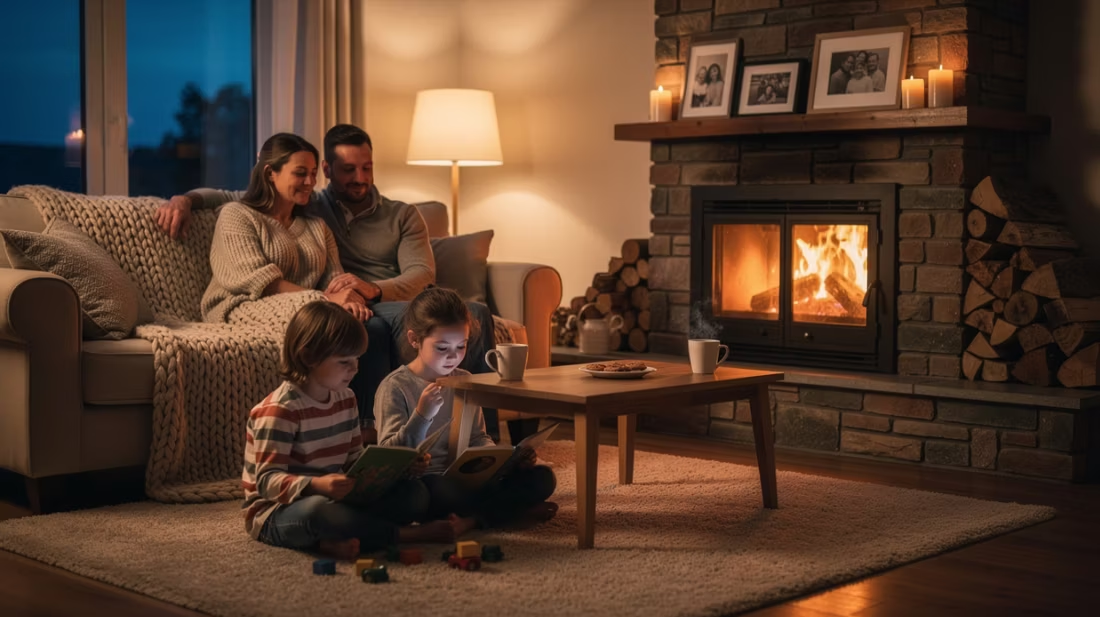
Four fuels. One honest answer for Pemiscot County.
Three steps. No salesperson until you're ready.
Tell us about your project
Your zip code, your situation, and the fuel you're leaning toward—or let the answers point you to one.
See what's actually available
The brands dealers within 100 miles genuinely carry—real options, never a catalog mirage.
Get your dealer & Project Guide
A trusted local dealer, plus the free Project Guide & Parts List that names every component of the job.
Frequently Asked Questions
Which fireplace fuel makes the most sense in Pemiscot County?
All four fuels work here, and the choice usually comes down to how a household already heats and how much they want a hearth to do. Wood remains popular in rural parts of the county—oak and hickory from the bottomland hardwood stands burn hot and long, and a mid-size wood stove is plenty to take the edge off a 30°F night without running as primary heat for months on end, since the season here is shorter than in colder parts of the Midwest. Gas fireplaces and inserts are a common upgrade in and around Caruthersville and Hayti where service lines reach, prized for the flip-a-switch convenience. Pellet stoves have a steady following too, fed by regional supply from Lignetics and Indeck Energy Services, and they're a good fit for anyone who wants wood-like ambiance without splitting and stacking firewood. Electric fireplaces are mostly supplemental here—with only about 3,594 heating degree days a year, an electric unit can genuinely handle a mild-winter evening in a smaller room even though it's not sized to be a whole-house heat source.
Do I need a permit to install a fireplace or stove in Pemiscot County?
In most cases, yes, particularly for anything involving new venting or a gas line. Homes inside Caruthersville or Hayti city limits typically pull permits through the city's building department, while unincorporated parts of the county go through Pemiscot County's building permit process. Wood stove and insert installs generally need to meet current EPA emissions standards, and gas installs require a licensed gas fitter for the line connection regardless of which fuel you're switching from. Pellet stove permitting follows a similar path to wood but without any curtailment restrictions to navigate, since the county has no non-attainment status. Plug-in electric fireplaces usually don't need a permit at all; a hardwired built-in electric unit that requires a new circuit is the exception. Most retailers we match homeowners with handle this paperwork as part of the installation.
Is firewood easy to source in Pemiscot County?
Yes—the county's location along the Mississippi River bottomlands means oak, hickory, walnut, and maple are all locally available, either self-cut on private land, purchased from area firewood dealers, or picked up as a byproduct of local land clearing and farming operations. These are dense hardwoods that season well and burn long, which is part of why wood stoves remain a practical option even in a county with a relatively mild, 3,594-HDD winter. For pellet users, regional distribution from Lignetics and Indeck Energy Services means you're generally not relying on far-flung shipping to keep a hopper full through the season.
Can I find a retailer in the county that carries more than one fuel type?
Many Pemiscot County retailers stock at least two fuel types rather than specializing narrowly, which is useful if you're weighing options—you can see a wood stove, a gas insert, and a pellet unit side by side and talk through what fits your home, your wood supply situation, and whether you're inside a town with gas service or relying on propane out in the county. We match you with the retailer whose lineup and service area genuinely fit your project rather than sending everyone to the same dealer regardless of fuel.
How does installation and service work for homes outside Caruthersville?
Installation crews and service techs are based mainly around Caruthersville and Hayti but regularly travel to Steele, Cooter, Wardell, Braggadocio, Holland, and Pascola. Because Pemiscot County has no burn-curtailment season and a shorter, milder winter than counties further north, scheduling is generally less crunched than it would be somewhere with a long cold season—but it's still smart to book your annual chimney sweep or gas inspection in late summer, before the first cold front moves through in November, rather than waiting until everyone else calls at once.
What does a fireplace installation typically cost in Pemiscot County?
Costs here run somewhat lower than in colder, more code-heavy parts of the country, largely because there's less venting complexity tied to extreme cold or altitude. Wood stove or insert installs typically run $3,500–$7,500, depending on whether new chimney venting is needed. Gas fireplaces, inserts, and stoves generally land between $3,800 and $9,000, with the gas-line work being the biggest cost swing. Pellet stove or insert installs usually run $3,500–$6,500. Electric fireplaces are the most affordable option—$200–$2,500 for the unit, plus $300–$1,000 in labor for anything beyond a simple plug-in placement. The county + fuel pages above break these numbers down further with local retailer pricing.
Can a fireplace actually lower my heating bill?
Yes—by creating a comfort zone. A furnace heats every square foot of the house just to warm the one room you're in; a gas fireplace on low burns roughly a sixth of the gas a typical furnace does. Set the furnace around 55–60 degrees as a baseline, then heat the rooms your family actually uses. Families who heat this way commonly save $20–$60 a month.
Can I install a fireplace myself?
If you're putting a fire in your house on purpose, it's best to work with an expert. Unless you're genuinely experienced in framing, gas line, vent pipe, and the national code on clearances to combustibles, have a professional do it—and ideally the same company that sells you the fireplace, so warranty, service, and liability all live under one roof.
Wood, gas, pellet, or electric—how do I choose?
Match the fuel to your life, not the other way around. Wood: lowest fuel cost and total power-outage independence, but you're hauling and stacking. Gas: press a button, set a thermostat, no maintenance to speak of. Pellet: wood economics with automatic feeding, in exchange for weekly cleaning and a need for electricity. Electric: plugs in anywhere with honest supplemental heat. Nobody regrets the fuel that fits how they actually live.
How much should I budget for a fireplace?
For an average home—covering the fireplace, the vent pipe, and basic installation—a budget between $3,900 and $5,500 gives you a lot of options across wood, gas, and pellet. By the time you add finish work, gas line, and electrical, the average complete installation lands between $5,000 and $12,000 all-in. In a remodel or new build, a good rule is to put about 2.5% of the total project cost toward the fireplace.
Get matched with a local Pemiscot County dealer.
Pick your fuel below and we'll put together a free Project Guide & Parts List—the right unit, the vent kit it needs, and the local dealer we recommend for your project.
Find Your Fireplace →