
Reliable heat for Phillips County winters.
Wood, gas, pellet, and electric fireplace resources for Phillipsburg and every rural community in the county. Find the right unit for your farmhouse or in-town home and connect with a trusted local hearth retailer.
Every Project Starts From One of These Five Situations
Plains heating in Phillips County, Kansas.
Phillips County sits in north-central Kansas, a farming community of under 4,000 people spread across open plains with few windbreaks. At climate zone 5A, with winters comparable to Fargo, ND, winters here run closer to Fargo, ND than to the rest of Kansas—average lows near 16°F, and wind off the open fields makes it feel colder still. Oak, hickory, and osage orange are the local firewood staples; osage orange in particular burns hot and long, a favorite for overnight loads in older farmhouses that rely on wood heat to supplement propane furnaces during the coldest stretches.
What you'll find on this hub: hearth retailers, service technicians, and fuel suppliers serving Phillipsburg and the smaller towns around it—Long Island, Kirwin, Logan, Agra, and the farms in between. Pick your fuel below to see local dealers, typical installation costs, and recommended units for this climate. Whether you're heating a Phillipsburg home or a farmhouse a half-hour out, this is the starting point.
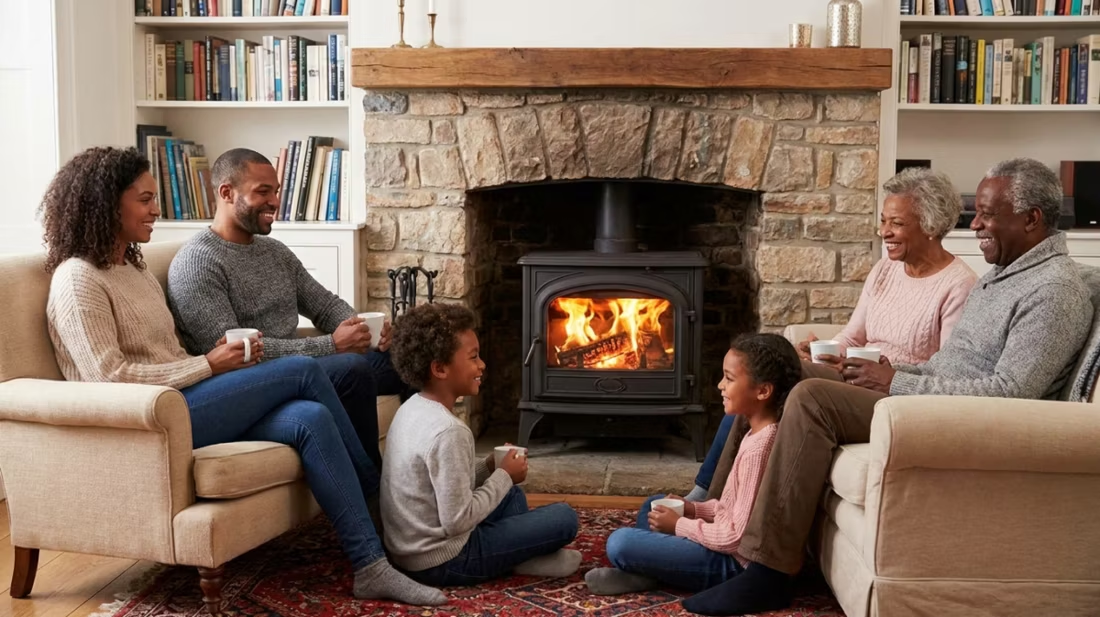
Four fuels. One honest answer for Phillips County.
Three steps. No salesperson until you're ready.
Tell us about your project
Your zip code, your situation, and the fuel you're leaning toward—or let the answers point you to one.
See what's actually available
The brands dealers within 100 miles genuinely carry—real options, never a catalog mirage.
Get your dealer & Project Guide
A trusted local dealer, plus the free Project Guide & Parts List that names every component of the job.
Frequently Asked Questions
Which fuel works best in Phillips County?
It depends on the home and how it's already heated. Wood remains common on farms and older properties—oak, hickory, and osage orange are all locally available, and osage orange in particular holds a long, hot overnight burn that suits the county's cold, windy nights. Gas (mostly propane out here, since municipal natural gas coverage is limited outside Phillipsburg) is the convenience choice—instant heat with no wood-splitting labor. Pellet stoves are a solid middle ground for homes that want wood-style ambiance without maintaining a woodpile; Lignetics and Indeck Energy Services both supply pellets into this region. Electric fireplaces work well as supplemental heat in bedrooms or additions but shouldn't be relied on as a primary heat source given winter lows averaging 16°F. Many Phillips County homes run a combination—propane furnace as the backbone, wood or pellet stove for supplemental heat and outage backup.
Do I need a permit to install a fireplace in Phillips County?
In most cases, yes, for new wood stoves, wood inserts, gas fireplaces, gas inserts, gas stoves, and pellet stoves—Phillips County requires a building permit for these installations, and gas work also needs a separate gas line permit performed by a licensed installer. Electric fireplaces are usually exempt unless the installation involves hardwiring a built-in unit into a new circuit. Because this is a small, largely rural county, permitting is handled through the county building office rather than a city department for most addresses outside Phillipsburg city limits. Most local hearth retailers or installers will pull the permit as part of the job, so you generally don't have to navigate it yourself.
Are there air quality restrictions on wood burning in Phillips County?
No. Phillips County has no designated air quality non-attainment status and no winter burn bans or curtailment periods—this is open plains country with good air dispersion, not a basin or valley prone to inversions. That means wood stove owners here don't deal with the voluntary or mandatory burn restrictions common in more urban or geographically trapped areas. New wood stove installations should still meet current EPA emissions standards, both for efficiency and because most manufacturers and retailers only sell EPA-certified units at this point, but there's no local ordinance layered on top of that federal baseline.
Can one local hearth retailer handle all four fuel types?
In a county this size, it's common for a single dealer to carry two or three fuel types rather than a large multi-brand showroom split across four. If a Phillipsburg-area retailer stocks wood, propane/gas, and pellet units under one roof, that's typical for a county of under 4,000 people—electric fireplaces are often the least emphasized line since they're viewed as supplemental rather than primary heat here. If you're cross-shopping fuels, ask the dealer directly what's on the showroom floor versus what's special-order; rural retailers often special-order less common units rather than stock them.
How does service work in rural areas of Phillips County?
Most technicians serving Phillips County are based in or near Phillipsburg and drive out to the surrounding farms and smaller towns like Long Island, Kirwin, Logan, and Agra. Expect a modest trip charge for calls well outside town, and expect to book ahead—in a county this rural, a single sweep or gas tech may be covering a wide radius alone. Scheduling annual service in late summer or early fall, before the first hard freeze, is the easiest way to avoid a mid-winter wait. For farmhouses relying on wood as backup heat during power outages, it's worth keeping a chimney sweep's number on hand year-round rather than waiting for a problem.
What's the typical cost range for fireplace installation across all fuel types in Phillips County?
Ranges vary by fuel and by how much existing infrastructure (venting, gas line, chimney) is already in place. Wood stove or insert installation: roughly $4,000–$8,500 for typical installs, higher for new full chimney construction on an older farmhouse. Gas or propane fireplace, insert, or stove: roughly $4,000–$10,000 depending on whether a new propane line or tank setup is needed. Pellet stove or insert: roughly $4,000–$7,000 for typical installs. Electric fireplace: $200–$3,000 for the unit itself, plus $400–$1,200 in labor for anything beyond a plug-and-play placement. See the county + fuel pages above for cost detail tied to specific local retailer pricing.
Can a fireplace actually lower my heating bill?
Yes—by creating a comfort zone. A furnace heats every square foot of the house just to warm the one room you're in; a gas fireplace on low burns roughly a sixth of the gas a typical furnace does. Set the furnace around 55–60 degrees as a baseline, then heat the rooms your family actually uses. Families who heat this way commonly save $20–$60 a month.
Can I install a fireplace myself?
If you're putting a fire in your house on purpose, it's best to work with an expert. Unless you're genuinely experienced in framing, gas line, vent pipe, and the national code on clearances to combustibles, have a professional do it—and ideally the same company that sells you the fireplace, so warranty, service, and liability all live under one roof.
Wood, gas, pellet, or electric—how do I choose?
Match the fuel to your life, not the other way around. Wood: lowest fuel cost and total power-outage independence, but you're hauling and stacking. Gas: press a button, set a thermostat, no maintenance to speak of. Pellet: wood economics with automatic feeding, in exchange for weekly cleaning and a need for electricity. Electric: plugs in anywhere with honest supplemental heat. Nobody regrets the fuel that fits how they actually live.
What are the biggest mistakes people make buying a fireplace?
Five come up constantly: budgeting for the unit but not the full job (vent, gas line, electrical, finish work); drowning in options instead of starting from style and fuel; buying without an in-home preview; handing installation to a handyman instead of a pro; and giving up out of sheer indecision. Every one is avoidable with a clear plan—step one, step two, step three.
Stove and Fireplace Dealers in Phillips County
Listings include WhyFire partner dealers, dealers we have verified as authorized for the brands we recommend, and established local businesses that carry hearth products. Every listing shows which one it is. The ones marked Preferred run on WhyFire's software, so they can show you real pricing and book your appointment right here. No manufacturer pays for placement. How we verify dealers →
Heartland Building Center
Builders Warehouse Inc
Fireplace Stone And Patio - Kearney
Alan Witte Sales
Find your fireplace in Phillips County.
Pick your fuel below and we'll match you with a trusted local dealer and send a free Project Guide & Parts List—the exact parts, including the vent kit, for your project in Phillips County.
Find Your Fireplace →