
Find the right fireplace for your Lake County home.
Fireplace resources for every city in Lake County—from Gary and Hammond to Crown Point and Cedar Lake. Find the right unit and connect with a trusted local hearth retailer.
Every Project Starts From One of These Five Situations
Reliable heat for Lake County's long, cold winters.
Lake County sits at the southern tip of Lake Michigan as the Indiana anchor of the Chicago metro—Gary, Hammond, East Chicago, Munster, Highland, Griffith, Merrillville, Schererville, Crown Point, St. John, Dyer, Hobart, Cedar Lake, and Lowell. Winters average a 15°F low with about 6,350 heating degree days—a cold load comparable to Buffalo, NY. NIPSCO's gas and electric infrastructure reaches nearly every neighborhood in the county, which shapes how homes here actually heat: gas fireplaces and inserts are the default retrofit for most Lake County homeowners, with electric units filling the gap in condos, apartments, and finished basements.
Wood-burning fireplaces are genuinely rare as a new installation here—not because winters aren't cold enough, but because quarter-acre suburban lots, municipal zoning in cities like Hammond and Gary, and near-universal NIPSCO gas access make wood a hard sell for most homeowners. A handful of rural exceptions exist around Lowell, Winfield Township, and lakefront cabins near Cedar Lake, where oak, hickory, and maple are locally available, but it's the exception, not the rule. Pellet stoves are similarly uncommon—regional suppliers like Indeck Energy Services, Lignetics, and Somerset Pellet Fuel serve the broader region, but Lake County has no established retail network for pellet appliances the way colder, more rural counties do. Pick gas or electric below to see local dealers, installation costs, and the resources that match your project.
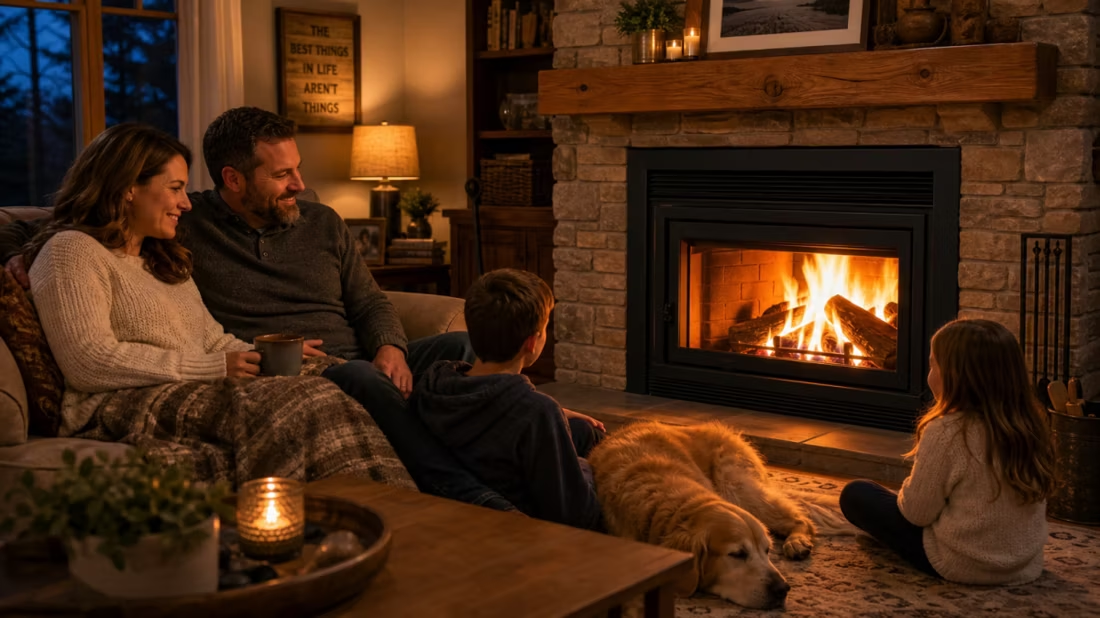
Four fuels. One honest answer for Lake County.
Three steps. No salesperson until you're ready.
Tell us about your project
Your zip code, your situation, and the fuel you're leaning toward—or let the answers point you to one.
See what's actually available
The brands dealers within 100 miles genuinely carry—real options, never a catalog mirage.
Get your dealer & Project Guide
A trusted local dealer, plus the free Project Guide & Parts List that names every component of the job.
Frequently Asked Questions
Which fuel works best in Lake County?
For the vast majority of Lake County homes, it comes down to gas or electric. NIPSCO's gas lines reach nearly every neighborhood from Hammond to Crown Point, which makes a direct-vent gas fireplace or insert the easiest retrofit—no chimney, no fuel storage, instant heat during a 15°F January morning. Electric units are the right call for condos, apartments, and finished basements where venting isn't practical, or as a supplemental heat source in a secondary room. Wood stoves exist here almost exclusively as exceptions—a lakefront cabin near Cedar Lake or a rural property out toward Lowell or Winfield Township—rather than a mainstream choice, and pellet stoves follow the same rare pattern. If you're in a typical Lake County subdivision, gas or electric will almost always be the practical answer.
Do I need a permit to install a fireplace in Lake County?
Usually, yes. Gas fireplace, insert, and stove installations require a building permit plus a separate gas line permit and a licensed gas-fitter for the connection—this applies whether you're in Gary, Hammond, Crown Point, Merrillville, or unincorporated Lake County, though the permit is issued through whichever city's building department covers your address. Electric fireplaces typically don't require a permit for plug-in units, but built-in electric fireplaces that need new circuits or hardwiring do require an electrical permit. Wood stove installs, while rare, still require a permit and a current EPA-certified appliance. Most local retailers handle the paperwork as part of the installation, so you generally don't have to navigate it alone.
Why don't more Lake County homes have wood-burning fireplaces despite cold winters averaging 15°F?
It's not a climate problem—6,350 heating degree days is a genuinely cold load, on par with Buffalo, NY. It's a housing and infrastructure pattern. Most of Lake County is dense suburban and urban development—quarter-acre lots in Munster, Highland, and Schererville, or rowhouse-style neighborhoods in Hammond and East Chicago—where there's little room for firewood storage and where municipal zoning often discourages new wood-burning installs. Add near-universal NIPSCO gas service, and gas simply wins on convenience for the typical homeowner. The exceptions tend to cluster in the county's more rural southern edge—Lowell, Winfield Township—and around Cedar Lake, where oak and hickory are locally available and lot sizes support a woodpile.
Can one local retailer handle both gas and electric fireplaces?
Yes—most Lake County hearth retailers that stock gas fireplaces and inserts also carry a line of electric units, since the two fuels serve overlapping customer needs: gas for primary supplemental heat with real flame, electric for no-vent installs in condos, apartments, and finished basements. If a dealer also lists wood stoves, they're typically a smaller specialty operation serving the county's rural pockets rather than a high-volume showroom. Ask any retailer directly which fuels they install versus which they only sell—installation capability varies more than the product lineup does.
How does service work across Lake County's many cities and suburbs?
Most gas fireplace service technicians and electric installers serving Lake County are based in the Merrillville–Schererville corridor and travel to Gary, Hammond, East Chicago, Munster, Crown Point, and outlying communities like Cedar Lake and Lowell as part of their standard coverage—the county is compact and well-connected by I-80/94 and US-30, so travel fees are uncommon for gas and electric work. NIPSCO handles gas line and meter issues directly. If you have one of the county's rare wood stoves, expect to schedule a chimney sweep further in advance, since fewer local techs specialize in that work and some travel in from neighboring Indiana or Illinois counties.
What's the typical cost range for fireplace installation in Lake County?
Gas fireplace, insert, or stove: roughly $4,000–$10,000 depending on whether existing gas line and venting are in place versus new construction requiring a gas-fitter to run new line. Electric fireplace: $200–$3,000 for the unit itself, plus $400–$1,200 in labor for built-in installs that require new circuits—plug-and-play wall units and inserts run at the low end. Wood stove installs, when they do happen, run $5,000–$12,000 given the added chimney and structural work required on a typical suburban Lake County home. Pellet stove installs follow a similar range to wood when a local installer can be found. For fuel-specific detail tied to actual local retailer pricing, see the county + fuel pages above.
Can a fireplace actually lower my heating bill?
Yes—by creating a comfort zone. A furnace heats every square foot of the house just to warm the one room you're in; a gas fireplace on low burns roughly a sixth of the gas a typical furnace does. Set the furnace around 55–60 degrees as a baseline, then heat the rooms your family actually uses. Families who heat this way commonly save $20–$60 a month.
Can I install a fireplace myself?
If you're putting a fire in your house on purpose, it's best to work with an expert. Unless you're genuinely experienced in framing, gas line, vent pipe, and the national code on clearances to combustibles, have a professional do it—and ideally the same company that sells you the fireplace, so warranty, service, and liability all live under one roof.
What is an in-home preview and do I need one?
It's a visit where a hearth professional measures your space, confirms the model you picked actually works in your home, and walks the specs—framing, gas line, venting, finish work—before anything is ordered. Some details you just can't know until you see the house. Never make a down payment without one; it's the single most-skipped step that burns buyers.
Wood, gas, pellet, or electric—how do I choose?
Match the fuel to your life, not the other way around. Wood: lowest fuel cost and total power-outage independence, but you're hauling and stacking. Gas: press a button, set a thermostat, no maintenance to speak of. Pellet: wood economics with automatic feeding, in exchange for weekly cleaning and a need for electricity. Electric: plugs in anywhere with honest supplemental heat. Nobody regrets the fuel that fits how they actually live.
Stove and Fireplace Dealers in Lake County
Listings include WhyFire partner dealers, dealers we have verified as authorized for the brands we recommend, and established local businesses that carry hearth products. Every listing shows which one it is. The ones marked Preferred run on WhyFire's software, so they can show you real pricing and book your appointment right here. No manufacturer pays for placement. How we verify dealers →
Von Tobel Lumber & Hardware
Judd & Son Chimney Services
Fireside Hearth & Home - Merrillville
Cugini Woodworking
Michiana Fireplace
Brickworks Supply Center
Find your fireplace in Lake County.
Pick your fuel below to get matched with a trusted local dealer and receive a free Project Guide & Parts List—the exact parts, vent kit, and recommended installer for your Lake County home.
Find Your Fireplace →